
A Structural Essay of What Must Happen – Toward a Maintenance Theory of Aging, Longevity, and Structural Decline
By Vincent Giuliano 9-15-2026
Abstract
Modern aging research has identified many mechanisms associated with biological aging, including DNA damage, mitochondrial dysfunction, cellular senescence, protein misfolding, stem cell exhaustion, immune decline, and epigenetic drift. These discoveries have greatly improved our understanding of how aging occurs. Yet they do not fully explain a deeper question:
Why does aging emerge so consistently among complex organisms in the first place?
This paper proposes that aging is not fundamentally caused by entropy accumulation or by a programmed mechanism of death. Rather, aging may arise from a more general structural principle governing all sufficiently complex systems.
As structures accumulate complexity, they acquire increasing maintenance obligations. Initially, maintenance capacity grows alongside complexity, allowing agency and functionality to expand. Eventually, however, maintenance complexity itself becomes a burden. Maintenance systems increasingly devote resources to maintaining one another, reducing their net effectiveness. Aging begins when effective maintenance capacity becomes insufficient to preserve accumulated structure. Death follows when unresolved failures accumulate faster than they can be corrected.
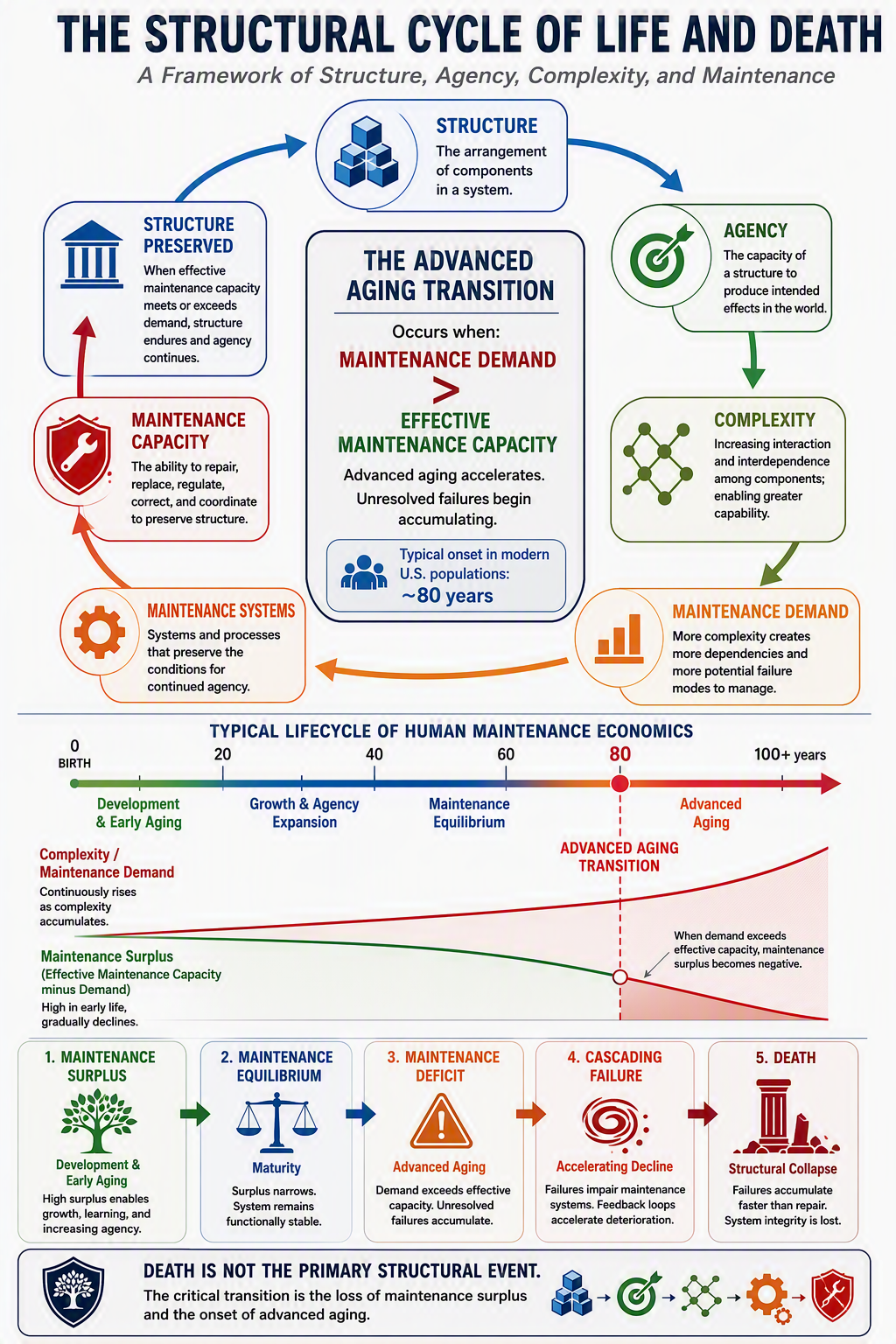
This framework introduces Maintenance as a fundamental structural variable alongside Agency and suggests a universal relationship between complexity growth, maintenance burden, aging, and collapse. The application is to biology.
- Introduction
Aging is usually viewed as a biological problem.
The organism accumulates damage, repair mechanisms become less effective, physiological functions decline, and death ultimately results.
While this description is broadly accurate, it remains largely mechanistic. It explains many of the processes involved without fully explaining why those processes appear to arise universally among complex organisms.
The central question of this paper is therefore not:
Why do organisms accumulate damage?
Rather:
Why do maintenance systems eventually become unable to preserve the structures they successfully maintained for decades?
This shift in perspective moves attention away from damage alone and toward the relationship between complexity and maintenance.
The proposed framework originates within a broader structural model in which enduring systems are understood through the interaction of:
- Structure
- Agency
- Complexity
- Maintenance
The central thesis is that aging emerges when the maintenance burden generated by accumulated complexity exceeds effective maintenance capacity.
- The Limits of Existing Explanations
Contemporary theories of aging provide powerful insights.
Damage accumulation theories emphasize the progressive buildup of molecular and cellular defects.
Disposable soma theory argues that evolutionary pressures favor reproduction over indefinite maintenance.
Antagonistic pleiotropy proposes that genes beneficial early in life may have detrimental effects later.
Hyperfunction theory suggests that developmental programs continue beyond their useful period and eventually produce pathology.
The Hallmarks of Aging framework identifies common biological manifestations of aging observed across species.
Each theory captures important aspects of the aging process.
However, these theories generally address specific mechanisms rather than a universal structural necessity.
None directly addresses why highly successful maintenance systems eventually become inadequate despite having sustained the organism for decades.
The present framework attempts to address that deeper structural question.
- Agency as a Structural Variable
Agency may be defined as:
The capacity of a structure to produce intended effects in the world.
Agency is observable throughout biology.
Single-celled organisms exhibit agency through adaptive responses.
Multicellular organisms exhibit greater agency through specialized tissues and coordinated behavior.
Development itself can be understood as the expansion of agency.
Growing complexity enables increasingly sophisticated interaction with the environment.
A mature organism possesses dramatically greater agency than a fertilized egg.
From this perspective, evolution, development, and learning all tend to increase agency through increasing structural complexity.
The relationship appears positive:
More structure enables greater capability.
More capability enables greater effectiveness.
- Maintenance as a Structural Variable
Agency alone is insufficient for persistence.
Any structure capable of producing effects must also preserve the conditions that allow those effects to occur.
Maintenance may therefore be defined as:
The capacity of a structure to preserve the conditions necessary for continued agency.
Maintenance is not equivalent to repair.
Repair is only one manifestation.
Maintenance includes:
- repair,
- replacement,
- regulation,
- error correction,
- resource allocation,
- resilience generation,
- systemic coordination.
In biological systems, examples include:
- DNA repair,
- protein quality control,
- autophagy,
- immune surveillance,
- stem cell renewal,
- hormonal regulation,
- homeostasis.
Maintenance is therefore not merely an accessory process.
It is a foundational requirement for persistence.
Without maintenance, agency rapidly disappears.
- Complexity and Maintenance Demand
Every increase in structure generates additional dependencies.
Every dependency introduces new maintenance obligations.
As complexity grows:
- the number of interacting elements increases,
- the number of possible failure modes increases,
- coordination requirements increase,
- monitoring requirements increase,
- repair requirements increase.
This suggests the relationship:
where:
- = maintenance demand
- = structural complexity
Importantly, maintenance demand may not increase linearly.
Each additional layer of complexity may generate disproportionately larger maintenance requirements.
This relationship appears throughout biology.
A human organism is vastly more complex than a bacterium.
It also requires vastly more maintenance.
The advantage is increased agency.
The cost is increased maintenance burden.
- The Emergence of Maintenance Overhead
Most maintenance systems require maintenance themselves.
DNA repair proteins require production, regulation, and replacement.
Immune systems must be monitored and controlled.
Stem cells require protection and replenishment.
Repair mechanisms themselves become objects of maintenance.
This introduces a crucial distinction.
Gross maintenance capacity:
Net maintenance capacity:
where:
- = total maintenance activity
- = maintenance overhead
- = effective maintenance capacity
Maintenance overhead includes:
- maintaining maintenance systems,
- coordinating maintenance systems,
- correcting failures within maintenance systems,
- resolving interactions among maintenance processes.
As organisms age, maintenance effort may remain substantial or even increase.
What declines is net maintenance effectiveness.
This distinction may be fundamental.
Aging may not result from the disappearance of maintenance activity but from the increasing proportion of maintenance devoted to maintaining maintenance.
- The Maintenance Transition
Early in life:
Maintenance surplus exists.
Structure expands.
Agency grows.
Damage remains manageable.
During maturity:
Growth slows.
Maintenance becomes increasingly dominant.
The organism remains functionally stable.
Aging begins when:
At this transition, unresolved failures begin accumulating.
The significance of this moment cannot be overstated.
The major event is not death.
The major event is the loss of maintenance surplus.
Once maintenance deficit emerges, decline becomes progressively more difficult to reverse.
- Cascading Maintenance Failure
Aging appears gradual.
Yet biological decline often accelerates late in life.
This may reflect positive feedback within maintenance systems.
Consider the following cycle:
- Reduced maintenance effectiveness allows damage accumulation.
- Damage accumulation impairs maintenance mechanisms.
- Impaired maintenance mechanisms reduce maintenance effectiveness.
- Further damage accumulates.
Each stage reinforces the next.
A similar pattern is observed in many complex systems.
Failures generate additional failures.
Coordination costs increase.
Resilience declines.
The organism enters a state in which preserving existing complexity consumes an increasing fraction of available resources.
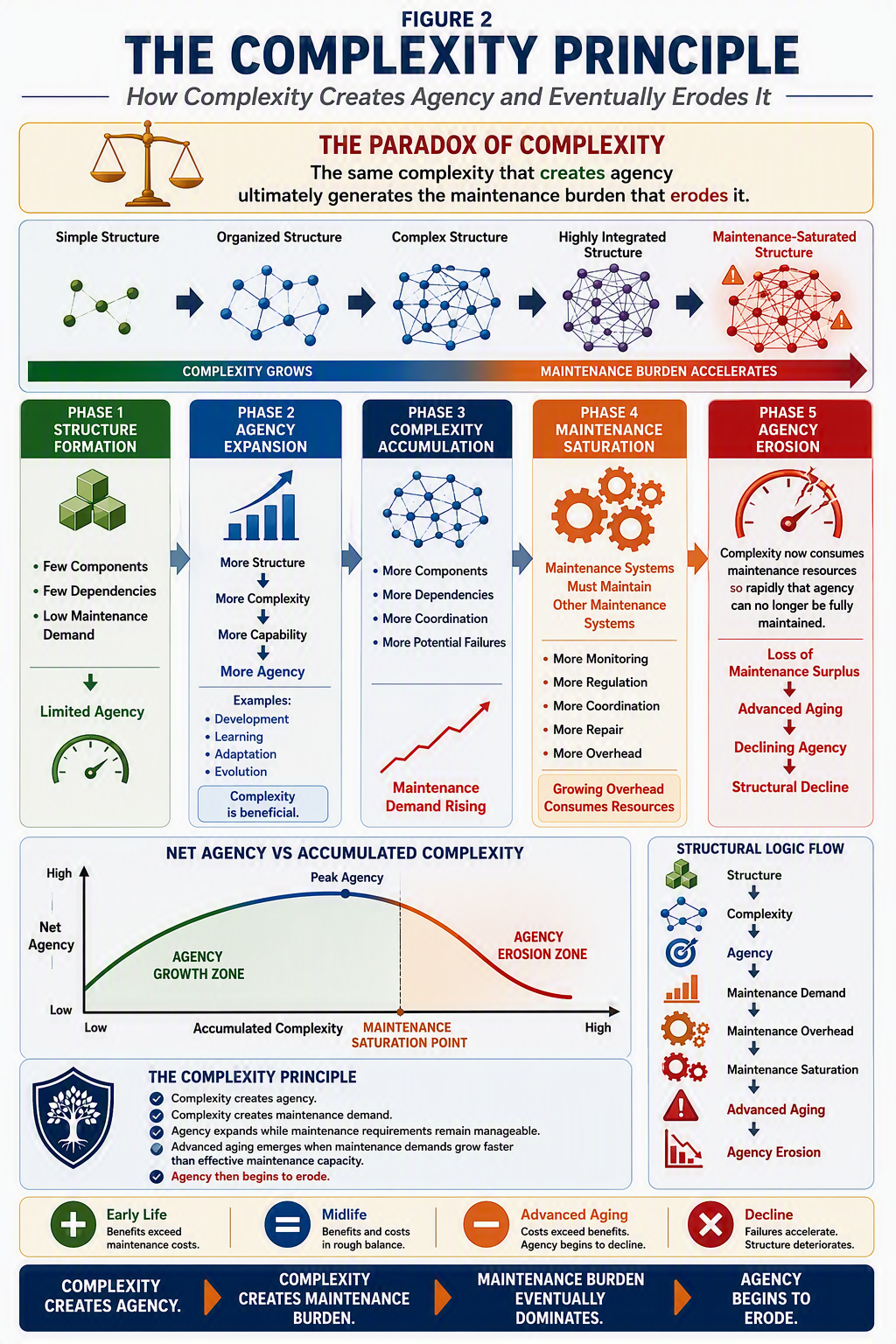
Here complexity undergoes an important transformation.
Initially complexity creates agency.
Eventually complexity consumes agency.
The same structures that once enabled success become burdens requiring preservation.
- Death as a Structural Event
Traditional explanations often depict death as a final failure.
The present framework suggests a different interpretation.
Death is not the primary event.
Death is the endpoint of a prior structural transition.
That transition occurs when:
or more formally:
where:
- represents failure generation,
- represents repair generation.
At this stage, unresolved failures accumulate inexorably.
Maintenance systems continue functioning.
They simply no longer generate enough effective restoration to preserve systemic integrity.
Death therefore becomes not a programmed objective but a structural consequence.
The system’s maintenance obligations have exceeded its maintenance capacity.
- Implications for Longevity Research
If this framework is correct, several implications follow.
First, interventions aimed solely at repairing damage may produce limited benefits if maintenance overhead remains unchanged.
Second, biological age may correlate more strongly with maintenance burden than chronological age.
Third, exceptionally long-lived organisms may possess unusually efficient maintenance architectures rather than merely slower damage accumulation.
Fourth, successful rejuvenation strategies may restore maintenance surplus rather than simply remove damage.
Finally, longevity research may benefit from measuring not only damage and repair but also the relationship between maintenance demand and maintenance capacity.
In this view, lifespan depends primarily upon preserving favorable maintenance economics.
- Specific examples in biology
- Senolytics
Senolytics are especially interesting because they may not primarily work by repairing damage. They may work by reducing maintenance overhead.
This distinction is important.
Step 1: What is a senescent cell?
A senescent cell is a cell that has stopped dividing but has not died.
Originally, senescence is a maintenance mechanism.
When a cell becomes damaged, the body may force it into senescence to prevent:
- cancer,
- replication of damaged DNA,
- tissue instability.
In youth, this is beneficial.
Senescence is therefore part of the maintenance architecture.
Step 2: What happens with aging?
Over time, senescent cells accumulate.
Now a paradox emerges.
The maintenance mechanism itself becomes a maintenance burden.
Senescent cells:
- occupy physical space,
- consume nutrients,
- resist removal,
- secrete inflammatory signaling molecules,
- alter neighboring cells,
- recruit immune resources.
The body must continually manage them.
A useful analogy is abandoned equipment in a factory.
The equipment is no longer producing anything useful, but it still:
- occupies floor space,
- requires monitoring,
- interferes with workflow,
- increases complexity.
The problem is not simply the presence of damage.
The problem is that an increasing fraction of maintenance capacity is devoted to dealing with the consequences of previous maintenance decisions.
Step 3: Maintenance Saturation
Suppose a tissue requires 100 units of maintenance effort.
In youth:
- 90 units go toward tissue renewal.
- 10 units go toward removing problems.
Net maintenance remains high.
As senescent cells accumulate:
- 40 units go toward managing senescent-cell-induced inflammation.
- 20 units go toward immune responses.
- 15 units go toward repairing collateral damage.
Now only 25 units remain for actual renewal.
Maintenance activity may be as high as ever.
But maintenance effectiveness collapses.
This is maintenance saturation.
The system becomes increasingly occupied maintaining accumulated complexity rather than restoring function.
Step 4: What Do Senolytics Do?
Senolytics selectively remove senescent cells.
Viewed through your framework:
They do not primarily increase maintenance capacity.
Instead, they reduce maintenance demand.
In equation form:
Senolytics work by reducing:
The result is:
without necessarily increasing the body’s intrinsic repair capabilities.
Step 5: Why Animal Studies Are Interesting
One reason senolytics have attracted attention is that when senescent cells are experimentally removed from aged animals, researchers often observe improvements in:
- physical performance,
- tissue function,
- inflammation markers,
- resilience.
Within your model this makes perfect sense.
The intervention is not necessarily creating new capability.
It is freeing existing maintenance systems from unnecessary burden.
The body can redirect resources back toward:
- repair,
- renewal,
- regulation.
In essence:
Senolytics restore maintenance surplus by eliminating structures that consume maintenance resources while contributing little or no net agency.
Step 6: The Deeper TOE Interpretation
This is a strong biological examples of the Complexity Principle.
Initially:
Senescence increases agency.
It protects the organism from cancer and instability.
Later:
Accumulated senescence decreases agency.
The solution becomes part of the problem.
Thus the progression is:
The senescent cells are not necessarily damaging the organism simply because they exist.
They are damaging the organism because they have become part of the maintenance overhead of the system.
Senescent cells represent a form of accumulated maintenance complexity. Senolytic therapies restore maintenance surplus not primarily by repairing damage, but by removing maintenance overhead. Their benefit arises from reducing the resources required to sustain accumulated structural burdens, thereby freeing maintenance capacity for renewal and agency.
That formulation ties senescence directly to the concepts of Agency, Maintenance, Complexity, and Maintenance Saturation, and may become one of the clearest biological illustrations of the theory.
- Yamanaka OSKM rejuvenation strategies
As compared to Senolytics, OSK renewal strategies presents an even stronger case for the structural theory of aging.
- Rejuvenation Through Restoration of Maintenance Surplus
The Maintenance Surplus framework provides a useful lens through which to interpret emerging rejuvenation therapies. Rather than viewing all interventions as forms of damage repair, the framework suggests that different therapies may act on different sides of the maintenance equation:
Aging emerges when effective maintenance capacity becomes insufficient to meet the maintenance demands generated by accumulated biological complexity. Rejuvenation can therefore occur through two broad mechanisms:
- Reduction of maintenance demand, and
- Restoration of maintenance capacity.
Senolytic therapies largely illustrate the first mechanism. By removing dysfunctional senescent cells that contribute disproportionately to inflammation, immune burden, and tissue dysfunction, senolytics reduce maintenance overhead. In structural terms, they eliminate accumulated maintenance burdens that consume resources without contributing meaningful biological agency.
Partial cellular reprogramming using the Yamanaka factors (OSKM: Oct4, Sox2, Klf4, and c-Myc) appears fundamentally different.
Rather than removing accumulated burdens, partial reprogramming may restore the functionality of maintenance systems themselves.
This distinction is crucial.
Maintenance of Maintenance
The framework developed in this paper proposes that aging is not simply the accumulation of damage within functional tissues. Aging also occurs within the systems responsible for preventing, repairing, and managing damage.
Over time:
- stem-cell systems become less regenerative,
- immune systems become less adaptive,
- DNA repair systems become less efficient,
- protein quality-control systems become less effective,
- mitochondrial quality-control systems become less reliable.
The maintenance architecture itself progressively loses functionality.
This phenomenon may be viewed as a second-order maintenance problem:
The systems responsible for maintenance increasingly require maintenance themselves.
As maintenance structures become more complex and more burdened, their net effectiveness declines. The result is the progressive loss of maintenance surplus that characterizes biological aging.
Partial Reprogramming as Restoration of Maintenance Capacity
Partial OSKM reprogramming has attracted significant interest because experimental evidence suggests it can reverse multiple markers associated with biological aging simultaneously.
Unlike interventions that target a specific damage category, partial reprogramming appears capable of producing broad rejuvenative effects across multiple biological subsystems.
Within the Maintenance Surplus framework, this observation suggests a potential interpretation:
Partial reprogramming may act primarily by restoring maintenance capacity rather than by directly repairing accumulated damage.
If aging reflects the progressive decline of maintenance systems, then rejuvenation may require restoration of those systems to a more youthful functional state.
In this view, partial reprogramming does not simply repair the outputs of maintenance. It acts upon the underlying maintenance architecture itself.
A useful analogy is that of an aging city.
Removing abandoned buildings and debris reduces maintenance burden and improves efficiency. This resembles the action of senolytics.
Rebuilding and modernizing the city’s repair crews, utility services, and maintenance infrastructure represents a different intervention. This resembles the role of partial cellular reprogramming.
Both strategies improve system performance, but they operate at different structural levels.
A Hierarchy of Biological Maintenance
The Maintenance Surplus framework suggests a hierarchical organization of biological systems:
Level 1: Functional Structures
- tissues,
- organs,
- vascular systems,
- neural systems,
- musculoskeletal systems.
These structures generate biological agency.
Level 2: Maintenance Structures
- stem-cell populations,
- immune surveillance systems,
- DNA repair systems,
- proteostasis networks,
- mitochondrial quality-control systems.
These structures preserve biological agency.
Level 3: Maintenance-of-Maintenance Structures
- epigenetic regulatory systems,
- cellular identity programs,
- developmental control networks,
- higher-order regulatory architectures governing repair and renewal.
These structures preserve the systems that preserve biological agency.
Partial OSKM reprogramming may exert its primary effects at this third level.
If true, its importance extends beyond simple repair. It would represent an intervention targeting the regulatory architecture responsible for maintaining maintenance itself.
Reversal of the Maintenance Deficit
The central transition to advanced agency usually beginning at about age 80 proposed in this paper occurs when:
At this point, unresolved failures begin accumulating faster than they can be corrected.
Most conventional therapies attempt to reduce the consequences of this imbalance.
Partial reprogramming may instead act directly upon the imbalance itself.
Symbolically:
Aging state:
where:
and
A successful rejuvenation intervention restores a favorable relationship:
Maintenance surplus returns.
From this perspective, rejuvenation is not merely the repair of existing damage. It is the restoration of the organism’s ability to repair itself.
Implications for Longevity Research
This framework suggests that future longevity interventions may be understood according to their effects on maintenance economics.
Some interventions primarily decrease maintenance demand by removing accumulated burdens.
Others increase maintenance capacity by restoring degraded repair systems.
The most powerful rejuvenation strategies may ultimately combine both approaches simultaneously.
Within this model, the significance of partial OSKM reprogramming is that it may restore the agency of maintenance itself.
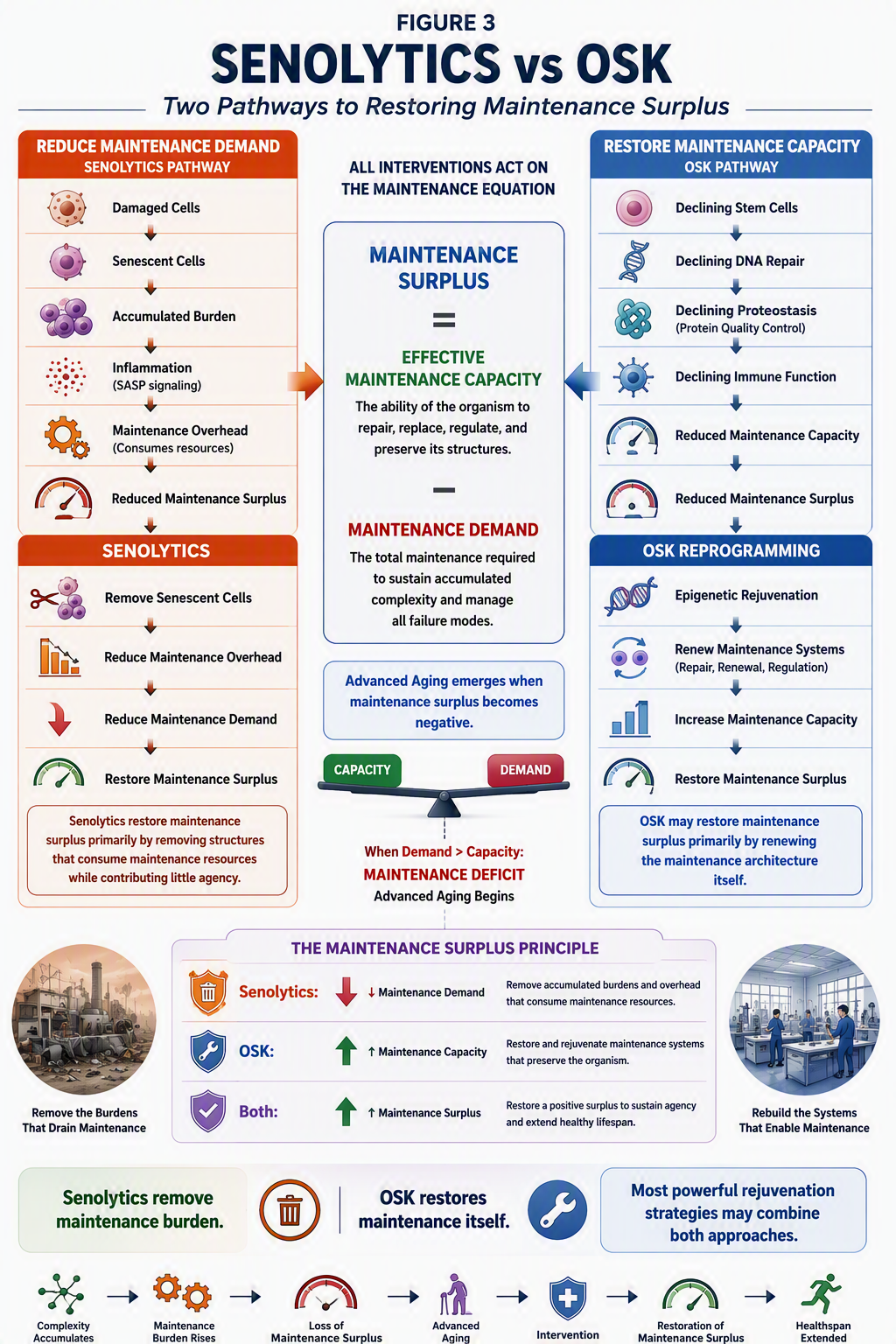
If aging represents a progressive loss of maintenance surplus, then successful rejuvenation may be defined as the restoration of that surplus through renewal of the maintenance architecture upon which biological longevity ultimately depends. OSK partial renewal strategies may provide a useful approach.
- Conclusion
This paper proposes that aging is not fundamentally a problem of entropy, nor primarily a programmed process of death.
Rather, aging may emerge from a universal structural relationship between complexity and maintenance.
Structure creates agency.
Agency creates complexity.
Complexity creates maintenance demand.
Maintenance preserves structure.
Yet maintenance systems themselves become part of the complexity they were created to sustain.
Aging begins when maintenance demand exceeds effective maintenance capacity.
Death follows when failures accumulate faster than they can be corrected.
From this perspective, aging is not an anomaly of biology.
It is a manifestation of a deeper structural principle governing all enduring complex systems.
The central challenge of longevity may therefore not be the elimination of damage.
It may be the preservation of maintenance surplus in the presence of ever-increasing complexity.
If so, the ultimate question of aging becomes:
Can any sufficiently complex structure indefinitely increase its maintenance capacity faster than it increases its maintenance burden?
The answer to that question may determine not only the limits of human longevity, but the fate of every enduring structure in nature.

