
The Nuclear DNA Damage/Mutation Theory of Aging

By Brendan Hussey

(I invited Brendan Hussey to generate this blog post after reading his comments to the post Closing the loop in the stem cell supply chain – presented graphically. It was clear that he had something fundamental to say about an important theory of aging and can write clearly and concisely. The only editing modifications I have made are minor corrections and implementing hyperlinks to referenced documents. Otherwise, the post is as written by Brendan. Also, I have posted a comment following the post.  Vince)

In its simplest form this theory states that stochastic DNA damage (mutations) accumulate throughout life, progressively disabling cells, tissues and organs until they can no longer function. This is sensible when one considers “In principle, all other macromolecules are renewable, whereas nuclear DNA, the blueprint of virtually all cellular RNA and proteins, is irreplaceable; any acquired error is permanent and may have irreversible consequences2.” The primary sources of DNA damage are largely endogenous; metabolism and replication. Damaged differentiated cells are destroyed naturally through apoptosis (programmed cell death) or they may be frozen in a state of senescence. This is often not a problem in many tissues as these lost cells are replaced via stem cell populations (eg. gut epithelium) or through division of neighboring differentiated cells (eg. liver). It is commonly assumed that accumulation of DNA mutations in stem/progenitor cells is what leads to eventual tissue failure due to lack of tissue homeostasis. While this theory has strong support, the role that DNA damage plays is this homeostatic decline is less well established. As is often the case in biology, the issue is complex and reconciling the data inevitably incorporates arguments from many of the various treaties in this Anti-Aging Firewalls blog..

Chronological & Replicative Damage

An important point of a lecture on mutation from my undergrad was to emphasize “Contrary to popular belief…Most DNA damage is caused by endogenous mutagens.” Consider that it often takes 20-30 years of heavy smoking to succumb to cancer; that is dying of exogenous influence. Endogenously generated mutations result from the most basic and essential of all cellular processes, metabolism and replication. Generally, metabolism as well as exogenous insults can be grouped into the category of chronological damage and replication can be grouped into replicative damage, which results in chronological ageing and replicative ageing 3, respectively (Figure 1). This distinction is a useful one as it allows us to categorize tissues based on their rate of replication (which is tied directly to cell turnover) and level of environmental exposure as well as rate and type of metabolism. This then allows us to predict the types of damage to which each tissue is likely to be vulnerable. As will be discussed in more detail later, tissue homeostasis stratagems depend on these variables and their interactions. For example, replication dilutes insults generated by chronological ageing, such as damaged proteins and lipids, which is important for highly metabolic cells or those with high levels of environmental exposure. However, the trade off is that replication increases mutations to DNA, which accumulate in dividing stem cells.
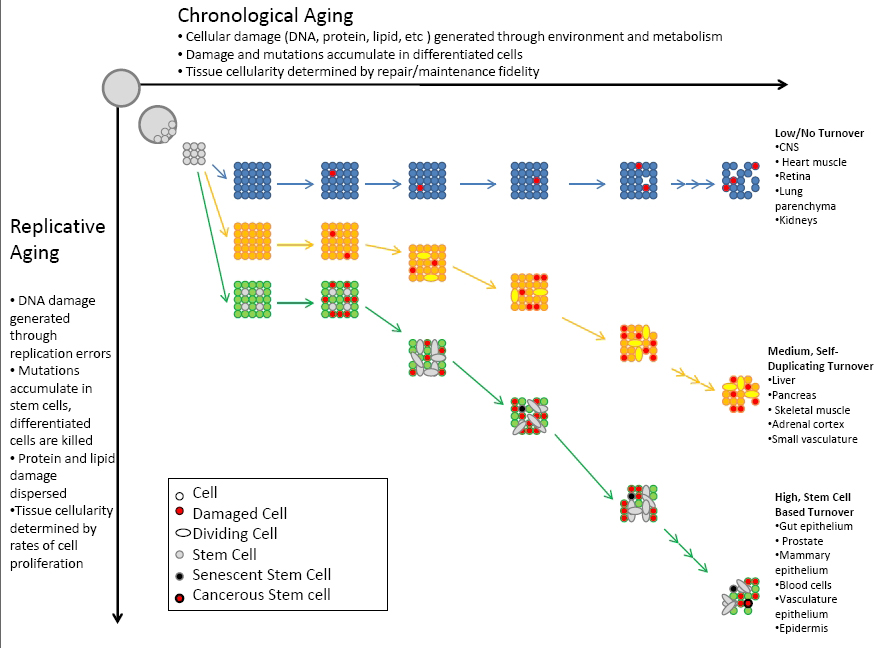
Metabolism continuously generates toxic byproducts such as reactive oxygen species (ROS) and advanced glycation end products (AGEs) which damage macromolecules such as DNA. ROS and AGEs are major candidates for aging and discussed in more detail in the Oxidative Damage and Tissue Glycation sections of the firewalls treatise. Such metabolic stress generates ~70,000 mutations per day in the form of single strand breaks (SSBs), double strand breaks (DSBs), depurinations, oxidations, etc (ref. lecture from my undergrad). Other estimates are even higher at about 100,000 DNA damage events per cell per day12. Environmental insults such as radiation, carcinogenic small molecules and viruses also contribute to chronological aging. As such, chronological ageing affects all cell types, differing in intensity depending on the metabolic rate and type of various cells as well as the level environmental exposure and repair fidelity. For example, a highly metabolic tissue with high environmental exposure such as the gut epithelium would be expected to generate a large amount of chronological damage and hence age chronologically more quickly than other tissues. The gut epithelium has a very high cell turnover rate to compensate for such damage, as will be discussed in more detail later.

Replication is another large source of mutagenesis for cells, particularly for the DNA, and is especially a problem for high turnover tissues. A simple calculation from the same lecture illustrates this fact; “Consider just errors made during DNA replication….You each have 46 chromosomes = 6 X 10⁹ bp DNA/cell. On average, a mistake is made once every in 109 bp of DNA copied. So, you have 6 mistakes/cell/division. You have ~1014 cells in your body that divide a minimum of once per year, so, a very conservative estimate is ~ 6 X 10¹⁴ mistakes per year…Or, at least 60 billion mistakes while in class for MBG*4270 today!!!” These are errors generated just by DNA polymerase, the DNA copying machine, and do not include the large mutations generated by reactivation of retroviruses and similar elements due to replication or the loss of telomere length (see the Telomere Shortening and Damage discussion). The actual error rate of DNA polymerase is 104 bp of DNA copied, but proofreading on the polymerase corrects many of these. Such DNA damage sensing and repair pathways are essential to cell survival. Not surprisingly these pathways are central to the DNA damage theory of aging.

Cellular Response to Mutation and DNA Damage

Before delving into mechanisms, a distinction must be made between two terms which are often used interchangeably; DNA damage and mutation11. DNA damage is a change to the DNA that compromises its functionality such as DSBs, SSBs, interstrand cross-links (ICLs) and telomere shortening, which are difficult to repair and are often cytotoxic resulting in cell death. Mutation, on the other hand, is a change to the coding of the DNA resulting in different functional products such as mutated proteins and can lead to numerous forms of cellular dysfunction such as cancer. Mutations result from polymerase errors in replication and from repair to DNA damage and are not inherently cytotoxic to the same extent as DNA damage. This distinction is central to cell survival and can predict cell turnover rates as well as susceptibility to cancer and aging.

A large amount of evidence for the DNA damage theory of aging comes from studies of humans and mice that have mutations in some aspect of the DNA sensing and repair pathways1. Mice have proved valuable models for disease in humans “In some cases, a mouse model even paved the way for identifying the parallel human syndrome… leaving no doubt that mouse models and human syndromes constitute valid ageing mutants.1” Mutations in genes which encode components of the sensing and repair pathways generate either, progeroid (pro-aging-like), cancerous, or both phenotypes depending on the cellular machinery affected.

The molecular mechanisms underlying these phenotypes hint at an interesting pattern and involve one of the most important DNA damage sensing and repair systems, the nucleotide excision repair (NER) pathway. Generally, damage to components which repair DNA damage often results in progeria, whereas damage to components which detect and repair mutations result in cancer. For example, defects in transcription joined NER (TC-NER), which repair damage in transcribed regions as transcription is happening, tend to cause progeria. Whereas, defects in global genome NER (GG-NER), which detect mutations anywhere in the genome at any time, often result in cancer. Defects to core NER components which are shared by both TC and GG-NER and other core cellular components such as DSB repair can cause both progeria and cancer. Progeria seems to be caused by defective repair machinery, that while able to detect mutation, cannot fix it defaulting to an apoptotic response to cytotoxicity via cellular mechanisms independent of NER. This results in increased tissue turnover as damaged cells are quickly discarded and replaced. Incidentally, progeroid syndromes of this type result in decreased incidence of cancer, as it is thought that cancerous cells cannot survive long enough to become malignant.

Cancer, on the other hand, seems to be the result of defective mutation detection machinery (not necessarily part of NER), which allows mutations to accumulate undetected, not triggering apoptosis. As aforementioned, tissue turnover initially helps prevent cancer development as differentiated cells which are harboring mutations are recycled before they can become malignant. Additionally, “…when oncogenic mutations induce pathological cell proliferation, rapid tissue expansion is originally limited by a corresponding increase in cell death. It is only when this natural compensatory mechanism is overcome by additional mutations that cancer progresses…5” Progeria and cancer can occur simultaneously depending on the type of DNA damage, the specifics of the pathways involved and importantly, their particular cell turnover rates.

The Role of Cell Turnover

Additional evidence for the link between progeria, cancer and cell turnover is evidenced in experiments involving p53, which promotes apoptosis. “The balance between deleting and preserving damaged cells appears to be particularly important for optimizing the trade-off between aging and cancer. This was elegantly demonstrated in a study by Tyner et al (2002) of which a mutant form of p53 showed constitutive activation. Heterozygotes between mutant and wild-type p53 showed increased p53 activity and had greatly reduced cancer incidence. However, they also showed faster aging. Their shortened life spans were accompanied by accelerated age-related reduction in mass and cellularity of various tissues, including spleen, liver, kidney, and testis. Accelerated age-related losses were also noted in skin thickness, hair growth, wound healing, and stress resistance (to anesthesia and to 5-fluorouracil treatment in hematopoietic precursor cells).2

Another example comes serendipitously from what began as an interest in chronologically controlled knockout of the DNA damage response gene Atr. “Loss of Atr is toxic to proliferating cells… and when Atr was somatically excised in adult mice in a widespread manner by conditional inactivation, the vast majority of proliferating cells rapidly disappeared, producing marked intestinal atrophy and bone marrow hypoplasia 2 weeks after conditional activation. However, the animals survived this transient period of cell loss because rare stem cells that had not recombined the Atr allele replaced the lost cells. By 1 month after conditional activation, the mice appeared largely normal, with rapidly proliferating tissues that had been fully reconstituted by sporadic Atr-competent cells. Surprisingly though, these reconstituted mice then developed a marked progeroid phenotype a few months later, with osteopaenia, graying and loss of lymphoid and haematopoietic progenitors.15

The same pattern is observed in aged mice, when challenged with radiation: “In the case of gut epithelial stem cells, even a very low dose (0.1 Gy) [of radiation] is sufficient to initiate apoptosis… It may be significant that, in aged mice, these stem cells, which exhibit some functional deterioration already, show increased levels of apoptosis in response to low-dose genotoxic stress…In general, in tissues where apoptosis is used to delete damaged cells, increased levels of apoptosis in aged organisms are likely to reflect higher background levels of accumulated cellular damage.2” Humans who have undergone chemo – radiotherapy again tie cell death back to ageing: “Indeed, long-term survivors of chemo- or radiotherapy show evidence of premature ageing.1

The idea of a tradeoff between aging and cancer is compelling. The above examples suggest that increased cell turnover protects against cancer, with the cost of aging. At least for the cases in which apoptosis is a response to damage and mutation. While cell turnover rates can be modulated by DNA damage, tissues have inherent turnover rates ranging from very frequent to practically non-existent. For example the intestinal epithelium turns-over as a whole in about 5 days4, whereas most CNS neurons never turn over in the lifetime of the organism. Regarding cell turnover, “In humans, the magnitude of this flux is truly astounding—it has been estimated that each of us eradicates and, in parallel, generates a mass of cells equal to almost our entire body weight each year5.” Hence, one may expect than that tissues with the highest rates of cell turnover, such as the gut epithelium, to be protected from cancer and very low turnover tissues, such as cardiac muscle and the CNS, to be leading cancer incidence rates. However, what is actually observed is the opposite. In terms of cell division alone, a clear correlation can be found between tissues with the highest cell turnover rates and most cancers, when lung cancer is omitted due to smoking3,5,13. For example, prostate, breast and colorectal cancers lead incidence rates for combined men and women, which are among tissues with the highest cell turnover rates3,5. The trend continues with other leading cell turnover tissues such as lymphoid, uterine and skin as cancer leaders.

This correlation may at first seem to be at odds with the aforementioned experimental evidence. However, sensitivity to genomic stress resulting in increased apoptosis is not the same thing as natural cell turnover. As mentioned, co-occurring with progeria is decreased organ cellularity; decreased tissue homeostasis. Stem cells supply the reservoir of replacement cells is most tissues5, and the commonly observed increase in apoptosis of stem cell progeny in these models explains the decrease in tissue homeostasis. This is dissimilar from what we consider regular tissue homeostasis in which stem cell progeny maintain tissue homeostasis. It is this difference that can explain why increasing sensitivity to DNA damage and hence increasing apoptosis can prevent cancer at the cost of aging but why normal, homeostatic tissue turnover causes cancer. The sensitivity of progeria models to DNA damage and mutations prevents their progeny from surviving and manifesting cancer, but this is not the case in normal tissue turnover in which the progeny are less sensitive to damage and survive long enough to become cancerous. This is consistent with a model of ageing and mutation showing that “If mutations occur as a result of errors during cell division, the model suggests that a low cellular turnover rate protects both against aging and the development of cancer. On the other hand, if mutations occur independent from cell division (e.g. if DNA is hit by damaging agents), I find that a high cellular turnover rate protects against aging, while it promotes the development of cancer.10” This model can also help explain why tissues have different cell turnover rates. Tissues such as the gut epithelium, blood cells and skin have high environmental exposure (independent of cell division) and hence a high turnover rate protects them from ageing, at least initially as tissue cellularity is highly maintained. These are also the same tissues that lead the incidence rates of cancer. This tradeoff between growth /tissue homeostasis and repair/maintenance appears to be a case of antagonistic pleiotropy, the evolutionary genetics theory of selection for traits which benefit the young and fertile but compromise the heath of the old. Evolutionary theories are often evoked for explaining differences in cell maintenance as not much information currently exists as to why such differences arose.

The “Disposable Soma” Theory

Due to the genotoxic nature of cell division, the question arises as to why cells take the risk of dividing so often in so many tissues given that examples exist in which cell turnover is not required for tissue fidelity over the lifetime of the organism. Clearly, cellular maintenance can be such that error production is so low, or so well repaired, that cells need not turnover as is the case for CNS neurons. Furthermore, CNS related disorders are far from the leading causes of disability and death in old age14, demonstrating the functional efficacy of their maintenance. The efficacy of cellular maintenance mechanisms is further exemplified in germ cells, which are immortal and divide massive amounts, especially in mammalian males. This difference in germ cell and somatic cell maintenance is central to the “disposable soma” hypothesis. The disposable soma is an evolutionary theory that seeks to explain the disparity in cellular maintenance between germ and somatic cells by means of limited resource allocation between the two energetically intensive processes of reproduction/growth and repair/maintenance.

Kirkwood says it best; “Somatic maintenance needs only to be good enough to keep the organism in sound physiological condition for as long as it has a reasonable chance of survival in the wild. For example, since more than 90% of wild mice die in their first year…any investment of energy in mechanism for survival beyond this age benefits 10% of the population…Energy is scarce, as shown by the fact that the major cause of mortality for wild mice is cold, due to failure to maintain thermogenesis…The mouse will therefore benefit by investing any spare energy into thermogenesis or reproduction, rather than into better capacity for somatic maintenance and repair, even though this means that damage will eventually accumulate to cause aging…The idea that intrinsic longetivity is tuned to the prevailing level of extrinsic mortality is supported by extensive observation on natural populations…Evolutionary adaptations such as flight, protective shells, and large brains all of which reduce extrinsic mortality, are associated with increased longetvity”2. There are numerous lines of supporting evidence for the disposable soma theory and as such it is the most widely supported (see refs 1-3, 6, 7). Some examples include the highly conserved IGF-1/insulin pathway as well as mTOR signaling and the negative correlation between lifespan and fecundity.

The disposable soma theory can help explain (in an evolutionary sense) why some tissues, such as the CNS, do not turn over yet remain highly functional throughout life. The brain, as a defense from extrinsic mortality, is essential to reproductive success and as such is maintained with as much efficacy. This is part of the reason that the human brain is a huge metabolic expense; “Although the brain represents only 2% of the body weight, it receives 15% of the cardiac output, 20% of total body oxygen consumption, and 25% of total body glucose utilization.8” However, not dividing helps by removing a large source of mutagenesis as does being isolated from the external environment. Physiological constraints involved in path finding and wiring also help explain why most CNS neurons do not divide in adulthood. Few other tissues benefit from such metabolically expensive cellular maintenance, notably heart muscle, the retina, lung parenchyma and kidneys3. Notice that these organs are also very infrequently the cause of death or incidence of cancer in old age13, 14, suggesting immediate reproductive importance. Additionally, this suggests that highly proliferative tissues are the limiting factors in ageing and culprits of cancer, agreeing with aforementioned evidence relating cellular turnover to the tradeoffs between cancer and progeria. Inevitably, stem cells are suspect as they represent the reservoir for tissue homeostasis. As replication is one of the dominant forces introducing mutations in cells it is only a matter of time before progenitor cells accumulate enough mutations to become cancerous. This is the basis for the widely accepted, but not uncontested, stem cell theory of ageing.

Stem cells

The mere existence of post-mitotic tissues that are maintained for an organism’s lifespan seems to be in sharp contrast to the commonly held belief that aging is a result of stem cell depletion and subsequent lack of tissue turnover. Indeed, this issue is far from resolved. While “ [a]lmost every tissue studied has shown age-related decrements in the rate and/or efficacy of normal cellular turnover and regeneration in response to injury3”, “… there is no evidence that the maximal lifespan of any species is determined by declining stem-cell function or, conversely, that increasing the number or functionality of any single stem-cell population would extend lifespan.3” As reviewed in ref. 3, experiments with haematopoietic stem (HS) cells and skeletal muscle satellite cells show little intrinsic limitations in stem cell functionality that cannot be corrected with transplantation to young, stimulating microenvironments. “When HS cells have been tested in serial-transplantation experiments, complete reconstitution of the blood occurs over several lifespans in mice, and old HS cells are as effective as young HS cells at reconstituting the blood lineages after transplantation” and “…regeneration mediated by aged satellite cells was highly effective when the cells were transplanted into young animals as whole-muscle grafts. In fact, the results were indistinguishable from the regeneration mediated by grafting of young muscle.” This seems to be in contrast to the aging models presented earlier where increased cell turnover and stem cell depletion specifically, as in the Atr mouse, caused aged phenotypes.

However this does not disqualify stem cells as the cause of aging. It merely suggests that cell-autonomous properties of stem cells, such as DNA damage, may not be the driving force for ageing. This brings to light an important detail that needs to be stressed from the stem cell studies; the stem cells were fully functional when transplanted into young hosts BUT they were not acting youthful initially in their aged donors. They were in fact acting quite impaired in many measures from delayed and inefficacious migration to aberrant transcription profiles, all characteristics in aged individuals. This has been shown quite extensively elsewhere as well15, and also see Stem Cell Supply Chain Breakdown theory of aging. What this suggests is that it is not the stem cells which are damaged per se, it is their environment. In fact, it appears that any measure in which stem cells initially seemed to be impaired can be fixed with the right microenvironment.

In depth discussion of systemic messengers that influence stem cells to cause ageing is beyond the scope of this article but there are numerous candidates worth noting. One source of messengers are senescent stem cells. “Senescent cells increase with age in mice, non-human primates and humans…[and] secrete inflammatory cytokines and other molecules that alter tissue microenvironments.6” The role of cytokines suggests a potential role of immune cells, which is provocative given the number of age related autoimmune diseases, most prominently atherosclerosis, the leading cause of death in old age14 (also see the discussions on Chronic Inflammation, Immune System Compromise and Susceptibility to Cardiovascular Disease). Additionally, senescent cells may alter stem cell proliferation by competing for soluble small molecules such as members of the Transforming Growth Factor-β (TGF- β)and Wnt families, as is seen in drosophila models (see ref 5). Additional evidence comes from the fact that, “In mammals, circulating levels of Wnt signal proteins increase with age, and this increase triggers muscle stem-cell ageing.7” TGF- β family members also play a role in mammals “with the identification of myostatin, a mammalian member of the TGF-β superfamily… This molecule is produced by adult skeletal muscle, circulates in the blood, and limits muscle fiber growth.5” Along the same lines of evidence for endocrine regulation is liver homeostasis. “A recent study suggests that adult liver homeostasis and regeneration is controlled by a similar mechanism of growth regulation. Bile acids are synthesized from cholesterol in the liver, secreted into the intestine to aid in lipid digestion, and then returned to the liver via the circulatory system. When liver function is compromised, circulating bile acid levels become elevated.

Intriguingly, Huang et al. recently found that bile acid triggers liver regeneration in mice through activation of a nuclear receptor signaling pathway… This observation leads to a simple model in which nuclear receptors regulate liver size by sensing its functional capacity. When liver injury or damage leads to a bile acid buildup, these receptors promote liver growth until normal hepatic function is restored and bile acid levels return to normal.5” This example is particularly intriguing as it ties in with the leading causes of death in old age, specifically the role of cholesterol and lipoproteins in the various forms of cardiovascular disease14. Furthermore, “[w]ith regard to the effects that the accumulation of senescent cells may have, there is evidence that the accumulation of senescent cells plays a role in liver fibrosis…, in immune dysfunction …, osteoarthritis … and in the development of atheroma.16” Finally, one cannot speak of systemic messengers without at least mentioning the IGF-1/insulin pathway as it is foundational to all ageing research and discussed in detail elsewhere1-3,6,7,12,15,16.

Implications for Ageing Interventions

As a whole, the DNA damage theory of ageing has implications for stem cell treatments, especially those intending to utilize induced plutipotent stem cells (iPSCs) as described in the Stem Cell Supply Chain Breakdown theory of aging. One issue is most iPSCs are derived from differentiated somatic cells such as the commonly used fibroblast. Fibroblasts are highly replicative and unsurprisingly display exponential increases in DNA damage markers with age resulting in senescent cells constituting as many as 35% of fibroblast populations in aged primates17. This accumulated DNA damage and increased sensitivity to senescence may be one reason why iPSC induction efficiencies are so low and iPSCs show impaired proliferative capacity and early senescence18. Furthermore, fibroblasts are one of the better donors for iPSC induction besides more pluripotent progenitors19, suggesting that many other tissues may have even more accumulated DNA damage that hinders their survival. This is supported by the study that generated the first all iPSC mice, which not only showed very low survival rates past early embryonic stages but more importantly that iPSC lines derived from the youngest donor cells had the highest survival rates20.  When one considers these experiments in light of the DNA damage theory of ageing, it appears that supplementing dwindling stem cell populations with iPSCs derived from aged differentiated somatic cells as a form of treatment for longevity promotion would be counterproductive. In order for this type of therapy to be effective, cells with very little DNA damage should be stored and expanded selectively for therapeutic needs for individuals throughout their life. One option is embryonic-like cells harvested very early in life as these cells would harbor the least amount of DNA damage and hence offer the most consistent and safe regenerative potential.

Concluding Statement

To summarize, “…current theoretical understanding suggests that, as cells age, they tend to accumulate damage. The rate at which damage arises is dictated, on the average, by genetically determined energy investments in cellular maintenance and repair, at levels optimized to take into account of evolutionary trade-offs. Long lived organisms make greater investments in cellular maintenance and repair than short lived organisms, resulting in slower accumulation of damage. In order to manage the risk presented by damaged cells, particularly the risk of malignancy, organisms have additionally evolved mechanisms, such as tumor suppressor functions, to deal with damaged cells. The actions of such ‘coping’ mechanisms will frequently involve second tier trade-offs.2” A primary example is cellular turnover, which results in such trade-offs between cancer and ageing. As such, high cell turnover tissues are the limiting factors in the DNA damage theory of aging, as exemplified by the leading causes of death from cancer. Dysregulated stem cells form the heart of failing tissue homeostasis but debate remains on the role of DNA damage in these stem cells. That the local niche environment or other soluble messengers have such a strong influence on stem cells suggests endocrine dysregulation and systemic decline as prime candidates for ageing. Additionally, leading causes of natural, “old age”, death such as atherosclerosis and other forms of cardiovascular disease do not clearly involve DNA damage. It is also important to note issues with applications in this area. From what we understand about the accumulation of DNA damage in differentiated somatic cells, care should be taken when considering the use of iPSCs derived from such cells for regenerative purposes.

References

1.    Garinis GA, van der Horst GT, Vijg J, Hoeijmakers JH. DNA damage and ageing: new-age ideas for an age-old problem. Nat Cell Biol. 2008 Nov;10(11):1241-7. Review.

2.    Kirkwood TB. Understanding the odd science of aging. Cell. 2005 Feb 25;120(4):437-47. Review

3.    Rando TA. Stem cells, ageing and the quest for immortality. Nature. 2006 Jun 29;441(7097):1080-6. Review

4.    Blanpain C, Horsley V, Fuchs E. 2007. Epithelial stem cells: turning over new leaves. Cell 128:445–58

5.    Pellettieri J, Sánchez Alvarado A. Cell turnover and adult tissue homeostasis: from humans to planarians. Annu Rev Genet. 2007;41:83-105. Review

6.    Vijg J, Campisi J. Puzzles, promises and a cure for ageing. Nature. 2008 Aug 28;454(7208):1065-71. Review.

7.    Kenyon CJ. The genetics of ageing.Nature. 2010 Mar 25;464(7288):504-12. Review.

8.    Book Chapter. Brain Energy Metabolism. An Integrated Cellular Perspective. Pierre J. Magistretti, Luc Pellerin, and Jean-Luc Martin. From Psychopharmacology – 4th Generation of Progress, Floyd E. Bloom, MD & David J. Kupfer, MD

9.    Yang J, Benyamin B, McEvoy BP, Gordon S, Henders AK, Nyholt DR, Madden PA, Heath AC, Martin NG, Montgomery GW, Goddard ME, Visscher PM. Common SNPs explain a large proportion of the heritability for human height. Nat Genet. 2010 Jul;42(7):565-9

10.                       Wodarz D. Effect of stem cell turnover rates on protection against cancer and aging. J Theor Biol. 2007 Apr 7;245(3):449-58.

11.                       Hoeijmakers, J.H., 2007. Genome maintenance mechanisms are critical for preventing cancer as well as other aging-associated diseases. Mech. Ageing Dev. 128, 460–462.

12.                       Lindahl, T. Instability and decay of the primary structure of DNA. Nature 362, 709–715 (1993).

13.                       U.S. Cancer Statistics Working Group. United States Cancer Statistics: 1999–2007 Incidence and Mortality Web-based Report. Atlanta: U.S. Department of Health and Human Services, Centers for Disease Control and Prevention and National Cancer Institute; 2010. Available at: www.cdc.gov/uscs.

14.                       World Health Organization (2004). “Annex Table 2: Deaths by cause, sex and mortality stratum in WHO regions, estimates for 2002” (pdf). The world health report 2004 – changing history.

15.                       Sharpless NE, DePinho RA. How stem cells age and why this makes us grow old. Nat Rev Mol Cell Biol. 2007 Sep;8(9):703-13.

16.                       Faragher RG, Sheerin AN, Ostler EL. Can we intervene in human ageing? Expert Rev Mol Med. 2009 Sep 7;11:e27

17.                       Herbig U, Ferreira M, Condel L, Carey D, Sedivy JM. Cellular senescence in aging primates. Science. 2006 Mar 3;311(5765):1257

18.                       Feng Q, Lu SJ, Klimanskaya I, Gomes I, Kim D, Chung Y, Honig GR, Kim KS, Lanza R. Hemangioblastic derivatives from human induced pluripotent stem cells exhibit limited expansion and early senescence. Stem Cells. 2010 Apr;28(4):704-12

19.                       Ghosh Z, Wilson KD, Wu Y, Hu S, Quertermous T, Wu JC. Persistent donor cell gene expression among human induced pluripotent stem cells contributes to differences with human embryonic stem cells. PLoS One. 2010 Feb 1;5(2):e8975

20.                       Zhao XY, Li W, Lv Z, Liu L, Tong M, Hai T, Hao J, Guo CL, Ma QW, Wang L, Zeng F, Zhou Q. iPS cells produce viable mice through tetraploid complementation. Nature. 2009 Sep 3;461(7260):86-90.

Brendan Hussey is a B.Sc in Molecular Biology and Genetics, minor Neuroscience, University of Guelph. His e-mail is bjohnhussey@gmail.com.

Posted in Uncategorized | 14 Comments

Nitrates and nitrites –Part 2: good for you

In the previous blog entry Nitrates and nitrites – Part 1: bad for you I described  how there are two current contradictory views about the value of human consumption of nitrates/nitrites.  One view is that consumption of these substances, perhaps through drinking fertalizer-contaminated water, perhaps by eating processed meats, is dangerous and should be avoided.  The result could be incidences of cancer, Alzheimer’s disease, diabetes or premature aging.  The arguments for this “bad for you” view and research justification for this view are laid out in the previous blog entry.  This current blog entry lays out an opposite and contradictory view – that consumption of nitrates can be “good for you.”  I also comment on some critical differences between the “bad for you” and “good for you” studies and say where I am on the issue.

The question of whether dietary nitrates are friends or foes goes back at least ten years

For many decades nitrates in drinking water were seen to be serious threats to public health, as illustrated by several publication s quoted in the previous “nitrates and nitrites are bad for you” blog entry.  The 1999 review article Dietary nitrate in man: friend or foe? Was one of the first to throw this view into question.  “Based on the premise that dietary nitrate is detrimental to human health, increasingly stringent regulations are being instituted to lower nitrate levels in food and water. Not only does this pose a financial challenge to water boards and a threat to vegetable production in Northern Europe, but also may be eliminating an important non-immune mechanism for host defense. Until recently nitrate was perceived as a purely harmful dietary component which causes infantile methaemoglobinaemia, carcinogenesis and possibly even teratogenesis. Epidemiological studies have failed to substantiate this. It has been shown that dietary nitrate undergoes enterosalivary circulation. It is recirculated in the blood, concentrated by the salivary glands, secreted in the saliva and reduced to nitrite by facultative Gram-positive anaerobes (Staphylococcus sciuri and S. intermedius) on the tongue. Salivary nitrite is swallowed into the acidic stomach where it is reduced to large quantities of NO and other oxides of N and, conceivably, also contributes to the formation of systemic S-nitrosothiols. NO and solutions of acidified nitrite, mimicking gastric conditions, have been shown to have antimicrobial activity against a wide range of organisms. In particular, acidified nitrite is bactericidal for a variety of gastrointestinal pathogens such as Yersinia and Salmonella. NO is known to have vasodilator properties and to modulate platelet function, as are S-nitrosothiols. Thus, nitrate in the diet, which determines reactive nitrogen oxide species production in the stomach (McKnight et al. 1997), is emerging as an effective host defense against gastrointestinal pathogens, as a modulator of platelet activity and possibly even of gastrointestinal motility and microcirculation. Therefore dietary nitrate may have an important therapeutic role to play, not least in the immunocompromised and in refugees who are at particular risk of contracting gastroenteritides.”

A 2007 article with the same theme is Dietary nitrate increases gastric mucosal blood flow and mucosal defense. “Salivary nitrate from dietary or endogenous sources is reduced to nitrite by oral bacteria. In the acidic stomach, nitrite is further reduced to bioactive nitrogen oxides, including nitric oxide (NO). In this study, we investigated the gastroprotective role of nitrate intake and of luminally applied nitrite against provocation with diclofenac and taurocholate. Mucosal permeability ((51)Cr-EDTA clearance) and gastric mucosal blood flow (laser-Doppler flowmetry) were measured in anesthetized rats, either pretreated with nitrate in the drinking water or given acidified nitrite luminally. Diclofenac was given intravenously and taurocholate luminally to challenge the gastric mucosa. Luminal NO content and nitrite content in the gastric mucus were determined by chemiluminescence. The effect of luminal administration of acidified nitrite on the mucosal blood flow was also investigated in endothelial nitric oxide synthase-deficient mice. Rats pretreated with nitrate or given nitrite luminally had higher gastric mucosal blood flow than controls. Permeability increased more during the provocation in the controls than in the nitrate- and nitrite-treated animals. Dietary nitrate increased luminal NO levels 50 times compared with controls. Nitrate intake also resulted in nitrite accumulation in the loosely adherent mucous layer; after removal of this mucous layer, blood flow was reduced. Nitrite administrated luminally in endothelial nitric oxide synthase-deficient mice increased mucosal blood flow. We conclude that dietary nitrate and direct luminal application of acidified nitrite decrease diclofenac- and taurocholate-induced mucosal damage. The gastroprotective effect likely involves a higher mucosal blood flow caused by nonenzymatic NO production. These data suggest an important physiological role of nitrate in the diet.”

Oral bacteria appears to play an important role in converting ingested nitrates into nitrites

This point is made in the 2008 publication The increase in plasma nitrite after a dietary nitrate load is markedly attenuated by an antibacterial mouthwash.  “Recent studies surprisingly show that dietary inorganic nitrate, abundant in vegetables, can be metabolized in vivo to form nitrite and then bioactive nitric oxide. A reduction in blood pressure was recently noted in healthy volunteers after dietary supplementation with nitrate; an effect consistent with formation of vasodilatory nitric oxide. Oral bacteria have been suggested to play a role in bioactivation of nitrate by first reducing it to the more reactive anion nitrite. In a cross-over designed study in seven healthy volunteers we examined the effects of a commercially available chlorhexidine-containing antibacterial mouthwash on salivary and plasma levels of nitrite measured after an oral intake of sodium nitrate (10mg/kg dissolved in water). In the control situation the salivary and plasma levels of nitrate and nitrite increased greatly after the nitrate load. Rinsing the mouth with the antibacterial mouthwash prior to the nitrate load had no effect on nitrate accumulation in saliva or plasma but abolished its conversion to nitrite in saliva and markedly attenuated the rise in plasma nitrite. We conclude that the acute increase in plasma nitrite seen after a nitrate load is critically dependent on nitrate reduction in the oral cavity by commensal bacteria. The removal of these bacteria with an antibacterial mouthwash will very likely attenuate the NO-dependent biological effects of dietary nitrate.”

The salutatory effects of consuming nitrates seem to revolve around release of nitric oxide which improves blood flow.  Many other health benefits are reported in addition to protection against gastrointesinal pathogens.

Dietary nitrates are protective of the heart and other organs

The 2009 publication Dietary nitrate and nitrite modulate blood and organ nitrite and the cellular ischemic stress response relates “Dietary nitrate, found in abundance in green vegetables, can be converted to the cytoprotective molecule nitrite by oral bacteria, suggesting that nitrate and nitrite may represent active cardioprotective constituents of the Mediterranean diet. We therefore tested the hypothesis that dietary nitrate and nitrite levels modulate tissue damage and ischemic gene expression in a mouse liver ischemia-reperfusion model. We found that stomach content, plasma, heart, and liver nitrite levels were significantly reduced after dietary nitrate and nitrite depletion and could be restored to normal levels with nitrite supplementation in water. Remarkably, we confirmed that basal nitrite levels significantly reduced liver injury after ischemia-reperfusion. Consistent with an effect of nitrite on the posttranslational modification of complex I of the mitochondrial electron transport chain, the severity of liver infarction was inversely proportional to complex I activity after nitrite repletion in the diet. The transcriptional response of dietary nitrite after ischemia was more robust than after normoxia, suggesting a hypoxic potentiation of nitrite-dependent transcriptional signaling. Our studies indicate that normal dietary nitrate and nitrite levels modulate ischemic stress responses and hypoxic gene expression programs, supporting the hypothesis that dietary nitrate and nitrite are cytoprotective components of the diet.”

Nitrates and brain functioning

The 2010 publication Acute effect of a high nitrate diet on brain perfusion in older adults reports “AIMS  Poor blood flow and hypoxia/ischemia contribute to many disease states and may also be a factor in the decline of physical and cognitive function in aging. Nitrite has been discovered to be a vasodilator that is preferentially harnessed in hypoxia. Thus, both infused and inhaled nitrite are being studied as therapeutic agents for a variety of diseases. In addition, nitrite derived from nitrate in the diet has been shown to decrease blood pressure and improve exercise performance. Thus, dietary nitrate may also be important when increased blood flow in hypoxic or ischemic areas is indicated. These conditions could include age-associated dementia and cognitive decline. The goal of this study was to determine if dietary nitrate would increase cerebral blood flow in older adults. METHODS AND RESULTS In this investigation we administered a high vs. low nitrate diet to older adults (74.7 ± 6.9 years) and measured cerebral perfusion using arterial spin labeling magnetic resonance imaging. We found that the high nitrate diet did not alter global cerebral perfusion, but did lead to increased regional cerebral perfusion in frontal lobe white matter, especially between the dorsolateral prefrontal cortex and anterior cingulate cortex. CONCLUSION These results suggest that dietary nitrate may be useful in improving regional brain perfusion in older adults in critical brain areas known to be involved in executive functioning.”

Dietary nitrates, metabolic syndrome and visceral fat accumulation

The 2010 publication Dietary inorganic nitrate reverses features of metabolic syndrome in endothelial nitric oxide synthase-deficient mice statesThe metabolic syndrome is a clustering of risk factors of metabolic origin that increase the risk for cardiovascular disease and type 2 diabetes. A proposed central event in metabolic syndrome is a decrease in the amount of bioavailable nitric oxide (NO) from endothelial NO synthase (eNOS). Recently, an alternative pathway for NO formation in mammals was described where inorganic nitrate, a supposedly inert NO oxidation product and unwanted dietary constituent, is serially reduced to nitrite and then NO and other bioactive nitrogen oxides. Here we show that several features of metabolic syndrome that develop in eNOS-deficient mice can be reversed by dietary supplementation with sodium nitrate, in amounts similar to those derived from eNOS under normal conditions. In humans, this dose corresponds to a rich intake of vegetables, the dominant dietary nitrate source. Nitrate administration increased tissue and plasma levels of bioactive nitrogen oxides. Moreover, chronic nitrate treatment reduced visceral fat accumulation and circulating levels of triglycerides and reversed the prediabetic phenotype in these animals. In rats, chronic nitrate treatment reduced blood pressure and this effect was also present during NOS inhibition. Our results show that dietary nitrate fuels a nitrate-nitrite-NO pathway that can partly compensate for disturbances in endogenous NO generation from eNOS. These findings may have implications for novel nutrition-based preventive and therapeutic strategies against cardiovascular disease and type 2 diabetes.”

The amazing properties of beetroot juice

A number of recent publications have been concerned with the positive circulatory effects of consuming beetroot juice, a juice high in nitrates.  The nitrates convert in the mouth into nitrites which produce nitric oxide which dilates blood vessels reducing blood pressure and increasing circulation.

Nitrates reduce blood pressure

The 2010 publication Inorganic nitrate supplementation lowers blood pressure in humans: role for nitrite-derived NO reports “Ingestion of dietary (inorganic) nitrate elevates circulating and tissue levels of nitrite via bioconversion in the entero-salivary circulation. In addition, nitrite is a potent vasodilator in humans, an effect thought to underlie the blood pressure-lowering effects of dietary nitrate (in the form of beetroot juice) ingestion. Whether inorganic nitrate underlies these effects and whether the effects of either naturally occurring dietary nitrate or inorganic nitrate supplementation are dose dependent remain uncertain. Using a randomized crossover study design, we show that nitrate supplementation (KNO(3) capsules: 4 versus 12 mmol [n=6] or 24 mmol of KNO(3) (1488 mg of nitrate) versus 24 mmol of KCl [n=20]) or vegetable intake (250 mL of beetroot juice [5.5 mmol nitrate] versus 250 mL of water [n=9]) causes dose-dependent elevation in plasma nitrite concentration and elevation of cGMP concentration with a consequent decrease in blood pressure in healthy volunteers. In addition, post hoc analysis demonstrates a sex difference in sensitivity to nitrate supplementation dependent on resting baseline blood pressure and plasma nitrite concentration, whereby blood pressure is decreased in male volunteers, with higher baseline blood pressure and lower plasma nitrite concentration but not in female volunteers. Our findings demonstrate dose-dependent decreases in blood pressure and vasoprotection after inorganic nitrate ingestion in the form of either supplementation or by dietary elevation. In addition, our post hoc analyses intimate sex differences in nitrate processing involving the entero-salivary circulation that are likely to be major contributing factors to the lower blood pressures and the vasoprotective phenotype of premenopausal women.”

Nitrites are cardioprotective

The 2009 publication Myocardial protection by nitrite explains: “Nitrite has long been considered to be an inert oxidative metabolite of nitric oxide (NO). Recent work, however, has demonstrated that nitrite represents an important tissue storage form of NO that can be reduced to NO during ischaemic or hypoxic events. This exciting series of discoveries has created an entirely new field of research that involves the investigation of the molecular, biochemical, and physiological activities of nitrite under a variety of physiological and pathophysiological states. This has also led to a re-evaluation of the role that nitrite plays in health and disease. As a result there has been an interest in the use of nitrite as a therapeutic strategy for the treatment of acute myocardial infarction. Nitrite therapy has now been studied in several animal models and has proven to be an effective means to reduce myocardial ischaemia-reperfusion injury. This review article will provide a brief summary of the key findings that have led to the re-evaluation of nitrite and highlight the evidence supporting the cardioprotective actions of nitrite and also highlight the potential clinical application of nitrite therapy to cardiovascular diseases.”

The 2009 publication Emerging role of nitrite in myocardial protection relates “Nitrite has long been considered an inert oxidative metabolite of nitric oxide (NO). However, recent experimental findings strongly suggest that nitrite is a critical storage form of NO that is converted back into NO during ischemic or hypoxic events as well as under physiological conditions. Thus, the conversion of nitrite into NO during cellular stress may be an evolutionarily conserved and redundant means for NO generation at a time when endothelial nitric oxide synthase is non-functional. As a result of the recent revelation that the nitrite anion serves an important biological function a large number of studies have been performed to characterize both the physiological actions and therapeutic potential of nitrite under diverse conditions. While the earliest experiments characterized the vasodilatory effects of nitrite in both animal models and humans, more recent research efforts have focused on the potential benefits of nitrite in a number of pathological states. Nitrite therapy has now been studied in numerous animal models and has proven to be an effective means to ameliorate myocardial ischemia-reperfusion (I/R) injury. This review will focus on recent experimental findings related to the cytoprotective actions of nitrite therapy in the setting of myocardial I/R injury.”

Dietary nitrates make exercise more efficient

A very-recent (December 2010) report A toast to health and performance! Beetroot juice lowers blood pressure and the O2 cost of exercise relates “Dietary nitrate administered in the form of beetroot juice decreases resting systolic blood pressure (SBP) and O(2) consumption during walking and running. The effects of dietary nitrate are thought to be mediated via reduction to biologically active nitrite and nitric oxide (NO) molecules. Potential mechanisms for dietary nitrate effects on O(2) cost of exercise are improved matching of O(2) delivery and consumption of active motor units, increased efficiency of mitochondrial oxidative phosphorylation, and stoichiometry of calcium transport to ATP hydrolysis by the sarcoplasmic reticulum calcium-ATPase.”

The 2010 study Acute and chronic effects of dietary nitrate supplementation on blood pressure and the physiological responses to moderate-intensity and incremental exercise relates “Dietary nitrate (NO(3)(-)) supplementation with beetroot juice (BR) over 4-6 days has been shown to reduce the O(2) cost of submaximal exercise and to improve exercise tolerance. However, it is not known whether shorter (or longer) periods of supplementation have similar (or greater) effects. We therefore investigated the effects of acute and chronic NO(3)(-) supplementation on resting blood pressure (BP) and the physiological responses to moderate-intensity exercise and ramp incremental cycle exercise in eight healthy subjects. Following baseline tests, the subjects were assigned in a balanced crossover design to receive BR (0.5 l/day; 5.2 mmol of NO(3)(-)/day) and placebo (PL; 0.5 l/day low-calorie juice cordial) treatments. The exercise protocol (two moderate-intensity step tests followed by a ramp test) was repeated 2.5 h following first ingestion (0.5 liter) and after 5 and 15 days of BR and PL. Plasma nitrite concentration (baseline: 454 ± 81 nM) was significantly elevated (+39% at 2.5 h postingestion; +25% at 5 days; +46% at 15 days; P < 0.05) and systolic and diastolic BP (baseline: 127 ± 6 and 72 ± 5 mmHg, respectively) were reduced by ∼4% throughout the BR supplementation period (P < 0.05). Compared with PL, the steady-state Vo(2) during moderate exercise was reduced by ∼4% after 2.5 h and remained similarly reduced after 5 and 15 days of BR (P < 0.05). The ramp test peak power and the work rate at the gas exchange threshold (baseline: 322 ± 67 W and 89 ± 15 W, respectively) were elevated after 15 days of BR (331 ± 68 W and 105 ± 28 W; P < 0.05) but not PL (323 ± 68 W and 84 ± 18 W). These results indicate that dietary NO(3)(-) supplementation acutely reduces BP and the O(2) cost of submaximal exercise and that these effects are maintained for at least 15 days if supplementation is continued.” 

The 2009 publication Dietary nitrate supplementation reduces the O2 cost of low-intensity exercise and enhances tolerance to high-intensity exercise in humans reports “Pharmacological sodium nitrate supplementation has been reported to reduce the O2 cost of submaximal exercise in humans. In this study, we hypothesized that dietary supplementation with inorganic nitrate in the form of beetroot juice (BR) would reduce the O2 cost of submaximal exercise and enhance the tolerance to high-intensity exercise. In a double-blind, placebo (PL)-controlled, crossover study, eight men (aged 19-38 yr) consumed 500 ml/day of either BR (containing 11.2 +/- 0.6 mM of nitrate) or blackcurrant cordial (as a PL, with negligible nitrate content) for 6 consecutive days and completed a series of “step” moderate-intensity and severe-intensity exercise tests on the last 3 days. On days 4-6, plasma nitrite concentration was significantly greater following dietary nitrate supplementation compared with PL (BR: 273 +/- 44 vs. PL: 140 +/- 50 nM; P < 0.05), and systolic blood pressure was significantly reduced (BR: 124 +/- 2 vs. PL: 132 +/- 5 mmHg; P < 0.01). During moderate exercise, nitrate supplementation reduced muscle fractional O2 extraction (as estimated using near-infrared spectroscopy). The gain of the increase in pulmonary O2 uptake following the onset of moderate exercise was reduced by 19% in the BR condition (BR: 8.6 +/- 0.7 vs. PL: 10.8 +/- 1.6 ml.min(-1).W(-1); P < 0.05). During severe exercise, the O2 uptake slow component was reduced (BR: 0.57 +/- 0.20 vs. PL: 0.74 +/- 0.24 l/min; P < 0.05), and the time-to-exhaustion was extended (BR: 675 +/- 203 vs. PL: 583 +/- 145 s; P < 0.05). The reduced O2 cost of exercise following increased dietary nitrate intake has important implications for our understanding of the factors that regulate mitochondrial respiration and muscle contractile energetics in humans.”

The November 2010 publication Dietary nitrate supplementation reduces the O2 cost of walking and running: a placebo-controlled study reportsDietary supplementation with beetroot juice (BR) has been shown to reduce resting blood pressure and the O(2) cost of sub-maximal exercise and to increase the tolerance to high-intensity cycling. We tested the hypothesis that the physiological effects of BR were consequent to its high nitrate content, per se, and not to the presence of other potentially bioactive compounds. We investigated changes in blood pressure, mitochondrial oxidative capacity (Q(max)), and the physiological responses to walking, moderate-intensity running and severe-intensity running following dietary supplementation with BR and nitrate-depleted beetroot juice (PL). Following control (non-supplemented) tests, nine healthy, physically-active male subjects were assigned in a randomized, double-blind, cross-over design to receive BR (0.5 L(.)d(-1); containing ~6.2 mmol of nitrate) and PL (0.5 L(.)d(-1); containing ~0.003 mmol of nitrate) for six days. Subjects completed treadmill exercise tests on days four and five, and knee-extension exercise tests for the estimation of Q(max) (using (31)P-MRS) on day six of the supplementation periods. Relative to PL, BR elevated plasma [nitrite] (PL: 183±119 vs. BR: 373±211 nM, P<0.05) and reduced systolic blood pressure (PL: 129±9 vs. BR: 124±10 mmHg; P<0.01). Q(max) was not different between PL and BR (PL: 0.93±0.05 vs. BR: 1.05±0.22 mM(.)s(-1)). The O(2) cost of walking (PL: 0.87±0.12 vs. BR: 0.70±0.10 L(.)min(-1); P<0.01), moderate-intensity running (PL: 2.26±0.27 vs. BR: 2.10±0.28 L(.)min(-1); P<0.01), and severe-intensity running (End-exercise V(O2); PL: 3.77±0.57 vs. BR: 3.50±0.62 L(.)min(-1); P<0.01) was reduced by BR, and time-to-exhaustion during severe-intensity running was increased by 15% (PL: 7.6±1.5 vs. BR: 8.7±1.8 min; P<0.01). In contrast, relative to control, nitrate-depleted beetroot juice did not alter plasma [nitrite], blood pressure or the physiological responses to exercise. These results indicate that the positive effects of 6 days of BR supplementation on the physiological responses to exercise can be ascribed to the high nitrate content per se.”

Perhaps the vasoprotective effects of eating certain vegetables is due to nitrates/nitrites and the production of NO.   

This theory is put forward in the 2008 publication  Acute blood pressure lowering, vasoprotective, and antiplatelet properties of dietary nitrate via bioconversion to nitrite (2008).   “Diets rich in fruits and vegetables reduce blood pressure (BP) and the risk of adverse cardiovascular events. However, the mechanisms of this effect have not been elucidated. Certain vegetables possess a high nitrate content, and we hypothesized that this might represent a source of vasoprotective nitric oxide via bioactivation. In healthy volunteers, approximately 3 hours after ingestion of a dietary nitrate load (beetroot juice 500 mL), BP was substantially reduced (Delta(max) -10.4/8 mm Hg); an effect that correlated with peak increases in plasma nitrite concentration. The dietary nitrate load also prevented endothelial dysfunction induced by an acute ischemic insult in the human forearm and significantly attenuated ex vivo platelet aggregation in response to collagen and ADP. Interruption of the enterosalivary conversion of nitrate to nitrite (facilitated by bacterial anaerobes situated on the surface of the tongue) prevented the rise in plasma nitrite, blocked the decrease in BP, and abolished the inhibitory effects on platelet aggregation, confirming that these vasoprotective effects were attributable to the activity of nitrite converted from the ingested nitrate. These findings suggest that dietary nitrate underlies the beneficial effects of a vegetable-rich diet and highlights the potential of a “natural” low cost approach for the treatment of cardiovascular disease.”By now, you should be getting the picture that nitrates and nitrites and substances that contain these like beetroot juice are definitely beneficial – the opposite message of that conveyed in the previous blog entry. 

Beetroot juice could possibly be useful in the treatment of obesity

The 2009 study In vitro effects of beetroot juice and chips on oxidative metabolism and apoptosis in neutrophils from obese individuals  relates “Oxidative stress and inflammation are involved in the development of obesity. Beetroot (Beta vulgaris var. rubra) is a food ingredient containing betalain pigments that show antioxidant activity. The in vitro effect of beetroot juice and chips on oxidative metabolism and apoptosis in neutrophils from obese individuals has been investigated. Fifteen obese women (aged 45 +/- 9 years, BMI >30 kg/m2) and nine healthy controls (women, aged 29 +/- 11 years, BMI = 22.2 +/- 1.6 kg/m2) were examined. –. Neutrophils from obese individuals had a significantly higher ROS production compared with the controls (p < 0.05). Beetroot products inhibited neutrophil oxidative metabolism in a concentration-dependent manner. Also observed were the pro-apoptotic effects of beetroot at a concentration range of 0.1-10% in 24 h culture of stimulated neutrophils. These natural products (in both the liquid and solid state) have antioxidant and antiinflammatory capacity, and could be an important adjunct in the treatment of obesity.”

Nitrites play a role in hypoxic signaling

 One if the alternative theories of aging described in my treatise is Declining hypoxic response.  I speculate there that keeping the hypoxic response turned on can possibly contribute to longevity. 

The 2009 paper Nitrite as regulator of hypoxic signaling in mammalian physiology relates: “In this review we consider the effects of endogenous and pharmacological levels of nitrite under conditions of hypoxia. In humans, the nitrite anion has long been considered as metastable intermediate in the oxidation of nitric oxide radicals to the stable metabolite nitrate. This oxidation cascade was thought to be irreversible under physiological conditions. However, a growing body of experimental observations attests that the presence of endogenous nitrite regulates a number of signaling events along the physiological and pathophysiological oxygen gradient. Hypoxic signaling events include vasodilation, modulation of mitochondrial respiration, and cytoprotection following ischemic insult. These phenomena are attributed to the reduction of nitrite anions to nitric oxide if local oxygen levels in tissues decrease. Recent research identified a growing list of enzymatic and nonenzymatic pathways for this endogenous reduction of nitrite. Additional direct signaling events not involving free nitric oxide are proposed. We here discuss the mechanisms and properties of these various pathways and the role played by the local concentration of free oxygen in the affected tissue.”

I note that VIAGRA® (sildenafil citrate), CIALIS® (tadalafil) and other drugs for erectile dysfunction work through release of nitric oxide (NO) from nerve terminals and endothelial cells and consequent dilation of arteries and increase of blood flow.  These drugs appear to be useful for treating a number of other conditions where enhancing circulation is important, for example relieving pulmonary arterial hypertension and symptoms of scleroderma. While not nitrates or nitrites in themselves, their circulatory functions appear to be quite similar.  In fact, some blogs have suggested that beetroot juice might be an alternative to VIAGRA or CIALIS, though i have seen no research to that effect. 

There is an explosion of research in the areas of nitrites-based signaling, physiology and medical applications.  Some of the many additional relevant publications are:

Nitrite as a physiological source of nitric oxide and a signalling molecule in the regulation of the cardiovascular system in both mammalian and non-mammalian vertebrates, The emerging role of nitrite as an endogenous modulator and therapeutic agent of cardiovascular function,The role of nitrite in nitric oxide homeostasis: a comparative perspective, Protective effect of red beetroot against carbon tetrachloride- and N-nitrosodiethylamine-induced oxidative stress in rats, Clinical translation of nitrite therapy for cardiovascular diseases, Mechanisms of nitrite reduction to nitric oxide in the heart and vessel wall, A mammalian functional nitrate reductase that regulates nitrite and nitric oxide homeostasis, Nitrite as a vascular endocrine nitric oxide reservoir that contributes to hypoxic signaling, cytoprotection, and vasodilation, Nitrite in nitric oxide biology: cause or consequence?, A systems-based review, Nitrite modulates contractility of teleost (Anguilla anguilla and Chionodraco hamatus, i.e. the Antarctic hemoglobinless icefish) and frog (Rana esculenta) hearts, Beta-adrenergic receptors and nitric oxide generation in the cardiovascular system, .

, Role of the anion nitrite in ischemia-reperfusion cytoprotection and therapeutics, ,Nitrite exerts potent negative inotropy in the isolated heart via eNOS-independent nitric oxide generation and cGMP-PKG pathway activation, Nitrite reductase activity of cytochrome c, Nitrite is a signaling molecule and regulator of gene expression in mammalian tissues,  Dietary nitrite restores NO homeostasis and is cardioprotective in endothelial nitric oxide synthase-deficient mice,  and Nitrite-dependent vasodilation is facilitated by hypoxia and is independent of known NO-generating nitrite reductase activities.


My take on dietary nitrates and nitrites

Reviewing the research described in this blog entry and in the previous blog entry, I frankly am unable at this time to come down on one side or the other on the question of health benefits of ingesting nitrates/nitrites or supplements containing them like beetroot juice.  The arguments on both sides of the ledger seem compelling.  Hopefully it has been valuable to readers to review both sides of the issue.  I can make a few comments, however.

1.     The cell-level and body-level research relating to the beneficial effects of nitrates/nitrites and NO is generally newer and there seems to be much more of it at the moment than corresponding research on the negative effects. Yet, publications on both sides of the good/bad ledger are continuing to appear.

2.     Some of the arguments relating to the negative health effects of nitrates and nitrites seems to be circumstantial, e.g., incidences of diabetes increasing concurrently with drinking water nitrites levels.  Other arguments seem to be well-founded.  E.g. under certain circumstances nitrites are converted to nitrosamines, and these are definitely carcinogenic. 

3.     Some of the “bad for you” research reports are based on very large multi-year population studies involving hundreds or thousands of people, while the “good for you” studies are typically based on theoretical knowledge and experimental studies with relatively small numbers of subjects.

4.     The two categories of studies tend to measure very different things and could possibly be both essentially valid.  E.g. it could be the case that consuming beetroot juice could improve circulation, exercise, cardiovascular and cognitive performance and at the same time increase susceptibility to cancers and neurodegenerative diseases and accelerate biomarkers of aging.   The situation could be similar to that of taking HGH shots where there may be immediate improvements in body morphology and exercise capability but the long-term effects are likely to be life-shortening(ref).   

5.     The “good for you” and the “bad for you” researchers seem to be pursuing different agendas and largely ignore each other’s work. 

6.     Some of the “good for you” researchers point out that the levels of consumption of nitrates and nitrites or even beetroot juice associated with eating plenty of vegetables is too small to be concerned with negative health effects.

7.     The “good for you” researchers have focused on nitrate/nitrite-inducing supplements like beetroot juice and, insofar as I have seen, have avoided talking about processed meat which contains nitrites.  They have also avoided discussing nitrosamines.

I am waiting to see how this seeming-conflict in an important area of health and aging plays out.  Particularly I am awaiting more studies of relating NO levels to the hypoxic and other longevity-related gene-activation pathways.  Meanwhile I intend to consume generous amounts of vegetables but for now I am holding off on the beetroot juice as a regular supplement.

Posted in Uncategorized | 5 Comments

Nitrates and nitrites – Part 1: bad for you

Every great once in a while mainline medical advice reverses itself about something important – what was bad becomes good or what was good becomes bad.  That happened with Vitamin D in recent years when stern warnings never to exceed 400IU a day gave way to recommendations that it is good for older people to take anywhere up to 4,000IU per day.  A reversal may now be taking place having to do with whether nitrates and nitrites lead to cancers and Alzheimer’s Disease and are therefore bad for you, or whether they have great cardiovascular effects and are therefore good for you.  There is controversy about this, clashing and clanging of gears as contradictory health advice is commonly given. 

The issue at hand is whether it is good or bad for your health to consume foods containing high amount of nitrates and nitrites, foods like processed meats and certain supplements like beet root juice.  The controversy extends to whether the large quantities of nitrates used in mass-scale agriculture constitutes a public health hazard because of contamination of public water supplies with nitrates.  Is this good or bad for public health?  This Part 1 blog entry presents the research case against consumption of nitrites and nitrites.  A following Part 2 blog entry presents the research case in favor of consumption of nitrites and nitrites. I added some additional citations here on January 10, 2010.

Nitrates/nitrites and nitrosamines

A nitrate is a polyatomic ion with  the molecular formula NO3 while nitrites are salts of nitrous acid (HNO2) containing the nitrite ion NO2.  “Nitrates can be reduced to nitrites by certain microorganisms present in foods and in the gastrointestinal tract(ref).”  Sodium nitrite is used for the curing of meat because it prevents bacterial growth and, in a reaction with the meat’s myoglobin, gives the product a desirable dark red color. Because of the toxicity of nitrite (the lethal dose of nitrite for humans is about 22 mg per kg body weight(ref)), the maximum allowed nitrite concentration in meat products is 200 ppm. Under certain conditions, especially during cooking, nitrites in meat can react with degradation products of amino acids, forming nitrosamines, which are known carcinogens(ref)” 

“Under certain conditions not yet fully understood, the natural breakdown products of proteins known as amines can combine with nitrites to form compounds known as nitrosamines. There are many different types of nitrosamines, most of which are known carcinogens in test animals(ref).”  Cooking a meat containing nitrites may generate greater or fewer nitrosamines depending on how the cooking takes place.  “Thus, well done or burned bacon probably is potentially more hazardous than less well done bacon. Bacon cooked by microwave has less nitrosamine than fried bacon(ref).”

Nitrosamines are formed by a chemical reaction between nitrites or other proteins. Sodium nitrite is deliberately added to meat and fish to prevent toxin production; it is also used to preserve, color and flavor meats. Ground beef, cured meats and bacon in particular contain abundant amounts of amines due to their high protein content. Because of the significant levels of added nitrates and nitrites, nitrosamines are nearly always detectable in these foods. Nitrosamines are also easily generated under strong acid conditions, such as in the stomach, or at high temperatures associated with frying or flame broiling. Reducing sodium nitrite content reduces nitrosamine formation in foods. — Nitrosamines basically become highly reactive at the cellular level, which then alters gene expression and causes DNA damage(ref).” 

“As established by the U.S. Department of Agriculture (USDA) in the Meat Inspection Regulations —  the use of nitrites, nitrates, or combinations of them cannot result in more than 200 parts per million (ppm), calculated as sodium nitrite, in the finished product(ref).”  People may have significant exposure to nitrites and nitrates from eating vegetable as well as from eating processed meats.  Green lettuce, spinach, celery and beets tend to have the greatest concentrations of nitrites and concentrations can be particularly high due to excessive pre-harvest use of fertilizers.

The health case against consumption of nitrates and nitrites

The arguments against consumption of substantial amounts of nitrates and nitrites are both old and new and are fairly convincing:

·        Nitrites are converted into nitrosamines under a number of conditions, and nitrosamines are known to be toxic or carcinogenic.

·        Exposure to nitrates, nitrites and nitrosamines is correlated with higher incidences of Alzheimer’s Disease, Parkinson’s disease and diabetes.

·        Consumption of foods containing large amounts of nitrates or nitrites lead to higher incidences of several cancers.

·        Shorter telomere lengths, biomarkers of aging,  are associated with consumption of processed meats containing nitrates/nitrites/nitrosamines, but not with consumption of unprocessed meats.  

Nitrates/nitrites/nitrosamines and Alzheimer’s Disease, Parkinson’s disease and diabetes 

Consumption of excess nitrates/nitrites/nitrosamines seems to play a role in creating or worsening these disease processes. 

The professionally-worded title of this 2009 publication conceals a strong underlying message:  Epidemilogical trends strongly suggest exposures as etiologic agents in the pathogenesis of sporadic Alzheimer’s disease, diabetes mellitus, and non-alcoholic steatohepatitis:  Nitrosamines mediate their mutagenic effects by causing DNA damage, oxidative stress, lipid peroxidation, and pro-inflammatory cytokine activation, which lead to increased cellular degeneration and death. However, the very same pathophysiological processes comprise the “unbuilding” blocks of aging and insulin-resistance diseases including, neurodegeneration, diabetes mellitus (DM), and non-alcoholic steatohepatitis (NASH). Previous studies demonstrated that experimental exposure to streptozotocin, a nitrosamine-related compound, causes NASH, and diabetes mellitus Types 1, 2 and 3 (Alzheimer (AD)-type neurodegeneration). Herein, we review evidence that the upwardly spiraling trends in mortality rates due to DM, AD, and Parkinson’s disease typify exposure rather than genetic-based disease models, and parallel the progressive increases in human exposure to nitrates, nitrites, and nitrosamines via processed/preserved foods. We propose that such chronic exposures have critical roles in the pathogenesis of our insulin resistance disease pandemic. Potential solutions include: 1) eliminating the use of nitrites in food; 2) reducing nitrate levels in fertilizer and water used to irrigate crops; and 3) employing safe and effective measures to detoxify food and water prior to human consumption. Future research efforts should focus on refining our ability to detect and monitor human exposures to nitrosamines and assess early evidence of nitrosamine-mediated tissue injury and insulin resistance.”

As further reported in a 2009 Science Daily article Nitrates May Be Environmental Trigger For Alzheimer’s, Diabetes And Parkinson’s Disease “A new study by researchers at Rhode Island Hospital have found a substantial link between increased levels of nitrates in our environment and food with increased deaths from diseases, including Alzheimer’s, diabetes mellitus and Parkinson’s. The study was published in the Journal of Alzheimer’s Disease. — Led by Suzanne de la Monte, MD, MPH, of Rhode Island Hospital, researchers studied the trends in mortality rates due to diseases that are associated with aging, such as diabetes, Alzheimer’s, Parkinson’s, diabetes and cerebrovascular disease, as well as HIV. They found strong parallels between age adjusted increases in death rate from Alzheimer’s, Parkinson’s, and diabetes and the progressive increases in human exposure to nitrates, nitrites and nitrosamines through processed and preserved foods as well as fertilizers. — De la Monte and the authors propose that the increase in exposure plays a critical role in the cause, development and effects of the pandemic of these insulin-resistant diseases. — De la Monte — says, “We have become a ‘nitrosamine generation.’ In essence, we have moved to a diet that is rich in amines and nitrates, which lead to increased nitrosamine production. We receive increased exposure through the abundant use of nitrate-containing fertilizers for agriculture.” She continues, “Not only do we consume them in processed foods, but they get into our food supply by leeching from the soil and contaminating water supplies used for crop irrigation, food processing and drinking.” — Nitrites and nitrates belong to a class of chemical compounds that have been found to be harmful to humans and animals. More than 90 percent of these compounds that have been tested have been determined to be carcinogenic in various organs. They are found in many food products, including fried bacon, cured meats and cheese products as well as beer and water. Exposure also occurs through manufacturing and processing of rubber and latex products, as well as fertilizers, pesticides and cosmetics.  — The researchers note that the role of nitrosamines has been well-studied, and their role as a carcinogen has been fully documented. The investigators propose that the cellular alterations that occur as a result of nitrosamine exposure are fundamentally similar to those that occur with aging, as well as Alzheimer’s, Parkinson’s and Type 2 diabetes mellitus. — De la Monte comments, “All of these diseases are associated with increased insulin resistance and DNA damage. Their prevalence rates have all increased radically over the past several decades and show no sign of plateau. Because there has been a relatively short time interval associated with the dramatic shift in disease incidence and prevalence rates, we believe this is due to exposure-related rather than genetic etiologies.”

A 2009 publication reinforces the message, at least insofar as nitrosamines are concerned, Nitrosamine exposure causes insulin resistance diseases: relevance to type 2 diabetes mellitus, non-alcoholic steatohepatitis, and Alzheimer’s disease. “The current epidemics of type 2 diabetes mellitus (T2DM), non-alcoholic steatohepatitis (NASH), and Alzheimer’s disease (AD) all represent insulin-resistance diseases. Previous studies showed that streptozotocin, a nitrosamine-related com-pound, causes insulin resistance diseases including, T2DM, NASH, and AD-type neurodegeneration. We hypothesize that chronic human exposure to nitrosamine compounds, which are widely present in processed foods, contributes to the pathogenesis of T2DM, NASH, and AD. Long Evans rat pups were treated with N-nitrosodiethylamine (NDEA) by i.p. (x3) or i.c. (x1) injection, and 2-4 weeks later, they were evaluated for cognitive-motor dysfunction, insulin resistance, and neurodegeneration using behavioral, biochemical, and molecular approaches. NDEA treatment caused T2DM, NASH, deficits in motor function and spatial learning, and neurodegeneration characterized by insulin resistance and deficiency, lipid peroxidation, cell loss, increased levels of amyloid-beta protein precursor/amyloid-beta, phospho-tau, and ubiquitin immunoreactivities, and upregulated expression of pro-inflammatory cytokine and pro-ceramide genes, which together promote insulin resistance. In conclusion, environmental and food contaminant exposures to nitrosamines play critical roles in the pathogenesis of major insulin resistance diseases including T2DM, NASH, and AD. Improved detection and prevention of human exposures to nitrosamines will lead to earlier treatments and eventual quelling of these costly and devastating epidemics.”

Another 2009 publication continues the theme Mechanisms of nitrosamine-mediated neurodegeneration: potential relevance to sporadic Alzheimer’s disease. “Streptozotocin (STZ) is a nitrosamine-related compound that causes Alzheimer’s disease (AD)-type neurodegeneration with cognitive impairment, brain insulin resistance, and brain insulin deficiency. Nitrosamines and STZ mediate their adverse effects by causing DNA damage, oxidative stress, lipid peroxidation, pro-inflammatory cytokine activation, and cell death, all of which occur in AD. We tested the hypothesis that exposure to N-nitrosodiethylamine (NDEA), which is widely present in processed/preserved foods, causes AD-type molecular and biochemical abnormalities in central nervous system (CNS) neurons. NDEA treatment of cultured post-mitotic rat CNS neurons (48 h) produced dose-dependent impairments in ATP production and mitochondrial function, and increased levels of 8-hydroxy-2′-deoxyguanosine, 4-hydroxy-2-nonenal, phospho-tau, amyloid-beta protein precursor-amyloid-beta (A beta PP-A beta), and ubiquitin immunoreactivity. These effects were associated with decreased expression of insulin, insulin-like growth factor (IGF)-I, and IGF-II receptors, and choline acetyltransferase. Nitrosamine exposure causes neurodegeneration with a number of molecular and biochemical features of AD including impairments in energy metabolism, insulin/IGF signaling mechanisms, and acetylcholine homeostasis, together with increased levels of oxidative stress, DNA damage, and A beta PP-A beta immunoreactivity. These results suggest that environmental exposures and food contaminants may play critical roles in the pathogenesis of sporadic AD.” 

Nitrates, nitrites and nitrosamines and cancer

The 2008 publication Processed meat and colorectal cancer: a review of epidemiologic and experimental evidence implicates nitrites and nitrosamines “Processed meat intake may be involved in the etiology of colorectal cancer, a major cause of death in affluent countries. The epidemiologic studies published to date conclude that the excess risk in the highest category of processed meat-eaters is comprised between 20% and 50% compared with non-eaters. In addition, the excess risk per gram of intake is clearly higher than that of fresh red meat. Several hypotheses, which are mainly based on studies carried out on red meat, may explain why processed meat intake is linked to cancer risk. Those that have been tested experimentally are (i) that high-fat diets could promote carcinogenesis via insulin resistance or fecal bile acids; (ii) that cooking meat at a high temperature forms carcinogenic heterocyclic amines and polycyclic aromatic hydrocarbons; (iii) that carcinogenic N-nitroso compounds are formed in meat and endogenously; (iv) that heme iron in red meat can promote carcinogenesis because it increases cell proliferation in the mucosa, through lipoperoxidation and/or cytotoxicity of fecal water. Nitrosation might increase the toxicity of heme in cured products.”

The 2008 publication Nutrition and gastric cancer risk: an update relates “Data from epidemiologic, experimental, and animal studies indicate that diet plays an important role in the etiology of gastric cancer. High intake of fresh fruits and vegetables, lycopene and lycopene-containing food products, and potentially vitamin C and selenium may reduce the risk for gastric cancer. Data also suggest that high intake of nitrosamines, processed meat products, salt and salted foods, and overweight and obesity are associated with increased risk for gastric cancer. However, current data provide little support for an association of beta-carotene, vitamin E, and alcohol consumption with risk for gastric cancer.”

The 2010 publication Nitrate intake and the risk of thyroid cancer and thyroid disease relates “BACKGROUND: Nitrate is a contaminant of drinking water in agricultural areas and is found at high levels in some vegetables. Nitrate competes with uptake of iodide by the thyroid, thus potentially affecting thyroid function.– METHODS: We investigated the association of nitrate intake from public water supplies and diet with the risk of thyroid cancer and self-reported hypothyroidism and hyperthyroidism in a cohort of 21,977 older women in Iowa who were enrolled in 1986 and who had used the same water supply for >10 years. — We observed no association with prevalence of hypothyroidism or hyperthyroidism. Increasing intake of dietary nitrate was associated with an increased risk of thyroid cancer (highest vs. lowest quartile, RR = 2.9 [1.0-8.1]; P for trend = 0.046) and with the prevalence of hypothyroidism (odds ratio = 1.2 [95% CI = 1.1-1.4]), but not hyperthyroidism.  — CONCLUSIONS: Nitrate may play a role in the etiology of thyroid cancer and warrants further study.” 

The 2007 report Nitrate intake relative to antioxidant vitamin intake affects gastric cancer risk: a case-control study in Korea had some surprising conclusions: “The objective of this study was to determine whether the intake of nitrate relative to antioxidant vitamin rather than absolute intake of nitrate affects the risk of gastric cancer (GC). In a case-control study in Korea using a food frequency questionnaire, trained dietitians interviewed 136 GC cases and an equal number of controls matched by sex and age. As an index of nitrate intake relative to antioxidant vitamins intake, we calculated the nitrate:antioxidant vitamin consumption ratio. The mean daily nitrate intake from foods was very high in our subjects. Higher absolute intake of nitrate was not associated with GC risk [odds ratios (OR) = 1.13; 95% confidence interval (CI) = 0.42-3.06]. However, the GC risk distinctly increased as the nitrate:antioxidant vitamin consumption ratio increased, particularly with higher nitrate:vitamin E (OR = 2.78; 95% CI = 1.01-7.67) and nitrate:folate ratios (OR = 3.37; 95% CI = 1.28-8.87). Therefore, GC risk was influenced by the intake of nitrate relative to antioxidant vitamins. Our results suggest that a decrease in the intake of nitrate relative to antioxidant vitamins is considerably more effective in reducing GC risk than either a lower absolute intake of nitrate or a higher intake of antioxidant vitamins alone.”

Note that there is a theme here that shows up frequently in the literature: cancer and other risks associated with ingestion of nitrites or nitrites or nitrosamines can be reduced by consumption of antioxidants.

 A number of other recent publications link nitric oxide to cancers.  The 2007 publication An emerging role for endothelial nitric oxide synthase in chronic inflammation and cancer relates “Nitric oxide (NO) is a free radical that is involved in carcinogenesis. Recent literature indicates that endothelial NO synthase (eNOS) can modulate cancer-related events (angiogenesis, apoptosis, cell cycle, invasion, and metastasis). We review the literature linking eNOS to carcinogenesis to encourage future research assessing the role of eNOS in cancer prevention and treatment.” 

The 2010 publication Nitric oxide and cancer relates “Nitric oxide (NO) is a lipophilic, highly diffusible and short-lived physiological messenger which regulates a variety of important physiological responses including vasodilation, respiration, cell migration, immune response and apoptosis. NO is synthesized by three differentially gene-encoded NO synthase (NOS) in mammals: neuronal NOS (nNOS or NOS-1), inducible NOS (iNOS or NOS-2) and endothelial NOS (eNOS or NOS-3). All isoforms of NOS catalyze the reaction of L-arginine, NADPH and oxygen to NO, L-citrulline and NADP. NO may exert its cellular action by cGMP-dependent as well as by cGMP-independent pathways including postranslational modifications in cysteine (S-nitrosylation or S-nitrosation) and tyrosine (nitration) residues, mixed disulfide formation (S-nitrosoglutathione or GSNO) or promoting further oxidation protein stages which have been related to altered protein function and gene transcription, genotoxic lesions, alteration of cell-cycle check points, apoptosis and DNA repair. NO sensitizes tumor cells to chemotherapeutic compounds. The expression of NOS-2 and NOS-3 has been found to be increased in a variety of human cancers. The multiple actions of NO in the tumor environment is related to heterogeneous cell responses with particular attention in the regulation of the stress response mediated by the hypoxia inducible factor-1 and p53 generally leading to growth arrest, apoptosis or adaptation.”  Several earlier publications also link NO to cancers, for example the 2003 publication Nitric oxide-mediated promotion of mammary tumour cell migration requires sequential activation of nitric oxide synthase, guanylate cyclase and mitogen-activated protein kinase. “ Together, these results indicate sequential activation of NOS, GC and MAPK pathways in mediating signals for C3L5 cell migration, an essential step in invasion and metastasis. Since NOS activity is positively associated with human breast cancer progression, the present results are relevant for development of therapeutic modalities for this disease.”  

The 2009 publication Dietary intake of polyphenols, nitrate and nitrite and gastric cancer risk in Mexico City reports: “N-nitroso compounds (NOC) are potent animal carcinogens and potential human carcinogens. The primary source of exposure for most individuals may be endogenous formation, a process that can be inhibited by dietary polyphenols. To estimate the risk of gastric cancer (GC) in relation to the individual and combined consumption of polyphenols and NOC precursors (nitrate and nitrite), a population-based case-control study was carried out in Mexico City from 2004 to 2005 including 257 histologically confirmed GC cases and 478 controls. Intake of polyphenols, nitrate and nitrite were estimated using a food frequency questionnaire. High intakes of cinnamic acids, secoisolariciresinol and coumestrol were associated with an approximately 50% reduction in GC risk. A high intake of total nitrite as well as nitrate and nitrite from animal sources doubled the GC risk. Odds ratios around 2-fold were observed among individuals with both low intake of cinnamic acids, secoisolariciresinol or coumestrol and high intake of animal-derived nitrate or nitrite, compared to high intake of the polyphenols and low animal nitrate or nitrite intake, respectively. Results were similar for both the intestinal and diffuse types of GC. Our results show, for the first time, a protective effect for GC because of higher intake of cinnamic acids, secoisolariciresinol and coumestrol, and suggest that these polyphenols reduce GC risk through inhibition of endogenous nitrosation. The main sources of these polyphenols were pears, mangos and beans for cinnamic acids; beans, carrots and squash for secoisolariciresinol and legumes for coumestrol.” 

The 2008 publication Geographic distribution of liver and stomach cancers in Thailand in relation to estimated dietary intake of nitrate, nitrite, and nitrosodimethylamine reports “It is our working hypothesis that the high rate of the liver and gastric cancers in North and Northeast Thailand is associated with increased daily dietary intake of nitrate, nitrite, and nitrosodimethylamine (NDMA).– Significant differences in dietary nitrate, nitrite, and NDMA intakes were seen between various Thai regions (P < 0.0001), and these corresponded to the variations in liver and stomach cancer ASR values between the regions. –” 

Going back to 2001 we have the publication Municipal drinking water nitrate level and cancer risk in older women: the Iowa Women’s Health Study.  This study was based on a cohort of 21,977 Iowa women who were 55-69 years of age at baseline in 1986 and had used the same water supply more than 10 years.  The study showed a positive association with increasing nitrate in drinking water with bladder cancer but not for other cancers.

The 2009 publication Too much of a good thing? Nitrate from nitrogen fertilizers and cancer points to a possible public health problem.  Nitrate levels in water supplies have been increasing in many areas of the world; therefore, additional studies of populations with well-characterized exposures are urgently needed to further our understanding of cancer risk associated with nitrate ingestion. Future studies should assess exposure for individuals (e.g., case-control, cohort studies) in a time frame relevant to disease development, and evaluate factors affecting nitrosation. Estimating N-nitroso compounds formation via nitrate ingestion requires information on dietary and drinking water sources of nitrate, inhibitors of nitrosation (e.g., vitamin C), nitrosation precursors (e.g., red meat, nitrosatable drugs), and medical conditions that may increase nitrosation (e.g., inflammatory bowel disease). Studies should account for the potentially different effects of dietary and water sources of nitrate and should include the population using private wells for whom exposure levels are often higher than public supplies.”

The 2010 study Estimation of incidence and social cost of colon cancer due to nitrate in drinking water in the EU: a tentative cost-benefit assessment  concludes “RESULTS: For above median meat consumption the risk of colon cancer doubles when exposed to drinking water exceeding 25 mg/L of nitrate (NO3) for more than ten years. — CONCLUSIONS: Our cost estimates indicate that current measures to prevent exceedance of 50 mg/L NO3 are probably beneficial for society and that a stricter nitrate limit and additional measures may be justified. –”

Eating processed meat and telomere lengths

The blog entry Telomere lengths, Part 2: Lifestyle, dietary, and other factors associated with telomere shortening and lengthening contains a long passage related to the different impacts of eating processed meats and unprocessed meats on telomere lengths. Because the difference between processed and unprocessed meats is largely associated with inclusion of nitrates/nitrites and nitrosamines, the passage is worth reproducing here:

Telomere lengths and processed meats

It is possible to couple the results of two studies related to processed meats to see some interesting relationships.  The first such study is described in a 2010 publication published in Circulation, a journal of the American Heart Association Red and Processed Meat Consumption and Risk of Incident Coronary Heart Disease, Stroke, and Diabetes Mellitus.  This study is a meta-analysis of studies relating red and processed meat to CHD (coronary heart disease), stroke, and diabetes mellitus. Background— Meat consumption is inconsistently associated with development of coronary heart disease (CHD), stroke, and diabetes mellitus, limiting quantitative recommendations for consumption levels. Effects of meat intake on these different outcomes, as well as of red versus processed meat, may also vary.Methods and Results— We performed a systematic review and meta-analysis of evidence for relationships of red (unprocessed), processed, and total meat consumption with incident CHD, stroke, and diabetes mellitus. We searched for any cohort study, case-control study, or randomized trial that assessed these exposures and outcomes in generally healthy adults. Of 1598 identified abstracts, 20 studies met inclusion criteria, including 17 prospective cohorts and 3 case-control studies. All data were abstracted independently in duplicate. Random-effects generalized least squares models for trend estimation were used to derive pooled dose-response estimates. The 20 studies included 1 218 380 individuals and 23 889 CHD, 2280 stroke, and 10 797 diabetes mellitus cases. Red meat intake was not associated with CHD (n=4 studies; relative risk per 100-g serving per day=1.00; 95% confidence interval, 0.81 to 1.23; P for heterogeneity=0.36) or diabetes mellitus (n=5; relative risk=1.16; 95% confidence interval, 0.92 to 1.46; P=0.25). Conversely, processed meat intake was associated with 42% higher risk of CHD (n=5; relative risk per 50-g serving per day=1.42; 95% confidence interval, 1.07 to 1.89; P=0.04) and 19% higher risk of diabetes mellitus (n=7; relative risk=1.19; 95% confidence interval, 1.11 to 1.27; P<0.001). Associations were intermediate for total meat intake. Consumption of red and processed meat were not associated with stroke, but only 3 studies evaluated these relationships.Conclusions Consumption of processed meats, but not red meats, is associated with higher incidence of CHD and diabetes mellitus. These results highlight the need for better understanding of potential mechanisms of effects and for particular focus on processed meats for dietary and policy recommendations.”

The second study (2008) looks at telomere lengths as related to kinds of food intake Dietary patterns, food groups, and telomere length in the Multi-Ethnic Study of Atherosclerosis (MESA)“Objective: With data from 840 white, black, and Hispanic adults from the Multi-Ethnic Study of Atherosclerosis, we studied cross-sectional associations between telomere length and dietary patterns and foods and beverages that were associated with markers of inflammation.Design: Leukocyte telomere length was measured by quantitative polymerase chain reaction. Length was calculated as the amount of telomeric DNA (T) divided by the amount of a single-copy control DNA (S) (T/S ratio). Intake of whole grains, fruit and vegetables, low-fat dairy, nuts or seeds, nonfried fish, coffee, refined grains, fried foods, red meat, processed meat, and sugar-sweetened soda were computed with responses to a 120-item food-frequency questionnaire completed at baseline. Scores on 2 previously defined empirical dietary patterns were also computed for each participant.   Results: After adjustment for age, other demographics, lifestyle factors, and intakes of other foods or beverages, only processed meat intake was associated with telomere length. For every 1 serving/d greater intake of processed meat, the T/S ratio was 0.07 smaller (β ± SE: –0.07 ± 0.03, P = 0.006). Categorical analysis showed that participants consuming 1 serving of processed meat each week had 0.017 smaller T/S ratios than did nonconsumers. Other foods or beverages and the 2 dietary patterns were not associated with telomere length.  – Conclusions: Processed meat intake showed an expected inverse association with telomere length, but other diet features did not show their expected associations.

So, together the two studies say:

·        Consumption of processed meat correlates with both shorter telomere lengths and increased susceptibility to CHD and diabetes mellitus.  Neither of these correlations exist for consumption of red meat.

·        Of a number of possibly not-good-for-you foods like sugar-sweetened soda, only consumption of processed meats was correlated with shorter telomeres.

·        Causal chain is unclear, e.g. whether eating processed meats leads to shorter telomeres which leads to increased disease susceptibilities or whether eating processed meats leads to disease susceptibilities which lead to shorter telomeres, or both or neither.

       From a health and longevity perspective the two studies combine fairly powerfully to contraindicate eating processed meats, foods which have long been suspected to be carcinogenic because they tend to be infused with nitrites(ref).

I resist the temptation to go on quoting more and more publications that are negative about nitrates/nitrites/nitrosamines.  A few central points seem to be made:

1.      A number of both laboratory and epidemiological studies suggest strong associations between consumption of nitrates/nitrites/nitrosamines with many diseases including Alzheimer’s disease, Parkinson’s disease, diabetes and multiple cancers.  The chain of causality is fairly well understood in terms of actions of nitrates/nitrites/nitrosamines.

2.     Telomere lengths, a proxy measure for aging, are definitely shorter among those eating processed meat but not unprocessed meat, again implicating nitrates/nitrites/nitrosamines.  Likewise eating processed meat but not unprocessed meat is associated with greater susceptibility to coronary heart disease and diabetes mellitus.

3.     The major sources of nitrates/nitrites/nitrosamines are drinking water contaminated with fertilizer runoff, certain vegetables and processed meat.

4.     The health risks associated with consumption of  nitrates/nitrites/nitrosamines can be significantly reduced by consumption of antioxidants and plant-based polyphenols which interfere with nitrosation.

One would think that with the collective evidence presented above, no respectable health scientists would advocate consuming nitrates or nitrites for health reasons.  However, in the past few years a case is being built up for exactly that.  In fact certain health supplements like beet root juice are being sold precisely because they are concentrated sources of nitrates.  The case for nitrates/nitrites seems to be that they lead to increased nitric oxide expression in the body and offer a number of positive cardiovascular benefits.  I will present this case in the following blog entry Nitrates and nitrites –Part 2: good for you.

Posted in Uncategorized | 10 Comments

The reputation of aging in ancient and current mythology

Why the pursuit of anti-aging science?  I take a short break from science in this blog entry and look at myths about aging and how aging is viewed in popular folklore – ancient and current.  These myths are important because aging science exists in our more-general culture and efforts to suggest an impending possibility for life-extension are often met with misplaced negative reactions. 

The reputation of aging in our culture is generally not a good one.  Facts about aging are often misperceived.   Aging is usually ignored, viewed in a context of resignation, or felt to be irrelevant until it is imminent.  Diseases and accidents are seen to be the main causes of death even though those diseases and accidents are ones of old age.  Myths about aging, old ones and modern ones, provide insights into where our culture has been and where it is now with respect to aging.

In ancient Greece aging was seen as ugly and tragic – except in Sparta

The paper Old Age in Ancient Greece: Narratives of desire, narratives of disgust illustrates how some of the current ambivalences about aging have very early roots.  “The Greek habit of dividing the world into mutually exclusive categories was a hallmark of their culture. One such division, between youth and old age, formed a persistent theme in Greek myth, poetry and theatre. Youth – neotas – was sweet, beautiful and heroic. To leave youth meant one quickly passed the threshold to old age – gems. Old age was ugly, mean and tragic. There was no middle ground, no third age. Sparta, the city state least inclined toward literature, litigation, art and trade provides an instructive contrast. Here an unchanging politics engendered an unending respect for those older than oneself. This was institutionalized in the powers of the Gerousia or Council of Elders.”

In Greek mythology “GERAS was the spirit (daimon) of old age, one of the malevolent spirits spawned by the goddess Nyx (Night). — He was depicted as a tiny shrivelled up old man. Geras’ opposite number was the goddess of youth, Hebe(ref).”

Old people were very rare in ancient Rome and seen with a mixture of disdain and respect

From Old age in ancient Rome: Mary Harlow and Ray Laurence look at what it meant to become a senior citizen in ancient Rome – “Rome, was the first ever metropolis, containing one million people and an urban culture that included architectural achievements unsurpassed until the modern period. This picture of an almost modern nation masks another of massive inequality, alongside sickness and disease that have not been experienced in the West for generations. Life expectancy at birth was short: on average roughly twenty-five to thirty years, with 50 per cent of those born not passing the age of ten. In other words, the demographic regime was not unlike that experienced in countries today such as Botswana through the causes of AIDS, international debt, poverty and inequality–a far cry from the modern Western world where average life expectancy becomes ever-higher and runs well into the seventies. A key question for understanding Rome is how society viewed those few people who survived into old age and experienced a life-span not unlike our own today.  — In short, once a man had reached the chronological age of sixty, he could step down from his formal obligations as a citizen and lead a life of leisure. This departure from public life was double-edged: it could be seen as a lifestyle that was characterized as productive (or indulgent) leisure but it could also mean social marginalization. Moving out of public life in effect led to a loss of social power and status in the eyes of those still in power. Retiring from public life was no easier for individuals in the Roman period than it is for some today–many of whom continue to work after their sixty-fifth birthday. Despite this, and the fact that there was no social marker, no rite of transition to mark this phase, there was pressure for older men to stand down in favour of younger. “   This sounds a lot like it is today.

Saturn was the god of Roman mythology who ruled over old age, but he was a very multi-faceted god with numerous other duties(ref). 

In the good-old-days, aging was generally seen as a crummy deal

Although we like to think that aging was seen in romantic terms in the good-old-days, the opposite seems to be true, at least in Western societies.  From Aging and Death in Folklore:   “For most pre-industrial cultures, life’s last chapter has been a bitter one. Surviving folklore reflects widespread resignation as to the inevitability of impoverishment, sexual impotence, failing health and vitality, and the loss of family and community status. No one expected the impossible. Such euphemisms as “golden years” and “senior citizens” did not exist.

  • You cannot teach an old dog new tricks.
  • There is no fool like an old fool.
  • An old man who takes a young wife invites Death to the wedding.
  • Nothing good will come from an old man who still wants to dance.
  • For an old man to marry is like wanting to harvest in the wintertime.
  • Old people can dye their hair, but they can’t change their backs.
  • Age is poverty.
  • Age is a troublesome guest.
  • Age is a sickness from which everyone must die.
  • Youth rises, age falls.
  • A young wife is an old man’s dispatch horse to the grave.
  • A young woman with an old husband is a wife by day and a widow by night.
  • A woman’s beauty, an echo in the forest, and a rainbow all quickly disappear.
  • When the old cow dances, her claws rattle.
  • When the wolf grows old, the crows ride him.

Source: Wander, Deutsches Sprichwörter-Lexikon, vol. 1, cols. 55, 58-60; Simrock, Die deutschen Sprichwörter, pp. 281, 614; Jente, Proverbia Communia, nos. 28, 102.

“These proverbs reflect a chapter of life that most of us would prefer to ignore. We do not like to be reminded of our own mortality, and in today’s world, institutions such as hospitals, hospices, retirement centers, and funeral homes (euphemisms abound in the language of death!) shield us from the worst of the Grim Reaper’s ravages. We cope, or so it might seem, by pretending that death does not exist(ref).”

Old women were particularly distrusted in folklore.

From the same source, Aging and Death in Folklore:   “In spite of the numerous tales and proverbs celebrating the wisdom of old people and promoting their care, folklore is replete with reflections of a basic distrust of age. Various demonic personages, notably changelings and the devil himself, can be rendered powerless by tricking them into revealing their age. More significantly, in pre-industrial Europe superstitions abound that cast suspicion at old people, especially women. Proverbs and popular superstitions state the claim succinctly:

  • If the devil can’t come himself, he sends an old woman.
  • It is not good if one goes out in the morning and encounters an old woman.
  • He who walks between two old women early in the morning shall have only bad luck the rest of the day.
  • To meet old women first thing in the morning means bad luck; young people, good luck.
  • Many men would rather let themselves be beaten to death, than to pass between two old women.
  • A person on his way to an important undertaking will have bad luck if he encounters an old woman. Encountering a young girl will bring him good luck.

Source: Wander, Deutsches Sprichwörter-Lexikon, vol. 4, col. 1105. Simrock, Die deutschen Sprichwörter, p. 554; Grimm, Deutsche Mythologie, vol. 3, items 58, 380, 791, 938, 1015.”

“Further, the sinister nature of old women is reflected in numerous folktales, for example: An old woman, promised a pair of shoes by the devil if she could bring discord to a happily married couple, told the wife that she could increase her husband’s love by cutting a few hairs from his chin. She then told the husband that his wife was plotting to cut his throat while he slept. The man pretended to sleep. Seeing his wife silently approaching with a razor, he struck her dead with a stick.”

“Source: Retold from “An Old Woman Sows Discord,” Ranke, Folktales of Germany, no. 66. Type 1353.

Such tales help explain the widespread superstition, documented above, that if the first person you saw in the morning was an old woman, you would have bad luck.”

There are many current myths about aging

Many websites elaborate and refute current myths about what aging is like.  One set of examples is from The Five Myths of Aging By  Lauri M. Aesoph N.D.The myths discussed and refuted there are:

“Myth #1: When I get old, I’ll become senile.

“Myth #2: Old age means losing all my teeth.

“Myth #3: The older I get, the sicker I’ll get.

“Myth #4: Lifestyle changes won’t help me when I get old.

“Myth #5: As long as I maintain the eating habits I had when I was younger, I’ll stay healthy.”

Another set of myths is treated in the website 5 Common Myths About Aging By Deborah Kotz.  They are:

1.     Losing those few extra pounds will extend your life.

2.     You ‘ll need a hearing aid.

3.     You’re bound to get crotchety and withdrawn.

4.     Senility is inevitable.

5.     You won’t have the energy to exercise well in your 80s 

Common myths relate to the conditions people expect when aging

A list of more-subtle myths is in the site COMMON MYTHS OF AGING by DeLee Lantz, Ph.D.  The examples and comments are drawn from a NIH questionnaire.

“1.  Baby boomers are the faster growing segment of the population.  False. Fact:   There are more than 3 million Americans over the age of 85. That number is expected to quadruple by the year 2040, when there will be more than 12 million people in that age group. The population age 85 and older is the fastest growing age group in the U.S. 

2.  Families don’t usually bother with older relatives.  False. Fact: Most older people live close to their    children and see them often. Many live with their    spouses. An estimated 80% of men and 60% of    women live in family settings. Only 5% of the older    populations lives in nursing homes.    

3.  Everyone becomes confused or forgetful if they live long enoughFact:  Confusion and serious forgetfulness in old age can be caused by Alzheimer’s disease or other conditions that result in irreversible damage to the brain. But at least 100 other problems can bring on the same symptoms. A minor head injury, high fever, poor nutrition, adverse drug reactions, and depression also can lead to confusion. These conditions are treatable, however, and the confusion they cause can be eliminated.    

4.  You can become too old to exercise.  False.  Fact:   Exercise at any age can help strengthen the heart and lungs and lower blood pressure. It also can improve muscle strength, and, if carefully chosen, lessen bone loss with age. 

5.  Heart disease is a much bigger problem for older men than for older women. False.   Fact:  The risk of heart disease increases dramatically for women after menopause. By age 65, both men and women have a one in three chance of showing symptoms. But risks can    be significantly reduced by following a healthy  diet and exercising.  

You can become too old to exercise. False.  Fact:   Exercise at any age can help strengthen the heart and lungs and lower blood pressure. It also can improve muscle strength, and, if carefully chosen, lessen bone loss with age.

7.  Heart disease is a much bigger problem for older men than for older women. False Fact:The risk of heart disease increases dramatically for women after menopause. By age 65, both men and women have a one in    three chance of showing symptoms. But risks can    be significantly reduced by following a healthy diet and exercising.  

8.  The older you get, the less you sleep.  False.  Fact: In later life, it’s the quality of sleep that declines, not total sleep time. Researchers found that sleep tends to become more fragmented as people age. A number of reports suggest that older people are less likely than younger people  to stay awake throughout the day and that older people tend to take more naps than younger people.      

9.   Most older people are depressed. Why shouldn’t they be? False.    Fact:  Most older people are not depressed. When  it does occur, depression is treatable throughout    the life cycle using a variety of approaches, such   family support, psychotherapy, or antidepressant medications.  A physician can determine whether    the depression is caused by medication an older   person might be taking, by physical illness, stress,    or other factors.  

10.  There’s no point in screening older people for cancer because they can’t be treated.  False.   Fact:  Many older people can beat cancer,  especially if it’s found early. Over half of all cancers occur in people 65 and older, which  means that screening for cancer in this age group is especially important.  

11.  If your parent had Alzheimer’s DIsease, you  will most likely get it.  False.  Fact: The overwhelming number of people with Alzheimer’s disease have not inherited the disorder. In a few families, scientists have seen an extremely high incidence of the disease and have identified genes in these families which they think may be responsible.  

12.  As your body changes with age, so does your personality.   False.Fact:  Research has found that, except for the changes that can result from Alzheimer’s disease and other forms of dementia, personality is one of the few constants of life. That is, you are likely to age much as you’ve lived.


13.  Older people might as well accept urinary accidents as a fact of life. False. Fact:  Urinary incontinence is a symptom, not a disease.  Usually, it is caused by specific changes in body function that can result from infection, diseases, pregnancy, or the use of certain medications. A variety of treatment options are available for people who seek medical attention.

14.  Falls and injuries just naturally happen to older people.  False.Fact: Falls are the most common cause of injuries among people over age 65. But many of these injuries, which result in broken bones, can be avoided. Regular vision and hearing tests and good safety habits can help prevent accidents. Knowing whether your medications affect balance and coordination is also a good idea.    

15.  Everyone eventually gets cataracts.   False.  Fact: Not everyone gets cataracts, although a great many older people do. Some 18 percent of    people between the ages of 65 and 74 have cataracts, while more than 40 percent of those  between 75 and 85 have the problem. Cataracts  can be treated very successfully with surgery; more than 90 percent of people say they can see better after the procedure. 

16.  “You can’t teach an old dog new tricks.  False.  Fact:  People at any age can learn new information and skills. Research indicates that older people can obtain new skills and improve old ones, including how to use a computer. 

There are many current myths and half-myths about aging science and the impact of life extension on society

This list is my own.

1.     Aging is part of the natural order Facts:  True and true also for death.  But lifespans vary greatly by species and human lifespans have varied significantly and can probably be extended significantly.

2.     Aging is inevitable; nothing can be done about it. Again, the inevitability is historically true but not necessarily true in the future.  Things can be done today to modulate the rate of aging within limits.  Lifestyle and dietary interventions can significantly delay physiological aging as can many poor habits accelerate it.  Further, it is my opinion that by 2017 we will see available interventions that will extend average lifespans by about 10 years in advanced countries.  Further, I project that by 2022 we will see interventions that will extend average human lifespans by more than 100 years.

3.     All the talk about social consequences of extending lifespans is irrelevant because life extension techniques are in the future and may never happen.  Out and out false!  First of all, independent of any special interventions our average lifespans are getting longer at a furious rate due to changes in our epigenomes, by about four hours every day.  See the blog entries , The Social ethics of longevity and Average US life expectancy is up 73 days in one year.  Increasing  knowledge of healthy lifestyles and dietary patterns and health-promoting supplements is leading millions of people to live longer, and the first wave of powerful science-based anti-aging interventions is probably only 5 years away.

4.     Social consequences of increased longevity are possibly things to think about in the future, but are not relevant now.  Again, false.  Some initial social consequences are being felt now.  It is in the news that the first wave of baby boomers is turning 65 this year, 75 million people who will be retiring, and drawing on federal health care and social security programs, programs predicated and funded on the basis of shorter projected life spans.

5.     Extending lifespans is not a good idea because it will overwhelm our healthcare system and send healthcare costs over the top.  While such a consequence on our healthcare system may be true in the short term, in the longer term the opposite is true.  All experiments that extend the lives of animals as well as theory points to the conclusion that extension of lifespan and extension of healthspan go hand-in-hand.  The diseases of old age still occur with the extension of lives but they are postponed proportionally .  So, if we could extend everyone’s lifespan in the US by 10 years, the result would be a precipitous drop in age-related cancers, dementia, cases of diabetes, fall injuries, etc.  As more people are becoming eligible for Medicare now, they are generally healthier than were people entering Medicare a dozen years ago.

6.     Extending lifespans is not a good idea because adding many unproductive older people would be an unbearable burden on the working and productive young.  Again, the opposite is true.  Many tens of millions of educated and skilled working adults representing trillions of dollars in human capital would stay as productive contributors in the workforce, utilizing their accumulated human capital to produce innovations and wealth.  Of course many things like raising retirement ages will have to happen to take advantage of that human capital.  We will also have to change a number of views about older people for them to be employable and paid attention to, and views about working in new careers among the older people themselves.  See the blog entries Getting the world ready for radical life extension, Social ethics of longevity, and Social evolution and biological evolution – another dialog with Marios Kyriazis.

7.     Old people tend to be rigid and set in their ways, so having a society with lots of old people due to life extension will lead to things becoming fixed and rigid.  The stereotype is not correct though many older people do tend to shrivel up and become rigid, particularly people who retire and seek “the good life” in a warmer climate but find nothing particularly generative or relevant.  Speaking personally , I was a forward-looking chance-taker in my youth, at the age of 22 in 1952 throwing myself into a completely undeveloped path called computers hoping that would lead to a good and very long career.  It did.  Fifty five years later in 2007 at the age of 77, I decided to take another chance and throw myself into another undeveloped path, longevity science with an eye to life extension, hoping that will lead to another good and very long career.  And that shows initial promise of happening.  I see myself contributing to society as much as I ever have in my life.  I have made several new close friends and colleagues during the last year and see my life as branching out in multiple new directions.  I think I am not unique.  Men and women in their 60s, 70s and 80s in good health and with good mental capabilities have a great capacity to innovate, to do things new and to create.  In fact we can take chances we might have hesitated to take in our youths because we have already lived a normal successful life.  We have little to loose and everything to gain. 

Average lifespan has nearly tripled since the time of the Romans and we have accommodated.  We will probably have the scientific possibility of tripling it again within a couple of decades.   This time the accommodation in our thinking and institutions will have to happen a lot faster for the possibility to become real – in decades rather than in millennia.   

 Enough about myths for now.  The next post will be back on the science of aging. 

Posted in Uncategorized | 1 Comment

Human growth hormone treatment – a fountain of accelerated aging?

A group of well-intentioned people, mostly men, take human growth hormone (HGH) or an HGH promoter to stay young and fit and, they think, to live longer.  They are wrong in one important respect: injection of HGH or use of a promoter of HGH, if anything, shortens lives.  Very recent research indicates that inhibition of growth hormone may in fact be an approach to life extension.  This blog reviews key past and current research related to growth hormone, its health effects and longevity/shortivity.

What is HGH?

Growth hormone (GH) is a protein-based peptide hormone. It stimulates growth, cell reproduction and regeneration in humans and other animals. Growth hormone is a 191-amino acid, single-chain polypeptide that is synthesized, stored, and secreted by the somatotroph cells within the lateral wings of the anterior pituitary gland. Somatotropin refers to the growth hormone 1 produced naturally in animals, whereas the term somatropin refers to growth hormone produced by recombinant DNA technology,[1] and is abbreviated “HGH” in humans. — Growth hormone is used as prescription drug in medicine to treat children’s growth disorders and adult growth hormone deficiency. In the United States, it is only available legally from pharmacies, by prescription from a doctor(ref).”

“In recent years in the United States, some doctors have started to prescribe growth hormone in GH-deficient older patients (but not on healthy people) to increase vitality. While legal, the efficacy and safety of this use for HGH has not been tested in a clinical trial. At this time, HGH is still considered a very complex hormone, and many of its functions are still unknown(ref).[2]

Starting back in the late 1990s a number of publications appeared suggesting that HGH treatment may produce a number of positive effects in individuals with GH deficiency and may even help with aging, such as the 1997 publication Growth hormone-releasing hormone and growth hormone-releasing peptide as therapeutic agents to enhance growth hormone secretion in disease and aging.  These GH secretagogues may have a therapeutic role in short stature and adult GH deficiency. In addition, the use of GH secretagogues in normal aging merits investigation, as growth hormone may regulate body composition in older adults.”  The results of those early studies are sometimes cited out of context today to help sell such secretagogues as anti-aging supplements. 

Marketing of HGH and HGH promoters for anti-aging

Normal production of HGH, like many other hormones, declines precipitously with advancing age.  Today HGH and HGH secretagogues are shamelessly marketed by many companies as anti-aging substances despite lack of supporting research evidence.  Claims for GH as an anti-aging treatment date back to 1990 when the New England Journal of Medicine published a study wherein GH was used to treat 12 men over 60 (Effects of human growth hormone in men over 60 years old). At the conclusion of the study, all the men showed statistically significant increases in lean body mass and bone mineral, while the control group did not. The authors of the study noted that these improvements were the opposite of the changes that would normally occur over a 10- to 20-year aging period. Despite the fact the authors at no time claimed that GH had reversed the aging process itself, their results were misinterpreted as indicating that GH is an effective anti-aging agent(ref)”  This has led to organizations such as the controversial American Academy of Anti-Aging Medicine promoting the use of this hormone as an “anti-aging agent”.[32]

The 2008 report Systematic review: the safety and efficacy of growth hormone in the healthy elderly relates “The literature published on randomized, controlled trials evaluating GH therapy in the healthy elderly is limited but suggests that it is associated with small changes in body composition and increased rates of adverse events. On the basis of this evidence, GH cannot be recommended as an antiaging therapy.” 

The 2007 article No proof that growth hormone therapy makes you live longer, study finds relatesSurveyors of anti-aging elixirs tout human growth hormone as a remedy for all things sagging-from skin to libidos – and claim it can even prevent or reverse aging. But researchers at the Stanford University School of Medicine say there’s no evidence to suggest that this purported fountain of youth has any more effect than a trickle of tap water when it comes to fending off Father Time.“There is certainly no data out there to suggest that giving growth hormone to an otherwise healthy person will make him or her live longer,” said Hau Liu, MD, a research fellow in the division of endocrinology and in the Center for Primary Care and Outcomes Research, and first author of a review study to be published in the Jan. 16 issue of Annals of Internal Medicine. “We did find, however, that there was substantial potential for adverse side effects.” — Those negative side effects included joint swelling and pain, carpal tunnel syndrome and a trend toward increased new diagnoses of diabetes or pre-diabetes. “You’re paying a lot of money for a therapy that may have minimal or no benefit and yet has a potential for some serious side effects,” Liu said. “You’ve got to really think about what this drug is doing for you.” — Growth hormone is widely promoted on the Internet and its use as a purported anti-aging drug has caught the attention of the popular media, ranging from the “Today Show” to Business Week. — Between 20,000 and 30,000 people in the United States used growth hormone as an anti-aging therapy in 2004, a tenfold increase since the mid-1990s, according to the authors of an unrelated study published in the Journal of the American Medical Association in 2005. This increase comes despite both the high cost of such therapy – often more than $1,000 a month – and the illegality of distributing growth hormone for anti-aging therapy in this country. Those numbers prompted Liu and some colleagues to see if the medical literature provided any support for such therapy.”

The Quackwatch article Growth Hormone Schemes and Scams provides a history of how marketing has trumped science in promoting HGH as an anti-aging substance. “Human growth hormone (HGH) is a substance secreted by the pituitary gland that promotes growth during childhood and adolescence. Growth hormone acts on the liver and other tissues to stimulate production of insulin-like growth factor I (IGF-I), which is responsible for the growth-promoting effects of growth hormone and also reflects the amount produced. Blood levels of circulating IGF-I tend to decrease as people age or become obese [1]. Many marketers would like you to believe that boosting HGH blood levels can reduce body fat; build muscle; improve sex life, sleep quality, vision and memory; restore hair growth and color; strengthen the immune system; normalize blood sugar; increase energy; and “turn back your body’s biological clock.” This article traces the history of these claims and why you should disregard them. — Marketing “Milestones” — The drive to popularize growth hormone began about 20 years ago with publication of the book Life Extension: A Practical Scientific Approach, by Durk Pearson and Sandy Shaw [2]. The book’s central premise was large amounts of vitamins, minerals, amino acids, and other substances would cause people to add muscle, burn fat, and live much longer. Although their advice had no scientific basis [3,4], Pearson and Shaw made hundreds of talk-show appearances that boosted sales of the substances they recommended. — Soon after the book’s publication, many amino acid products were claimed to cause overnight weight loss by increasing the release of growth hormone. So called “growth-hormone releasers” were also marketed to bodybuilders with claims that they would help build muscle. Such claims are unfounded because amino acids taken by mouth do not stimulate growth hormone release. These formulations are based mainly on misinterpreted studies of intravenous arginine, which can increase HGH blood levels for an hour or so. Taking it by mouth has no such effect. The FTC [5-9], and the New York City Department of Consumer Affairs [10] attacked some companies making “growth-hormone release” claims, but these actions had very little effect on the overall marketplace. — In 1990, The New England Journal of Medicine published a study that attracted mainstream media attention. The study involved 12 men, aged 61 to 81, who were apparently healthy but had IGF-I levels below those found in normal young men. The 12 men were given growth hormone injections three times a week for six months and compared with 9 men who received no treatment. The treatment resulted in a decrease in adipose (fatty) tissue and increases in lean body (muscle) mass and lumbar spine density [11]. An accompanying editorial warned that some of the subjects had experienced side effects and that the long-range effects of administering HGH to healthy adults were unknown. It also warned that the hormone shots were expensive and that the study had not examined whether the men who received the hormone had substantially improved their muscle strength, mobility, or quality of life [1]. — Despite the warning, the study inspired many offbeat physicians to market themselves as “anti-aging specialists.” Many such physicians offer expensive tests that supposedly determine the patient’s “biological age,” which they promise to lower with expensive hormone shots and dietary supplements.”

Continuing the Quackwatch quote, “In 2001, NBC’s Dateline showed what happened when a 57-year-old woman visited a Cenegenics clinic in Las Vegas, Nevada, where she underwent $1,500 worth of tests and was offered a hormone and 40-pill-a-day supplement program that would cost $1,500 a month. She was told that although she tested at “age 54,”her hormone levels were “sub-optimal” and that optimal would be the level of a 30-year -old [12]. — — The Internet has added another dimension to the HGH marketplace. Thousands of Web sites and spam e-mailers are hawking the actual hormone; alleged HGH releasers; alleged oral hormone products (which can’t work because any HGH would be digested); and/or “homeopathic HGH” products. – The bottom line: Although growth hormone levels decline with age, it has not been proven that trying to maintain the levels that exist in young persons is beneficial. Considering the high cost, significant side effects, and lack of proven effectiveness, HGH shots appear to be a very poor investment. So called “growth-hormone releasers,” oral “growth hormone,” and “homeopathic HGH” products are fakes.” (The writer might be going a bit too far here, in that while some products are fakes, HGH secretagogues may to some extent work.)

Substances marketed mainly to men for strength and sexual vitality include include testosterone and strength-promoting steroids in addition to HGH.  See the recent well-researched three-part press exposition in the Star-Ledger Strong at any cost, especially Part 3:  Booming anti-aging business relies on risky mix of steroids, growth hormone.

Molecular biology of GH and aging

A number of publications point to the importance of IGF-1 axis signaling in regulating healthspan and lifespan, for example the 2008 publication  Role of the GH/IGF-1 axis in lifespan and healthspan: lessons from animal models.  Growth hormone administration normally stimulates IGF production in tissues whereas greater longevity is normally associated with downregulation of IGF activity.  The 2004 article The GH/IGF-I axis and longevity reports “These and other results suggest that in mammals too, lifespan can be increased by continuous, long-term downregulation of IGF signaling. Since growth hormone administration normally stimulates IGF production in tissues, the question arises whether the beneficial effects of GH, as reported by others, could be IGF independent.”  So, besides producing nasty side effects, giving HGH to healthy elderly people may in fact shorten their lives.  As pointed out in the 2010 article [IGF and insulin signaling pathways in longevity]: “The role of the somatotropic hormone axis in mammalian longevity has been studied in diverse experimental models in vivo. This endocrine axis allows regulation of lifespan via metabolism modifications and oxidative stress defense mechanisms.”  Interventions like rapamycin which affect this axis via suppression of the mTOR gene or promotion of SIRT1 activity via resveratrol which also impacts on this axis appear indeed to be life-extending.  The evidence suggests that affecting this axis via exogenous GH administration could well produce the opposite effect and be life-shortening. 

 Inhibiting growth hormone and cancer

Starting in the mid-late 1990s, inhibition of growth hormone has been seen as a possible anti-cancer therapy.  The 2001 paper Antagonists of GHRH Decrease Production of GH and IGF-I in MXT Mouse Mammary Cancers and Inhibit Tumor Growth.  “The goal of our study was to investigate whether antagonists of GHRH can interfere with the effects of GH and IGF-I in MXT mouse mammary cancers. GHRH antagonists JV-1-36 and JV-1-38 inhibited growth of estrogen-independent MXT mouse mammary cancers in vivo, producing about 50% reduction in tumor volume (P < 0.05). This growth inhibition was associated with a decrease in cell proliferation and an increase in apoptosis in MXT cancers.– Our results demonstrate that GHRH antagonists decrease the local production of both GH and IGF-I in MXT mouse mammary cancers, the resulting growth inhibition being the consequence of reduced cell proliferation and increased apoptosis.” 

Other publications on the anti-cancer effects of inhibiting growth hormone go as far back as 1997.  They include Antagonists of growth hormone-releasing hormone and somatostatin analog RC-160 inhibit the growth of the OV-1063 human epithelial ovarian cancer cell line xenografted into nude mice, Antagonists of growth hormone-releasing hormone inhibit the proliferation of experimental non-small cell lung carcinoma, Suppression of tumor growth by growth hormone-releasing hormone antagonist JV-1-36 does not involve the inhibition of autocrine production of insulin-like growth factor II in H-69 small cell lung carcinoma, Review Endocrine and antineoplastic actions of growth hormone-releasing hormone antagonists,  Inhibition of proliferation of PC-3 human prostate cancer by antagonists of growth hormone-releasing hormone: lack of correlation with the levels of serum IGF-I and expression of tumoral IGF-II and vascular endothelial growth factor, Antagonists of growth hormone-releasing hormone arrest the growth of MDA-MB-468 estrogen-independent human breast cancers in nude mice, Antagonists of growth hormone-releasing hormone (GH-RH) inhibit in vivo proliferation of experimental pancreatic cancers and decrease IGF-II levels in tumours, Inhibition of growth and metastases of MDA-MB-435 human estrogen-independent breast cancers by an antagonist of growth hormone-releasing hormone, Antagonists of growth hormone-releasing hormone (GH-RH) inhibit IGF-II production and growth of HT-29 human colon cancers, Inhibition of PC-3 human prostate cancers by analogs of growth hormone-releasing hormone (GH-RH) endowed with vasoactive intestinal peptide (VIP) antagonistic activity, Inhibition of proliferation in human MNNG/HOS osteosarcoma and SK-ES-1 Ewing sarcoma cell lines in vitro and in vivo by antagonists of growth hormone-releasing hormone: effects on insulin-like growth factor II, Inhibition of growth, production of insulin-like growth factor-II (IGF-II), and expression of IGF-II mRNA of human cancer cell lines by antagonistic analogs of growth hormone-releasing hormone in vitro, Inhibition of growth and reduction in tumorigenicity of UCI-107 ovarian cancer by antagonists of growth hormone-releasing hormone and vasoactive intestinal peptide, Growth hormone-releasing hormone (GHRH) antagonists inhibit the proliferation of androgen-dependent and -independent prostate cancers, Growth hormone-releasing hormone: an autocrine growth factor for small cell lung carcinoma, , Growth hormone-releasing hormone antagonist MZ-5-156 inhibits growth of DU-145 human androgen-independent prostate carcinoma in nude mice and suppresses the levels and mRNA expression of insulin-like growth factor II in tumors, Growth hormone-releasing hormone antagonist MZ-4-71 inhibits in vivo proliferation of Caki-I renal adenocarcinoma, Growth inhibition of estrogen-dependent and estrogen-independent MXT mammary cancers in mice by the bombesin and gastrin-releasing peptide antagonist RC-3095. 

Inhibition of growth hormone may be an approach to life extension

A December 2010 research publication suggests that life extension could possibly result from the opposite of what the HGH hucksters are promoting: Effects of a growth hormone-releasing hormone antagonist on telomerase activity, oxidative stress, longevity, and aging in mice.  “Here, we determined the effects of treatment with the GH-releasing hormone (GHRH) receptor antagonist MZ-5-156 on aging in SAMP8 mice, a strain that develops with aging cognitive deficits and has a shortened life expectancy. Starting at age 10 mo, mice received daily s.c. injections of 10 μg/mouse of MZ-5-156. Mice treated for 4 mo with MZ-5-156 showed increased telomerase activity, improvement in some measures of oxidative stress in brain, and improved pole balance, but no change in muscle strength. MZ-5-156 improved cognition after 2 mo and 4 mo, but not after 7 mo of treatment (ages 12, 14 mo, and 17 mo, respectively). Mean life expectancy increased by 8 wk with no increase in maximal life span, and tumor incidence decreased from 10 to 1.7%. These results show that treatment with a GHRH antagonist has positive effects on some aspects of aging, including an increase in telomerase activity.” 

I caution that the SAMP8 mice used in the experiment were relatively short-lived to start with and it is not clear that the same experiment applied to normal wild-type mice would also result in healthspan extension and lifespan extension.  Nonetheless, the popular press has speculated that the research results probably apply to humans as well.  According a press report that appeared in multiple publications “ Scientists found blocking growth hormone with a compound called MZ-5-156, might actually help people live longer and reverse signs of aging, contrary to current thinking. — The researchers say the study is important because many older adults use growth hormone, thinking it is the fountain of youth, when instead it may be just the opposite and hazardous. — The study, published online in the Proceedings of the National Academy of Sciences, showed that blocking growth hormone in mice with a compound called MZ-5-156 improved cognition and activity of telomerase that protects DNA from damage that could increase lifespan. — They also found decreased tumor activity in the mice that are genetically engineered for studying the aging process. John E. Morley, M.D., study co-investigator and director of the divisions of geriatric medicine and endocrinology at Saint Louis University School of Medicine says sometime people take growth hormone because they think it will be the fountain of youth. — MZ-5-156 that is a “growth hormone-releasing hormone (GHRH) antagonist”, inhibited a variety of cancers, including prostate, breast, brain and lung cancers.” The ability of many GHRH antagonists for curbing cancer has been noted in the past. — In the aging mice, MZ-5-156 improved short-term memory and reversed oxidative stress in the brain, in turn reversing memory loss. — William A. Banks, M.D., lead study author and professor of internal medicine and geriatrics at the University of Washington School of Medicine in Seattle, said the findings from the research team, “determine that antagonists of growth hormone-releasing hormone have beneficial effects on aging.” — Contrary to the popular belief that growth hormone may be the “fountain-of-youth”, the new findings show that blocking the effect of growth hormone with the growth hormone releasing compound MZ-5-156, reversed signs of aging in mice and inhibited several types of cancer.

As a personal note, I took an HGH secretagogue for a short period about 15 years ago and then stopped.  As long-stated in my treatise “I do not take HGH or HGH promoters because they can have serious side effects – I tried once and got a serious case of arthritis.” 

The central guiding principle of this blog is scientific integrity.  For that reason I do not accept advertisements or commercial sponsorships and I do not associate myself with anti-aging practitioners who provide therapies based on faulty or misrepresented science.

Posted in Uncategorized | 16 Comments

Epigenetics of cancer and aging

The 14th theory of aging described in my treatise is Programmed Epigenomic Changes.  But exactly what are the epigenomic changes and how do they work?  Much is still to be learned in this area but recent research is going a long way to increase our understanding.  A great deal of this research has focused on epigenetic mechanisms in certain cancers but many of the lessons being learned also relate to aging  This blog entry reviews selected research publications on topics related to the epigenetics of certain cancers and aging. 

The two most- studied forms of epigenetic changes are:

·        DNA methylation of the promoter regions of certain genes, generally resulting in the silencing of the affected genes. If a pro-apoptic gene like P53 is silenced, for example, the result can be tumor formation.  If a longevity-related gene like SIRT1 is silenced, the result could be susceptibility to an age-related disease like diabetes and shortened lifespan.  Or, silencing SIRT1 in a cancer cell might lead that cell to die.  If certain DNA repair genes like WRN are methylated and silenced, the result can be premature aging. “DNA methylation also affects the expression of genes involved in maintaining the integrity of the genome through DNA repair and detoxification of reactive oxygen species(ref).”  Of particular interest from the viewpoint of DNA methylation in mammals are the so-called CpG islands.  “CpG islands typically occur at or near the transcription start site of genes, particularly housekeeping genes, in vertebrates.[2]  – “Unlike CpG sites in the coding region of a gene, in most instances, the CpG sites in the CpG islands of promoters are unmethylated if genes are expressed(ref).”

·        Histone deacetylation and acetylation, generally having to do respectively with silencing or unsilencing of genes.   Histones are spindles in a cell’s nucleus around which DNA is wrapped; they play important roles in gene activation.  Histone acetylation is a chemical modification of a portion of a histone which leads to selective unwrapping of the DNA making the exposed genes amenable to activation and expression.  Histone deacetylation is the opposite.  

For further background on what is covered here you can review some of my previous blog posts including Epigenetics, epigenomics and aging, DNA methylation, personalized medicine and longevity, Histone acetylase and deacetylase inhibitors, Homicide by DNA methylation, Epigenomic complexity, Epigenetics going mainstream, DNA repair cleanup failure – a root cause for cancers?   and Genomic stability, DNA repair and the sirtuin SIRT6. The May 2010 blog entry Epigenetics, inflammation, cancer, immune system, neurological and cardiovascular disease and aging quotes from publications dealing with practical applications of epigenetics in a variety of biological situations.  This current blog post focuses on cancers and aging.

Overview

The 2010 publication DNA methylation and cancer provides an overview on DNA methylation.  “DNA methylation is one of the most intensely studied epigenetic modifications in mammals. In normal cells, it assures the proper regulation of gene expression and stable gene silencing. DNA methylation is associated with histone modifications and the interplay of these epigenetic modifications is crucial to regulate the functioning of the genome by changing chromatin architecture. The covalent addition of a methyl group occurs generally in cytosine within CpG dinucleotides which are concentrated in large clusters called CpG islands. DNA methyltransferases are responsible for establishing and maintenance of methylation pattern. It is commonly known that inactivation of certain tumor-suppressor genes occurs as a consequence of hypermethylation within the promoter regions and a numerous studies have demonstrated a broad range of genes silenced by DNA methylation in different cancer types. On the other hand, global hypomethylation, inducing genomic instability, also contributes to cell transformation. Apart from DNA methylation alterations in promoter regions and repetitive DNA sequences, this phenomenon is associated also with regulation of expression of noncoding RNAs such as microRNAs that may play role in tumor suppression. DNA methylation seems to be promising in putative translational use in patients and hypermethylated promoters may serve as biomarkers. Moreover, unlike genetic alterations, DNA methylation is reversible what makes it extremely interesting for therapy approaches. The importance of DNA methylation alterations in tumorigenesis encourages us to decode the human epigenome. Different DNA methylome mapping techniques are indispensable to realize this project in the future.” 

Research findings

Typical patterns of GPC island methylation together with certain mutations appear to be associated with specific cancers

Colorectal cancer is one of the most-studied in this regard.  Going back to 2007, the publication TGFBR2 mutation is correlated with CpG island methylator phenotype in microsatellite instability-high colorectal cancer reports “The transforming growth factor-beta receptor type 2 gene (TGFBR2) is mutated in most microsatellite instability-high (MSI-H) colorectal cancers. Promoter methylation of RUNX3 (runt-related transcription factor 3; encoding a transcription factor downstream of the TGF-beta pathway) is observed in colorectal cancer with CpG island methylator phenotype (CIMP), which is characterized by extensive promoter methylation and is associated with MSI-H and BRAF mutations. —  Using 144 MSI-H colorectal cancers derived from 2 large prospective cohort studies, we analyzed a mononucleotide repeat of TGFBR2 and quantified DNA methylation (by MethyLight technology) in 8 CIMP-specific promoters  –.  After stratification by sex, location, tumor differentiation, RUNX3 status, KRAS/BRAF status, or p53 status, CIMP-high was persistently correlated with TGFBR2 mutation. In contrast, RUNX3, KRAS, or BRAF status was no longer correlated with TGFBR2 mutation after stratification by CIMP status. In conclusion, TGFBR2 mutation is associated with CIMP-high and indirectly with RUNX3 methylation. Our findings emphasize the importance of analyzing global epigenomic status (for which CIMP status is a surrogate marker) when correlating a single epigenetic event (eg, RUNX3 methylation) with any other molecular or clinicopathologic variables.” 

[“Microsatellites are repeated sequences of DNA. Although the length of these microsatellites is highly variable from person to person, each individual has microsatellites of a set length. — These repeated sequences are common, and normal. — The appearance of abnormally long or short microsatellites in an individual’s DNA is referred to as microsatellite instability. Microsatellite instability (MSI) is a condition manifested by damaged DNA due to defects in the normal DNA repair process.[1] Sections of DNA called microsatellites, which consist of a sequence of repeating units of 1-6 base pairs in length, become unstable and can shorten or lengthen, –(ref)”]

The 2008 publication Comprehensive biostatistical analysis of CpG island methylator phenotype in colorectal cancer using a large population-based sample reports “The CpG island methylator phenotype (CIMP) is a distinct phenotype associated with microsatellite instability (MSI) and BRAF mutation in colon cancer.DNA methylation at 16 CpG islands [CACNA1G, IGF2, NEUROG1, RUNX3 and SOCS1 plus CDKN2A (p16), CHFR, CRABP1, HIC1, IGFBP3, MGMT, MINT1, MINT31, MLH1, p14 (CDKN2A/ARF) and WRN] was quantified in 904 colorectal cancers by real-time PCR (MethyLight).multivariate logistic regression demonstrated that CIMP-high was independently associated with older age, proximal location, poor differentiation, MSI-high, BRAF mutation, and inversely with LINE-1 hypomethylation and beta-catenin (CTNNB1) activation. — CONCLUSIONS: Our study provides valuable data for standardization of the use of CIMP-high-specific methylation markers. CIMP-high is independently associated with clinical and key molecular features in colorectal cancer. Our data also suggest that KRAS mutation is related with a random CpG island methylation pattern which may lead to CIMP-low tumors.”

The 2010 review publication DNA methylation markers in colorectal cancer reports: “Colorectal cancer (CRC) arises as a consequence of the accumulation of genetic and epigenetic alterations in colonic epithelial cells during neoplastic transformation. Epigenetic modifications, particularly DNA methylation in selected gene promoters, are recognized as common molecular alterations in human tumors. Substantial efforts have been made to determine the cause and role of aberrant DNA methylation (“epigenomic instability”) in colon carcinogenesis. In the colon, aberrant DNA methylation arises in tumor-adjacent, normal-appearing mucosa. Aberrant methylation also contributes to later stages of colon carcinogenesis through simultaneous methylation in key specific genes that alter specific oncogenic pathways. Hypermethylation of several gene clusters has been termed CpG island methylator phenotype and appears to define a subgroup of colon cancer distinctly characterized by pathological, clinical, and molecular features. DNA methylation of multiple promoters may serve as a biomarker for early detection in stool and blood DNA and as a tool for monitoring patients with CRC. DNA methylation patterns may also be predictors of metastatic or aggressive CRC. Therefore, the aim of this review is to understand DNA methylation as a driving force in colorectal neoplasia and its emerging value as a molecular marker in the clinic.”

The 2010 publication [Promoter hypermethylation and CpG island methylator phenotype in colorectal carcinogenesis] summarizes the situation.  “Amino acid alterations or insufficient protein synthesis caused by the mutation on genes has long been recognized as the main mechanism of silencing of suppressor genes leading to carcinogenesis. However, epigenetic silencing of the cancer related genes induced by hyper-methylation of promoter is recognized as an additional important molecular mechanism for carcinogenesis. Differing molecular mechanisms of colorectal carcinogenesis have become known after advanced understanding of genes silenced by promoter methylation.” 

Hypomethylation as well as hypermethylation can play roles in cancer susceptibility and ill-health

Some genes can best remain methylated.  The 2010 publication Epigenomic diversity of colorectal cancer indicated by LINE-1 methylation in a database of 869 tumors reports “BACKGROUND: Genome-wide DNA hypomethylation plays a role in genomic instability and carcinogenesis. LINE-1 (L1 retrotransposon) constitutes a substantial portion of the human genome, and LINE-1 methylation correlates with global DNA methylation status. LINE-1 hypomethylation in colon cancer has been strongly associated with poor prognosis. However, whether LINE-1 hypomethylators constitute a distinct cancer subtype remains uncertain. Recent evidence for concordant LINE-1 hypomethylation within synchronous colorectal cancer pairs suggests the presence of a non-stochastic mechanism influencing tumor LINE-1 methylation level. Thus, it is of particular interest to examine whether its wide variation can be attributed to clinical, pathologic or molecular features. — DESIGN: Utilizing a database of 869 colorectal cancers in two prospective cohort studies, we constructed multivariate linear and logistic regression models for LINE-1 methylation (quantified by Pyrosequencing). Variables included age, sex, body mass index, family history of colorectal cancer, smoking status, tumor location, stage, grade, mucinous component, signet ring cells, tumor infiltrating lymphocytes, CpG island methylator phenotype (CIMP), microsatellite instability, expression of TP53 (p53), CDKN1A (p21), CTNNB1 (beta-catenin), PTGS2 (cyclooxygenase-2), and FASN, and mutations in KRAS, BRAF, and PIK3CA. — CONCLUSIONS: LINE-1 extreme hypomethylators appear to constitute a previously-unrecognized, distinct subtype of colorectal cancers, which needs to be confirmed by additional studies. Our tumor LINE-1 methylation data indicate enormous epigenomic diversity of individual colorectal cancers.”

Hypermethylation of microRNA genes can play roles in cancers

The 2008 publication Inactivation of miR-34a by aberrant CpG methylation in multiple types of cancer reports “Recently, we and others identified the microRNA miR-34a as a target of the tumor suppressor gene product p53. Ectopic miR-34a induces a G(1) cell cycle arrest, senescence and apoptosis. Here we report that miR-34a expression is silenced in several types of cancer due to aberrant CpG methylation of its promoter. 19 out of 24 (79.1%) primary prostate carcinomas displayed CpG methylation of the miR-34a promoter and concomitant loss of miR-34a expression. CpG methylation of the miR-34a promoter was also detected in breast (6/24; 25%), lung (7/24; 29.1%), colon (3/23; 13%), kidney (3/14; 21.4%), bladder (2/6; 33.3%) and pancreatic (3/19; 15.7%) carcinoma cell lines, as well as in melanoma cell lines (19/44; 43.2%) and primary melanoma (20/32 samples; 62.5%). Silencing of miR-34a was dominant over its transactivation by p53 after DNA damage. Re-expression of miR-34a in prostate and pancreas carcinoma cell lines induced senescence and cell cycle arrest at least in part by targeting CDK6. These results show that miR-34a represents a tumor suppressor gene which is inactivated by CpG methylation and subsequent transcriptional silencing in a broad range of tumors. 

The 2010 publication Epigenetic silencing of miR-137 is an early event in colorectal carcinogenesis reports “Global downregulation of microRNAs (miRNA) is a common feature in colorectal cancer (CRC). Whereas CpG island hypermethylation constitutes a mechanism for miRNA silencing, this field largely remains unexplored. Herein, we describe the epigenetic regulation of miR-137 and its contribution to colorectal carcinogenesis. We determined the methylation status of miR-137 CpG island in a panel of six CRC cell lines and 409 colorectal tissues [21 normal colonic mucosa from healthy individuals (N-N), 160 primary CRC tissues and their corresponding normal mucosa (N-C), and 68 adenomas]. TaqMan reverse transcription-PCR and in situ hybridization were used to analyze miR-137 expression. In vitro functional analysis of miR-137 was performed. Gene targets of miR-137 were identified using a combination of bioinformatic and transcriptomic approaches. We experimentally validated the miRNA:mRNA interactions. Methylation of the miR-137 CpG island was a cancer-specific event and was frequently observed in CRC cell lines (100%), adenomas (82.3%), and CRC (81.4%), but not in N-C (14.4%; P < 0.0001 for CRC) and N-N (4.7%; P < 0.0001 for CRC). Expression of miR-137 was restricted to the colonocytes in normal mucosa and inversely correlated with the level of methylation. Transfection of miR-137 precursor in CRC cells significantly inhibited cell proliferation. Gene expression profiling after miR-137 transfection discovered novel potential mRNA targets. We validated the interaction between miR-137 and LSD-1. Our data indicate that miR-137 acts as a tumor suppressor in the colon and is frequently silenced by promoter hypermethylation. Methylation silencing of miR-137 in colorectal adenomas suggests it to be an early event, which has prognostic and therapeutic implications.” 

Aberrant DNA methylation and histone modifications can work together to induce silencing of miRNA genes in cancers 

The 2009 publication Epigenetic regulation of microRNA expression in colorectal cancer reports “In the last years, microRNAs (miRNA) have emerged as new molecular players involved in carcinogenesis. Deregulation of miRNAs expression has been shown in different human cancer but the molecular mechanism underlying the alteration of miRNA expression is unknown. To identify tumor-supressor miRNAs silenced through aberrant epigenetic events in colorectal cancer (CRC), we used a sequential approach. We first identified 5 miRNAs down-regulated in patient with colorectal cancer samples and located around/on a CpG island. Treatment with a DNA methyltransferase inhibitor and a HDAC inhibitor restored expression of 3 of the 5 microRNAs (hsa-miR-9, hsa-miR-129 and hsa-miR-137) in 3 CRC cell lines. Expression of hsa-miR-9 was inversely correlated with methylation of their promoter regions as measure by MSP and bisulphate sequencing. Further, methylation of the hsa-miR-9-1, hsa-miR-129-2 and hsa-miR-137 CpG islands were frequently observed in CRC cell lines and in primary CRC tumors, but not in normal colonic mucosa. Finally, methylation of hsa-miR-9-1 was associated with the presence of lymph node metastasis. In summary, our results aid in the understanding of miRNA gene regulation showing that aberrant DNA methylation and histone modifications work together to induce silencing of miRNAs in CRC.” 

P53 apoptotic protection in cancers can be subverted by promoter methylation and silencing of its microRNA components microRNA-34b/c

The 2008 publication Epigenetic silencing of microRNA-34b/c and B-cell translocation gene 4 is associated with CpG island methylation in colorectal cancer relates “Altered expression of microRNA (miRNA) is strongly implicated in cancer, and recent studies have shown that, in cancer, expression of some miRNAs cells is silenced in association with CpG island hypermethylation. To identify epigenetically silenced miRNAs in colorectal cancer (CRC), we screened for miRNAs induced in CRC cells by 5-aza-2′-deoxycytidine (DAC) treatment or DNA methyltransferase knockout. We found that miRNA-34b (miR-34b) and miR-34c, two components of the p53 network, are epigenetically silenced in CRC; that this down-regulation of miR-34b/c is associated with hypermethylation of the neighboring CpG island; and that DAC treatment rapidly restores miR-34b/c expression. Methylation of the miR-34b/c CpG island was frequently observed in CRC cell lines (nine of nine, 100%) and in primary CRC tumors (101 of 111, 90%), but not in normal colonic mucosa. Transfection of precursor miR-34b or miR-34c into CRC cells induced dramatic changes in the gene expression profile, and there was significant overlap between the genes down-regulated by miR-34b/c and those down-regulated by DAC. We also found that the miR-34b/c CpG island is a bidirectional promoter which drives expression of both miR-34b/c and B-cell translocation gene 4 (BTG4); that methylation of the CpG island is also associated with transcriptional silencing of BTG4; and that ectopic expression of BTG4 suppresses colony formation by CRC cells. Our results suggest that miR-34b/c and BTG4 are novel tumor suppressors in CRC and that the miR-34b/c CpG island, which bidirectionally regulates miR-34b/c and BTG4, is a frequent target of epigenetic silencing in CRC.”

This document also points out how a hypermethylation problem in the miR-34b/c CpG island can be cleared up using a demethylation agent DAC.  This agent, 5-Aza-2′-deoxycytidine, has been known for some time to inhibit promoter methylation and to suppress the growth of certain tumor cell lines. “We exposed seven human tumor cell lines and two human fibroblast cell strains to the demethylating agent, 5-aza-2′-deoxycytidine (5-Aza-CdR), to determine whether the silencing of growth-regulatory genes by de novo methylation in immortalized cell lines could be reversed, possibly restoring growth control. After recovery from the immediate cytotoxic effects of 5-Aza-CdR, this agent suppressed cellular growth in all seven tumor lines but not in either fibroblast strain(ref).”

The 2010 publication The miR-34 family in cancer and apoptosis is a review paper confirming the role of hypermethylation in miR-34a/b/c as inactivating P53 protection in a variety of tumor types including neuroblastomas: “Recently, the transcription factor encoded by tumor suppressor gene p53 was shown to regulate the expression of microRNAs. The most significant induction by p53 was observed for the microRNAs miR-34a and miR-34b/c, which turned out to be direct p53 target genes. Ectopic miR-34 expression induces apoptosis, cell-cycle arrest or senescence. In many tumor types the promoters of the miR-34a and the miR-34b/c genes are subject to inactivation by CpG methylation. MiR-34a resides on 1p36 and is commonly deleted in neuroblastomas. Furthermore, the loss of miR-34 expression has been linked to resistance against apoptosis induced by p53 activating agents used in chemotherapy. In this review, the evidence for a role of miR-34a and miR-34b/c in the apoptotic response of normal and tumor cells is surveyed.”  This knowledge could conceivably lead to treatments for otherwise untreatable and rapid-killer diseases like gliablastoma. 

Additional interesting publications relating CpG Island methylator phenotype (CIMP) to cancers are (2010) NGX6 gene mediated by promoter methylation as a potential molecular marker in colorectal cancer,  (2009) Colon tumor mutations and epigenetic changes associated with genetic polymorphism: insight into disease pathways and the 2006 report Association of smoking, CpG island methylator phenotype, and V600E BRAF mutations in colon cancer. 

Histone deacetylase inhibition is being investigated as an epigenetic treatment for cancers

For example, the 2009 publication Epigenetic Targeting of Transforming Growth Factor beta Receptor II and Implications for Cancer Therapy reports “The transforming growth factor (TGF) beta signaling pathway is involved in many cellular processes including proliferation, differentiation, adhesion, motility and apoptosis. The loss of TGFbeta signaling occurs early in carcinogenesis and its loss contributes to tumor progression. The loss of TGFbeta responsiveness frequently occurs at the level of the TGFbeta type II receptor (TGFbetaRII) which has been identified as a tumor suppressor gene (TSG). In keeping with its TSG role, the loss of TGFbetaRII expression is frequently associated with high tumor grade and poor patient prognosis.   Reintroduction of TGFbetaRII into tumor cell lines results in growth suppression. Mutational loss of TGFbetaRII has been characterized, particularly in a subset of colon cancers with DNA repair enzyme defects. However, the most frequent cause of TGFbetaRII silencing is through epigenetic mechanisms. Therefore, re-expression of TGFbetaRII by use of epigenetic therapies represents a potential therapeutic approach to utilizing the growth suppressive effects of the TGFbeta signaling pathway. However, the restoration of TGFbeta signaling in cancer treatment is challenging because in late stage disease, TGFbeta is a pro-metastatic factor. This effect is associated with increased expression of the TGFbeta ligand. In this Review, we discuss the mechanisms associated with TGFbetaRII silencing in cancer and the potential usefulness of histone deacetylase (HDAC) inhibitors in reversing this effect. The use of HDAC inhibitors may provide a unique opportunity to restore TGFbetaRII expression in tumors as their pleiotropic effects antagonize many of the cellular processes, which mediate the pro-metastatic effects associated with increased TGFbeta expression.” 

The SIRT1 gene is activated in cancers – whoops!

In the course of this discussion we find that another familiar gene SIRT1 is involved in a whole new context.  In previous blog entries and in the aging-science community, SIRT1 has been mainly discussed as a longevity gene, the one involved in calorie restriction.  And activation of SIRT1 via substances such as resveratrol has been seen as a very good thing for longevity(ref)(ref)(ref).  However, the flip side is that the SIRT1 gene is activated in many cancers and it has been suggested that SIRT1 inhibition may provide an approach to shrinking tumors.

The 2009 publication SIRT1 histone deacetylase expression is associated with microsatellite instability and CpG island methylator phenotype in colorectal cancer speaks to this issue.  “The class III histone deacetylase SIRT1 (sir2) is important in epigenetic gene silencing. Inhibition of SIRT1 reactivates silenced genes, suggesting a possible therapeutic approach of targeted reversal of aberrantly silenced genes. In addition, SIRT1 may be involved in the well-known link between obesity, cellular energy balance and cancer. However, a comprehensive study of SIRT1 using human cancer tissue with clinical outcome data is currently lacking, and its prognostic significance is uncertain. Using the database of 485 colorectal cancers in two independent prospective cohort studies, we detected SIRT1 overexpression in 180 (37%) tumors by immunohistochemistry. We examined its relationship to the CpG island methylator phenotype (CIMP), related molecular events, clinical features including body mass index, and patient survival. We quantified DNA methylation in eight CIMP-specific promoters (CACNA1G, CDKN2A, CRABP1, IGF2, MLH1, NEUROG1, RUNX3, and SOCS1) and eight other CpG islands (CHFR, HIC1, IGFBP3, MGMT, MINT1, MINT31, p14, and WRN) by MethyLight. SIRT1 overexpression was associated with CIMP-high (> or =6 of 8 methylated CIMP-specific promoters, P=0.002) and microsatellite instability (MSI)-high phenotype (P<0.0001).  — In both univariate and multivariate analyses, SIRT1 overexpression was significantly associated with the CIMP-high MSI-high phenotype (multivariate odds ratio, 3.20; 95% confidence interval, 1.35-7.59; P=0.008). In addition, mucinous component (P=0.01), high tumor grade (P=0.02), and fatty acid synthase overexpression (P=0.04) were significantly associated with SIRT positivity in multivariate analysis. SIRT1 was not significantly related with age, sex, tumor location, stage, signet ring cells, cyclooxygenase-2 (COX-2), LINE-1 hypomethylation, KRAS, BRAF, BMI, PIK3CA, HDAC, p53, beta-catenin, COX-2, or patient prognosis. In conclusion, SIRT1 expression is associated with CIMP-high MSI-high colon cancer, suggesting involvement of SIRT1 in gene silencing in this unique tumor subtype.”

P53 in the absence of hypomethylation activates the microRNA miR-34a resulting in reduced SIRT1 and tumor suppression, at least in glioma cells    

Going further, the 2010 publication MicroRNA-34a: a novel tumor suppressor in p53-mutant glioma cell line U25 relates “BACKGROUND AND AIMS: Previous studies showed that microRNA-34 (miR-34a) family was found to be a direct target of p53, functioning downstream of the p53 pathway as tumor suppressors. MiR-34a was identified to represent the status of p53 and participate in initiation and progress of cancers. We undertook this study to investigate the role of miR-34a in glioma cells. — METHODS: Expression levels of miR-34a in glioma cell lines and normal brains were detected using qRT-PCR. Human U251 glioma cells were transfected with miR-34a mimics, and the effects of miR-34a restoration were assessed by MTT assays, cell cycle analysis, caspase-3 activation, and in vitro migration and invasion assays. A computational search revealed a conserved target site of miR-34a within the 3′-untranslated region of SIRT1. Luciferase reporter assay was performed to examine the effects of miR-34a on expression of potential target gene SIRT1, and mRNA and protein expression of SIRT1 after miR-34a transfection were detected by qRT-PCR and Western blot analysis. — RESULTS: MiR-34a expression was markedly reduced in p53-mutant cells U251 compared with A172 and SHG-44 cells expressing wild-type p53 and normal brains. Overexpression of miR-34a in U251 cells resulted in inhibition of cell growth and arrest in G0-G1 phase and induced apoptosis. Also, restoration of miR-34a significantly reduced in vitro migration and invasion capabilities. Reporter assays indicated that SIRT1 was a direct target of miR-34a. In U251 cells, overexpression of miR-34a decreased SIRT1 protein levels but not mRNA expressions, which demonstrated miR-34a-induced SIRT1 inhibition occurred at the posttranscriptional level. — CONCLUSIONS: Our results demonstrate that miR-34a acts as a tumor suppressor in p53-mutant glioma cells U251, partially through regulating SIRT1.”

There has been controversy about the positive or negative roles SIRT1 plays in cancers.  The probable bottom line is that SIRT1 and SIRT1 activators including resveratrol can play positive roles in both preventing/treating cancers and extending lifespans

To delve further into the role of SIRT1 in cancers and aging and its relationship to epigenetics I quote rather extensively from the 2009 publication SIRT1, Is It a Tumor Promoter or Tumor Suppressor?SIRT1 has been considered as a tumor promoter because of its increased expression in some types of cancers and its role in inactivating proteins that are involved in tumor suppression and DNA damage repair. However, recent studies demonstrated that SIRT1 levels are reduced in some other types of cancers, and that SIRT1 deficiency results in genetic instability and tumorigenesis, while overexpression of SIRT1 attenuates cancer formation in mice heterozygous for tumor suppressor p53 or APC. Here, I review these recent findings and discuss the possibility that activation of SIRT1 both extends lifespan and inhibits cancer formation. — SIRT1, a proto member of the sirtuin family, modifies histones through deacetylation of K26 in histone H1 (H1K26), K9 in histone H3 (H3K9) and K16 in histone H4 (H4K16). It also deacetylates many non-histone proteins that are involved in cell growth, apoptosis, neuronal protection, adaptation to calorie restriction, organ metabolism and function, cell senescence, and tumorigenesis [1, 35]. However, it remains controversial whether SIRT1 acts as a tumor promoter or tumor suppressor due to recent controversy over SIRT1 regarding: 1) its expression level in human cancers; 2) its activity on tumor suppressors and oncoproteins; 3) its effect on growth arrest, cell death, and DNA damage repair; and, finally, 4) its long-term impact on lifespan and cancer risk.”

Going on “It has been shown that SIRT1 is significantly elevated in human prostate cancer [6], acute myeloid leukemia [7], and primary colon cancer [8]. Hida et al. examined SIRT1 protein levels in several different types of skin cancer by immunohistochemical analysis [9]. Overexpression of SIRT1 was frequently observed in all kinds of non-melanoma skin cancers including squamous cell carcinoma, basal cell carcinoma, Bowen’s disease, and actinic keratosis. Based on the elevated levels of SIRT1 in cancers, it was hypothesized that SIRT1 serves as a tumor promoter [10]. However it does not rule out a possibility that increased expression of SIRT1 is a consequence, rather than a cause, of tumorigenesis. In contrast, Wang et al. analyzed a public database and found that SIRT1 expression was reduced in many other types of cancers, including glioblastoma, bladder carcinoma, prostate carcinoma and ovarian cancers as compared to the corresponding normal tissues [11]. Their further analysis of 44 breast cancer and 263 hepatic carcinoma cases also revealed reduced expression of SIRT1 in these tumors [11]. These data suggest that SIRT1 acts as a tumor suppressor rather than a promoter in these tissues.”

The author of this paper presents arguments on both sides of the issue.  On the one hand, there are the surface factors that suggest that SIRT1 activation in older people are likely to increase the risk of carcinogenesis, such as high expression of SIRT1 in certain cancers and inhibition of P53 apoptosis of cancer cells by SIRT1.  On the other hand are the factors that suggest that SIRT1 activation is likely to be both protective against cancers and enhance longevity such as feedback loops through which SIRT1 expression indirectly triggers cancer cell death. “To illustrate the molecular mechanism underlying how activated SIRT1 triggers cell death, the researchers demonstrated that SIRT1 negatively regulates expression of Survivin, which encodes an anti-apoptotic protein, by deacetylating H3K9 within the promoter of Survivin [40]. Altogether, these data suggest that SIRT1 mediates BRCA1 signaling and inhibits tumor growth through repressing transcription of oncogenes or activity of oncoproteins.”  Further SIRT1 plays an important rold in DNA damage repair.  “Sirt1-/- cells displayed chromosome aneuploidy and structural aberrations, conceivably originated from the continuous division of abnormal mitosis. SIRT1 deficiency also causes reduced ability to repair DNA-double strand breaks (DSBs), radiation sensitivity, and impaired DDRs characterized by diminished γH2AX, BRCA1, RAD51 and NBS1 foci formation upon γ-irradiation. Thus, SIRT1 may play a role in recruiting these proteins to DNA damage sites. — In response to oxidative DNA damage, SIRT1 dissociates from its original loci and relocalizes to DSBs to promote repair and maintain genome integrity. Their data indicated that the efficient recruitment of SIRT1 to DSBs requires DNA damage signalling through ATM and H2AX. Without SIRT1, recruitment of RAD51 and NBS1 to DSBs was delayed and strongly reduced, thus highlighting a key role of SIRT1 in the DNA damage repair process. The researchers further showed that SIRT1 inhibits a functionally diverse set of genes that are dereprssed by oxidative stress.”

The author come down on the side of SIRT1 playing a highly positive role both for possibly treating cancers and even for possible life extension.  “Aging has been considered as the most potent carcinogen for cancer, as cancer incidence is quickly elevated in the aging population [46]. It is of great interest to define the conditions, in which the activation of SIRT1 can both extend lifespan and inhibits tumor formation. In C. elegans, mutations that increase the lifespan can also inhibit tumor growth [47]. In animal models, caloric restriction, which activates SIRT1, extends lifespan and is also highly protective against cancer [19, 4850]. — Then, can direct activation of SIRT1 both extend lifespan and reduce cancer risk? Several lines of evidence suggest that it is possible. First, it has been shown that activation of SIRT1 by a low dose of dietary resveratrol partially mimics caloric restriction and retards aging parameters in mice [51]. Similarly, SRT1720, a more potent and specific agonist in activating SIRT1 than resveratrol [52], mimics low energy levels and protects against diet-induced metabolic disorders by enhancing fat oxidation [49].”

The article concludes “Finally, as illustrated above that SIRT1 overexpression suppresses the age-related transcriptional changes and reduces formation of colon cancer in APC+/min mice [38], BRCA1-associated mammary cancer [40], spontaneous cancers in multiple tissues of Sirt1+/-;p53+/- mice [11], and γ-irradiation induced lymphoma in p53+/- mice [42]. Thus, through improving metabolic conditions by increasing SIRT1 activity, it is possible to both extend lifespan and reduce cancer risk in humans in the foreseeable future.” 

I am inclined to support the author’s optimistic viewpoint.  Like many SIRT1 researchers, I regularly take resveratrol supplements.  I have been doing so for about four years now.

A 2010 publication confirms the central perceptions of the previously-cited one: SIRT1 and p53, effect on cancer, senescence and beyond: “NAD(+)-dependent Class III histone deacetylase SIRT1 is a multiple function protein critically involved in stress responses, cellular metabolism and aging through deacetylating a variety of substrates including p53, forkhead-box transcription factors, PGC-1alpha, NF-kappaB, Ku70 and histones. The first discovered non-histone target of SIRT1, p53, is suggested to play a central role in SIRT1-mediated functions in tumorigenesis and senescence. SIRT1 was originally considered to be a potential tumor promoter since it negatively regulates the tumor suppressor p53 and other tumor suppressors. There is new evidence that SIRT1 acts as a tumor suppressor based on its role in negatively regulating beta-catenin and survivin. This review provides an overview of current knowledge of SIRT1-p53 signaling and controversies regarding the functions of SIRT1 in tumorigenesis.”

There have been a number of additional recent and interesting publications related to SIRT1, its role in longevity pathways, and its molecular activation and inactivation.  I expect to cover these in another blog entry.

Posted in Uncategorized | 5 Comments

Additional 2010 research progress with induced pluripotent stem cells

Research related to induced pluripotent stem cells (iPSCs) is proceeding at warp speed.  I have posted multiple blog entries related to iPSCs, ten so far in 2010.  These are all listed in the November 2010 blog post Past blog postings on stem cells and epigenomics.  In a recent series of comments however(ref), my reader B has made it clear to me that there were still major gaps in my coverage of important iPSC developments over the last year.  I fill-in on several of these developments here, occasionally also mentioning research already covered. 

Key Developments 

Taken together, a series of publications seem to establish: 

·        Initial passages (test-tube generations) of iPSCs tend to have certain epigenomic differences from corresponding hESCs (human embryonic stem cells) depending on their donor tissue of origin and exhibit a tendency to differentiate back into those donor tissues.   

·        Genome-wide transcriptional profiles of ESCs and iPSCs can reveal the disparities between them.

·        Assuring full pluripotency and equivalence of iPSCs to hESCs can be accomplished by multiple passages or by use of hDAC inhibitors.  Thus, there may be a genomic and functional difference between freshly created iPSCs and ones subject to subsequent treatment to assure full pluripotency.

·        While there are molecular differences between various strains of iPSCs and ESCs and possible functional differences, some iPSCs are sufficiently pluripotent to create fully functional mice.

·        At least some lines of iPSCs exhibit signs of epigenetic youth and significantly delayed senescence.  Tissues created from them are correspondingly young.  However, several reports of what iPSC reversion does to telomere lengths appear to be contradictory.

·        There is at least one report that iPS cells display mitochondrial rejuvenation compared to their fibroblast source cells.  This mitochondrial rejuvenation was passed on to fibroblast cells derived from the iPSCs.

·        Researchers have succeeded reverted a large number of cell types to iPSC status.

·        More reliable and efficient means for cell reprogramming that yield more consistent “higher-fidelity” iPSC are being discovered.   

·        iPSC research might well lead to therapies for HIV.

·        The iPSC research field is still young, vibrant and full of surprises.  Although new research results keep pouring in, there is much still to be learned.

·        The promise for the future is bright. 

Here are some of the relevant publications supporting the above points.  Paying attention to the dates of some of these publications and what they say illustrates how thought processes about iPSCs have been evolving just in the course of one year. 

Epigenomic characteristics of iPSCs compared to fully pluripotent hESCs 

The February 2010 publication Persistent donor cell gene expression among human induced pluripotent stem cells contributes to differences with human embryonic stem cells.  “– although hiPSCs have been described as “embryonic stem cell-like”, these cells have a distinct gene expression pattern compared to hESCs, making incomplete reprogramming a potential pitfall. It is unclear to what degree the difference in tissue of origin may contribute to these gene expression differences. To answer these important questions, a careful transcriptional profiling analysis is necessary to investigate the exact reprogramming state of hiPSCs, as well as analysis of the impression, if any, of the tissue of origin on the resulting hiPSCs. In this study, we compare the gene profiles of hiPSCs derived from fetal fibroblasts, neonatal fibroblasts, adipose stem cells, and keratinocytes to their corresponding donor cells and hESCs. Our analysis elucidates the overall degree of reprogramming within each hiPSC line, as well as the “distance” between each hiPSC line and its donor cell. We further identify genes that have a similar mode of regulation in hiPSCs and their corresponding donor cells compared to hESCs, allowing us to specify core sets of donor genes that continue to be expressed in each hiPSC line. We report that residual gene expression of the donor cell type contributes significantly to the differences among hiPSCs and hESCs, and adds to the incompleteness in reprogramming. Specifically, our analysis reveals that fetal fibroblast-derived hiPSCs are closer to hESCs, followed by adipose, neonatal fibroblast, and keratinocyte-derived hiPSCs. — Conclusions and outlook:  After analyzing, in detail, genome-wide transcriptional profiles of starting cell populations, partially reprogrammed cells and iPSCs and comparing these with ESCs, we conclude that iPSCs and ESCs share a well-defined core pluripotency network. However, some core genes often seem expressed at lower levels in iPSCs. In addition, this network comprises not only the usual pluripotency transcription factors, but also genes not yet described as, but likely to be, involved in pluripotency and/or self-renewal and genes responsible for many other biological processes, such as cell-cell communication and metabolism.” 

he May 2010 publication Aberrant silencing of imprinted genes on chromosome 12qF1 in mouse induced pluripotent stem cells.  By comparing genetically identical mouse ES cells and iPSCs, we show here that their overall messenger RNA and microRNA expression patterns are indistinguishable with the exception of a few transcripts encoded within the imprinted Dlk1-Dio3 gene cluster on chromosome 12qF1, which were aberrantly silenced in most of the iPSC clones. Consistent with a developmental role of the Dlk1-Dio3 gene cluster, these iPSC clones contributed poorly to chimaeras and failed to support the development of entirely iPSC-derived animals (‘all-iPSC mice’). In contrast, iPSC clones with normal expression of the Dlk1-Dio3 cluster contributed to high-grade chimaeras and generated viable all-iPSC mice. Notably, treatment of an iPSC clone that had silenced Dlk1-Dio3 with a histone deacetylase inhibitor reactivated the locus and rescued its ability to support full-term development of all-iPSC mice. Thus, the expression state of a single imprinted gene cluster seems to distinguish most murine iPSCs from ES cells and allows for the prospective identification of iPSC clones that have the full development potential of ES cells.” 

The July 2010 publication Cell type of origin influences the molecular and functional properties of mouse induced pluripotent stem cells. “Here we show that iPSCs obtained from mouse fibroblasts, hematopoietic and myogenic cells exhibit distinct transcriptional and epigenetic patterns. Moreover, we demonstrate that cellular origin influences the in vitro differentiation potentials of iPSCs into embryoid bodies and different hematopoietic cell types. Notably, continuous passaging of iPSCs largely attenuates these differences. Our results suggest that early-passage iPSCs retain a transient epigenetic memory of their somatic cells of origin, which manifests as differential gene expression and altered differentiation capacity.”–– “iPSCs derived from different somatic cell types retain a transient epigenetic and transcriptional memory of their cell types of origin  at early passage, despite acquiring pluripotent gene expression, transgene-independent growth and the ability to contribute to tissues in chimeras.  Continuous passaging resolves these differences giving rise to iPSCs that are molecularly and functionally indistinguishable.” 

The August 2010 publication Chromatin structure and gene expression programs of human embryonic and induced pluripotent stem cells.  “Recent studies have suggested that ESCs and iPSCs represent different pluripotent states with substantially different gene expression profiles. We describe here a comparison of global chromatin structure and gene expression data for a panel of human ESCs and iPSCs. Genome-wide maps of nucleosomes with histone H3K4me3 and H3K27me3 modifications indicate that there is little difference between ESCs and iPSCs with respect to these marks. Gene expression profiles confirm that the transcriptional programs of ESCs and iPSCs show very few consistent differences. Although some variation in chromatin structure and gene expression was observed in these cell lines, these variations did not serve to distinguish ESCs from iPSCs.” 

The September 2010 publication Analysis of human and mouse reprogramming of somatic cells to induced pluripotent stem cells. What is in the plate?  For one thing, the introduction to this paper provides a concise summary of progress in generating iPSCs up to the date of the publication.  Briefly, cornerstone publications in the reprogramming field have described the following attributes of iPSCs: they can be transmitted to the germ line [2], generated without the oncogenic factor c-Myc [3], [4], obtained from human cells using the same set of factors [5], [6] as well as other factors [7], obtained without permanent genomic manipulation [8], [9], [10], [11], [12], [13], produced from patient cells [14], [15], [16] even with the correction of a genetic disease [17], and more recently, a study demonstrated that iPSCs can give rise to viable mice by tetraploid complementation assays [18], [19], [20]. Similar to ESCs, iPSC lines have been shown to differentiate into derivatives of the three embryonic germ layers. More specifically, studies have demonstrated iPSC’s ability to generate cells of the cardiovascular and hematopoietic lineages [21], [22], insulin-secreting islet like structures [23], functional cardiomyocytes [24], cells of the neural lineages [25], cells of the adipose lineage [26] and retinal cells [27]. Moreover, a number of papers have began to decipher the mechanisms involved in reprogramming [28], [29], [30], [31], [32], [33], [34], [35], [36], a phenomenon that will likely require significant effort in order to be fully understood.” 

There are a large number of reprogramming experiments published so far encompassing genome-wide transcriptional profiling of the cells of origin, the iPSCs and ESCs, which are used as standards of pluripotent cells and allow us to provide here an in-depth analysis of transcriptional profiles of human and mouse cells before and after reprogramming. When compared to ESCs, iPSCs, as expected, share a common pluripotency/self-renewal network. Perhaps more importantly, they also show differences in the expression of some genes(ref).”

Among things stated under Conclusions and Outlook are: “After analyzing, in detail, genome-wide transcriptional profiles of starting cell populations, partially reprogrammed cells and iPSCs and comparing these with ESCs, we conclude that iPSCs and ESCs share a well-defined core pluripotency network. However, some core genes often seem expressed at lower levels in iPSCs. In addition, this network comprises not only the usual pluripotency transcription factors, but also genes not yet described as, but likely to be, involved in pluripotency and/or self-renewal and genes responsible for many other biological processes, such as cell-cell communication and metabolism. — Although we cannot answer the question of whether iPSCs are truly functionally equivalent to ESCs, it seems increasingly obvious that there exists more than one state of pluripotency. This would explain why we can distinguish between ESCs and iPSCs, but also between iPSCs generated with different protocols. As we believe it is important to select the best iPSCs in terms of their differentiation potential, we propose that checking the newly generated iPSC lines for the silencing of a number of genes marked with bivalent domains would assist in preselecting the most promising iPSCs for further studies. Importantly, even though the field of somatic cell reprogramming moves incredible fast and brings us closer every day to getting the “perfect” protocol for iPSC generation in terms of efficiency, a crucial question remains: will we be able to get cells which are safe to use for therapeutical applications? To answer this question, not only will different cell types, ages and origins have to be tested, but also the protocol used for the generation of the iPSCs. Moreover, understanding the path through which somatic cells arrive to a pluripotent state should allow us to evaluate, more accurately, the potential risks inherent in the use of iPSCs in therapy. The propensity of iPSCs to differentiate and not to go wayward after transplantation, judged by the integrity of their genome and epigenome, will need to be evaluated in great detail(ref).” 

The September 2010 publication Epigenetic memory in induced pluripotent stem cells relates “Here we observe that low-passage induced pluripotent stem cells (iPSCs) derived by factor-based reprogramming of adult murine tissues harbour residual DNA methylation signatures characteristic of their somatic tissue of origin, which favours their differentiation along lineages related to the donor cell, while restricting alternative cell fates. Such an ‘epigenetic memory’ of the donor tissue could be reset by differentiation and serial reprogramming, or by treatment of iPSCs with chromatin-modifying drugs. In contrast, the differentiation and methylation of nuclear-transfer-derived pluripotent stem cells were more similar to classical embryonic stem cells than were iPSCs. Our data indicate that nuclear transfer is more effective at establishing the ground state of pluripotency than factor-based reprogramming, which can leave an epigenetic memory of the tissue of origin that may influence efforts at directed differentiation for applications in disease modeling or treatment.” 

The December 2010 publication  Induced pluripotent stem cells: epigenetic memories and practical implications.  It was generally assumed that iPSCs are functionally equivalent to their embryonic stem cell (ESC) counterparts. Recently, a number of research groups have demonstrated that this is not the case, showing that iPSCs retain ‘epigenetic memory’ of the donor tissue from which they were derived and display skewed differentiation potential. This raises the question whether such cells are fit for experimental, diagnostic or therapeutic purpose. A brief survey of the literature illustrates that differences at both epigenetic and transcriptome level are observed between various pluripotent stem cell populations. Interestingly, iPSC populations with perceived ‘anomalies’ can be coaxed to a more ESC-like cellular state either by continuous passaging-which attenuates these epigenetic differences-or treatment with small molecules that target the machinery responsible for remodelling the genome.  This suggests that the establishment of an epigenetic status approximating an ESC counterpart is largely a passive process. The mechanisms responsible remain to be established. Meanwhile, other areas of reprogramming are rapidly evolving such as, trans-differentiation of one somatic cell type to another by the forced expression of key transcription factors.” 

At least some forms of iPSCs exhibit significantly delayed senescence though reports of what iPSC reversion does to telomere lengths appear to be contradictory.

The October 2010 publication The LARGE principle of cellular reprogramming: lost, acquired and retained gene expression in foreskin and amniotic fluid-derived human iPS cells has a lot to say, including about this topic.  Cellular reprogramming is a means of assigning greater value to primary AFCs (human amniotic fluid cells) by inducing self-renewal and pluripotency and, thus, bypassing senescence. Here, we report the generation and characterization of human amniotic fluid-derived induced pluripotent stem cells (AFiPSCs) and demonstrate their ability to differentiate into the trophoblast lineage after stimulation with BMP2/BMP4. We further carried out comparative transcriptome analyses of primary human AFCs, AFiPSCs, fibroblast-derived iPSCs (FiPSCs) and embryonic stem cells (ESCs). This revealed that the expression of key senescence-associated genes are down-regulated upon the induction of pluripotency in primary AFCs (AFiPSCs).Our study aimed at a more detailed molecular characterization of AFiPSCs. To this end, we generated AFiPSCs and demonstrated their ability to differentiate into the extraembryonic trophoblast lineage. This study also highlights the potential of cellular reprogramming to avert replicative senescence observed in bulk primary AFCs.”

Going on:  — Results: Senescence is bypassed by the derivation of AFiPSCs from human AFCs  To investigate the effect of reprogramming on bypassing senescence observed in primary AFC cultures (Figure 1A-II, -III), we analyzed the expression of senescence and telomere-associated genes in young primary AFCs (P6) and senescent AFC (P17) compared to AFiPSC lines (approximately P20). From a list of 116 senescence-associated genes (Table S4) derived from the Gene Ontology database [35], including those described by Vaziri et al. [45], we identified 64 genes as significantly differentially expressed in AFCs at passage 17 compared to the union of all AFiPSC lines (Figure 5). Of these, telomere-associated genes and genes involved in regulating the cell cycle, e.g. MAD2L2, PARP1, RPA3, DKC1, MSH6, CHEK1, PLK1, POU2F1, CDC2, BLM, WRN, DNMT1, DNMT3B, LMNB1, and CDT1, were down-regulated in primary AFCs compared to AFiPSCs and ESCs. In contrast, PIN1, LMNA, GADD45A, CBX6, NOX4, ENG, HIST2H2BE, CDKN2A, CDKN1A, GDF15 and SERPINE1, among others, were up-regulated in primary AFCs compared to AFiPSCs and ESCs. — Cellular reprogramming bypasses senescence of bulk primary AFCsOne of the great advantages of AFiPSCs over their bulk primary counterparts for any desirable application is their acquisition of the ability to propagate indefinitely. The data presented herein suggest, that this phenotypically rejuvenated appearance of AFiPSCs is based on a gene regulatory network, which averts or at least markedly delays the onset of senescence. This is based on the fact that primary AFCs and AFiPSCs and ESCs exhibit opposing expression patterns related to a large number of senescence-associated genes. In particular, we could detect high expression levels of various cell cycle and telomere elongation-associated genes, such as MAD2L2, PARP1, RPA3, DKC1, MSH6, CHEK1, PLK1, POU2F1, CDC2, LMNB1 and CDT1, as well as TERT itself in AFiPSCs in contrast to primary AFCs(ref).”

This same publication concerned itself with a core pluripotency network shared by ESCs and iPSCs.  AFiPSCs, FiPSCs and ESCs share a core self-renewal gene regulatory network driven by OCT4, SOX2 and NANOG. Nevertheless, these cell types are marked by distinct gene expression signatures. For example, expression of the transcription factors, SIX6, EGR2, PKNOX2, HOXD4, HOXD10, DLX5 and RAXL1, known to regulate developmental processes, are retained in AFiPSCs and FiPSCs. Surprisingly, expression of the self-renewal-associated gene PRDM14 or the developmental processes-regulating genes WNT3A and GSC are restricted to ESCs. — This supports the idea that the main function of KLF4 and c-MYC in the process of reprogramming is to accelerate or enhance the efficiency by increasing a balanced cellular proliferation, while in pluripotent cells they seem to be dispensable [61][63]. — Among the expressed genes, which are universally acquired during reprogramming processes, independent of the cell source, are key pluripotency-regulating factors, such as POU5F1, SOX2 and NANOG. These establish a core gene regulatory network essential for maintaining self-renewal and pluripotency [46] (ref). 

A December 2009 publication Telomere dynamics in human cells reprogrammed to pluripotency reported : “IPSCs, like ESCs, have been shown in several reports to display increased activity of at least one important enzymatic component of telomere homeostasis – the reverse transcriptase telomerase (TERT) – compared to the activity seen in somatic cell types (i.e. [14], [15]). More recently it was shown that mouse fibroblasts reprogrammed to pluripotency have both TERT activity and elongated telomeres [9]. This group further demonstrated that although one component of the reprogramming cocktail, the oncogene c-myc, had been shown to directly activate telomerase expression in human cells [17], [18], it was not required for telomere elongation in mouse IPSCs. Marion and colleagues further demonstrated that fibroblasts from both young (6 month) and old donor mice (2.3 yr) elongate telomeres to a similar degree following IPSC conversion.” — Together, these results led the authors to justifiably conclude that “most telomere elongation occurs postreprogramming”[9]. — We examined telomere length in human skin fibroblasts from young and old donor subjects, IPSCs derived from these cells, and IPSCs returned to a differentiated phenotype. We found that like animal cells reprogrammed by either somatic cell nuclear transfer or direct reprogramming, human fibroblasts converted to the IPSC phenotype generally displayed significantly elongated telomeres, and after re-differentiation, displayed a loss of telomere length. Like the mouse, this process was observed irrespective of the inclusion of c-myc in the reprogramming cocktail, and occured to approximately the same degree in cells derived from either young and old subjects. Unlike the mouse however, we observed greater heterogeneity between cell lines, both in the magnitude of telomere elongation during IPSC conversion and telomere shortening following redifferentiation. Also unlike the slow and progressive telomere elongation reported in mouse IPSCs, based on the seven human IPSC lines we analyzed, hIPSC telomeres achieved the 14–15 Kb length characteristic of human ESCs as early as P5.”

The March 2010 paper Telomere elongation in induced pluripotent stem cells from dyskeratosis congenita patients reported consistent results.  “Here we show that reprogrammed DC cells overcome a critical limitation in telomerase RNA component (TERC) levels to restore telomere maintenance and self-renewal. We discovered that TERC upregulation is a feature of the pluripotent state, that several telomerase components are targeted by pluripotency-associated transcription factors, and that in autosomal dominant DC, transcriptional silencing accompanies a 3′ deletion at the TERC locus. Our results demonstrate that reprogramming restores telomere elongation in DC cells despite genetic lesions affecting telomerase, and show that strategies to increase TERC expression may be therapeutically beneficial in DC patients.”

The May 2010 publication Spontaneous reversal of the developmental aging of normal human cells following transcriptional reprogramming expresses a quite different view of telomere length restoration in iPSCs.  “An hES-derived mortal clonal cell strain EN13 was reprogrammed by SOX2, OCT4 and KLF4. The six resulting induced pluripotent stem (iPS) cell lines were surveyed for telomere length, telomerase activity and telomere-related gene expression. In addition, we measured all these parameters in widely-used hES and iPS cell lines and compared the results to those obtained in the six new isogenic iPS cell lines. —  We observed variable but relatively long TRF lengths in three widely studied hES cell lines (16.09-21.1 kb) but markedly shorter TRF lengths (6.4-12.6 kb) in five similarly widely studied iPS cell lines. Transcriptome analysis comparing these hES and iPS cell lines showed modest variation in a small subset of genes implicated in telomere length regulation. However, iPS cell lines consistently showed reduced levels of telomerase activity compared with hES cell lines. — CONCLUSION: Prematurely aged (shortened) telomeres appears to be a common feature of iPS cells created by current pluripotency protocols. However, the spontaneous appearance of lines that express sufficient telomerase activity to extend telomere length may allow the reversal of developmental aging in human cells for use in regenerative medicine.”

Previous blog posts have also cited contradictory reports as to whether telomere lengths in iPSCs are disappointingly short(ref) or amply long (ref).  My own conjecture is that all these reports are accurate and the differences are due to differences in the iPSC cell lines studied.  A take-away message here is that iPSCs are far from all being the same thing.

More reliable and efficient means for cell reprogramming that yield more consistent “higher-fidelity” iPSC are being discovered.   

See the discussions of several additional publications in the July 2010 blog entry   Induced pluripotent stem cells – developments on the road to big-time utilization  and in the October 2010 entry  A breakthrough in producing high-fidelity induced pluripotent stem cells.  

iPSC cells display mitochondrial rejuvenation

The November 2010 publication Mitochondrial rejuvenation after induced pluripotency reports “We have examined the properties of mitochondria in two fibroblast lines, corresponding IPSCs, and fibroblasts re-derived from IPSCs using biochemical methods and electron microscopy, and found a dramatic improvement in the quality and function of the mitochondrial complement of the re-derived fibroblasts compared to input fibroblasts. This observation likely stems from two aspects of our experimental design: 1) that the input cell lines used were of advanced cellular age and contained an inefficient mitochondrial complement, and 2) the re-derived fibroblasts were produced using an extensive differentiation regimen that may more closely mimic the degree of growth and maturation found in a developing mammal.  CONCLUSIONS/SIGNIFICANCE: These results – coupled with earlier data from our laboratory – suggest that IPSC conversion not only resets the “biological clock”, but can also rejuvenate the energetic capacity of derived cells.” 

More is constantly being learned about efficiently reprogramming cells to iPSCs

The October 2010 publication Generation of iPSCs from mouse fibroblasts with a single gene, Oct4, and small molecules  reports “Here, we identify a specific chemical combination, which is sufficient to permit reprogramming from mouse embryonic and adult fibroblasts in the presence of a single transcription factor, Oct4, within 20 days, replacing Sox2, Klf4 and c-Myc. The iPSCs generated using this treatment resembled mouse embryonic stem cells in terms of global gene expression profile, epigenetic status and pluripotency both in vitro and in vivo. We also found that 8 days of Oct4 induction was sufficient to enable Oct4-induced reprogramming in the presence of the small molecules, which suggests that reprogramming was initiated within the first 8 days and was independent of continuous exogenous Oct4 expression.”

Researchers have succeeded in reverting a large number of cell types to iPSC status

I cite only a few 2010 and late 2009 publications as examples: Generation of induced pluripotent stem cells by efficient reprogramming of adult bone marrow cells, Effective generation of iPS cells from CD34+ cord blood cells by inhibition of p53, Reprogramming adult hematopoietic cells, and Conversion of ancestral fibroblasts to induced pluripotent stem cells.

More is being learned relative to directing the differentiation of ESCs and iPSCs into target cell lines.

I cite only an example publication, the January 2010 report SIP1 mediates cell-fate decisions between neuroectoderm and mesendoderm in human pluripotent stem cells.  Highlights are “* Smad-interacting protein 1 (SIP1) regulates hESC differentiation.  * SIP1 upregulation promotes neuroectodermal differentiation.  * SIP1 inhibits mesendodermal and endodermal differentiation.  * SMAD2/3 and NANOG/OCT4/SOX2 cooperatively regulate SIP1 expression.”  Also, “In turn, Activin-Nodal signaling cooperates with NANOG, OCT4, and SOX2 to control the expression of SIP1 in hESCs, thereby limiting the neuroectoderm-promoting effects of SIP1.” The mesendoderm is embryonic tissue which differentiates into mesoderm and endoderm.  The mesoderm is “The middle embryonic germ layer, lying between the ectoderm and the endoderm, from which connective tissue, muscle, bone, and the urogenital and circulatory systems develop(ref).”  The endoderm is “The innermost of the three primary germ layers of an animal embryo, developing into the gastrointestinal tract, the lungs, and associated structures. Also called hypoblast(ref).” And the ectoderm is “The outermost of the three primary germ layers of an embryo, from which the epidermis, nervous tissue, and, in vertebrates, sense organs develop(ref).”

iPSC research might well lead to therapies for HIV 

The November 2010 publication Generation of HIV-1 Resistant and Functional Macrophages From Hematopoietic Stem Cell–derived Induced Pluripotent Stem Cells relates “By developing iPSCs to treat HIV, there is the potential for generating a continuous supply of therapeutic cells for transplantation into HIV-infected patients. In this study, we have used human hematopoietic stem cells (HSCs) to generate anti-HIV gene expressing iPSCs for HIV gene therapy. HSCs were dedifferentiated into continuously growing iPSC lines with four reprogramming factors and a combination anti-HIV lentiviral vector containing a CCR5 short hairpin RNA (shRNA) and a human/rhesus chimeric TRIM5α gene. Upon directed differentiation of the anti-HIV iPSCs toward the hematopoietic lineage, a robust quantity of colony-forming CD133+ HSCs were obtained. These cells were further differentiated into functional end-stage macrophages which displayed a normal phenotypic profile. Upon viral challenge, the anti-HIV iPSC-derived macrophages exhibited strong protection from HIV-1 infection. Here, we demonstrate the ability of iPSCs to develop into HIV-1 resistant immune cells and highlight the potential use of iPSCs for HIV gene and cellular therapies.”  Note that since the original donor cells and the redirected iPSC cells were both in the hematopoietic lineage, some of the possible problems of epigenetic traces were obviated. 

The scheduled January 2011 publication Human Pluripotent Stem Cells Produce Natural Killer Cells That Mediate Anti-HIV-1 Activity by Utilizing Diverse Cellular Mechanisms offers an additional hope for the battle against HIV.  “Natural killer (NK) cells are a key component of the innate immune system with the ability to kill diverse tumor cells and virus-infected cells. While NK cells have been shown to play an important role in the control of HIV-1 replication, their functional activities are often compromised in HIV-1-infected individuals. We have previously demonstrated the derivation of NK cells from human embryonic stem cells (hESCs) with the ability to potently kill multiple types of tumor cells both in vitro and in vivo. We now demonstrate the derivation of functional NK cells from human induced pluripotent stem cells (iPSCs). More importantly, both hESC- and iPSC-derived NK cells are able to inhibit HIV-1 NL4-3 infection of CEM-GFP cells. Additional studies using HIV-1-infected human primary CD4+ T cells illustrated that hESC- and iPSC-derived NK cells suppress HIV-1 infection by at least three distinct cellular mechanisms: killing of infected targets through direct lysis, antibody-dependent cellular cytotoxicity, and production of chemokines and cytokines. Our results establish the potential to utilize hESC- and iPSC-derived NK cells to better understand anti-HIV-1 immunity and provide a novel cellular immunotherapeutic approach to treat HIV/AIDS.” 

Promise for the future is bright 

The July 2010 publication Evolution of induced pluripotent stem cell technology summarizes progress and the challenges remaining.  “iPSC technology provides unprecedented opportunities in biomedical research and regenerative medicine. However, there remain a great deal to learn about iPSC safety, the reprogramming mechanisms, and better ways to direct a specific reprogramming process. The iPSC field will flourish on its mechanistic studies, iPSC-based disease modeling, and identification of new small molecules that modulate reprogramming.” 

iPSCs have not been ready yet for use in human regenerative medicine experiments although I believe the start of that time is rapidly approaching.  I conjecture that If the furious 2010 pace of iPSC research continues we might see animal experiments in the major longevity intervention Closing the loop in the stem cell supply chain in as little as 5-7 years.  And the pace appears to be accelerating.

Posted in Uncategorized | 3 Comments

Stochastic epigenetic evolution – a new and different theory of evolution, aging and disease susceptibility

In several earlier blog entries I have advocated the concept that social evolution is leading now to rapid biological evolution in humans, the entries including Social evolution and biological evolution – another dialog with Marios Kyriazis, and Social ethics of longevity.  How could this happen given that evolution has taken millions of years?  I have suggested that the evolution involved is epigenetic evolution which moves far faster than Darwinian genetic evolution.  This blog entry is about a new theory that explains how this evolution is taking place: stochastic epigenetic evolution.

Stochastic epigenetic evolution is a new and different theory offering explanations for both aging and the current rapid pace of human evolution.  It is based on the notion that components of the epigenome are not stable but are in constant flux due to random events.  This flux may be responsible for variable disease susceptibilities, ability of the organism to evolve very rapidly to accommodate to new conditions, and perhaps even aging itself. 

It is not that there is already a scarcity of theories of aging.  I have laid out 14 major theories of aging and 6 additional candidate theories in my treatise ANTI-AGING FIREWALLS – THE SCIENCE AND TECHNOLOGY OF LONGEVITY.  The new theory of stochastic epigenetic evolution is interesting because it is different than the others, and because it explains some things otherwise not well explained.  I present an overview of the theory here and discuss some of its ramifications.

Background on evolution

Classic “evolution (also known as biological, genetic or organic evolution) is the change in the inherited traits of a population of organisms through successive generations.[1] This change results from interactions between processes that introduce variation into a population, and other processes that remove it. As a result, variants with particular traits become more, or less, common. A trait is a particular characteristic—anatomical, biochemical or behavioural—that is the result of gene–environment interaction(ref).” 

According to the classical view of evolution “The main source of variation is mutation, which introduces genetic changes. These changes are heritable (can be passed on through reproduction), and may give rise to alternative traits in organisms. Another source of variation is genetic recombination, which shuffles the genes into new combinations which can result in organisms exhibiting different traits. Under certain circumstances, variation can also be increased by the transfer of genes between species,[2][3] and by the extremely rare, but significant, wholesale incorporation of genomes through endosymbiosis[4][5] (ref). 

So, in the classical view evolution is based on mutations in the genome and the process is likely to be extremely slow taking many generations to take hold.  Two main processes cause variants to become more common or rarer in a population. One is natural selection, through which traits that aid survival and reproduction become more common, while traits that hinder survival and reproduction become rarer. Natural selection occurs because only a small proportion of individuals in each generation will survive and reproduce, since resources are limited and organisms produce many more offspring than their environment can support(ref).” I comment that this classical description obviously does not match what is happening in many modern countries like Japan or Italy where too-few children are being born to maintain the population size.

Going on, “Over many generations, heritable variation in traits is filtered by natural selection and the beneficial changes are successively retained through differential survival and reproduction. This iterative process adjusts traits so they become better suited to an organism’s environment: these adjustments are called adaptations.[6]  — However, not all change is adaptive. Another cause of evolution is genetic drift, which leads to random changes in how common traits are in a population(ref).

This classical view of evolution is far too slow to explain many examples of observed evolution.  Why for example are Americans now significantly taller and longer-lived than they were a couple of generations back?  And consider for examples the case of lizards transported from one Caribbean island to another.  An experiment with lizards in the Caribbean has demonstrated that evolution moves in predictable ways and can occur so rapidly that changes emerge in as little as a decade. — The experiment involved the introduction of one species of lizard to fourteen small, lizard-free Caribbean island near the Exumas in the Bahamas. The lizards were left for fourteen years. The original intent of the experiment was to study extinction. The experiment, started by Thomas Schoener of the University of California at Davis, would have provided scientists with important information as they observed the extinction of the introduced lizards. Unfortunately, the lizards adapted to their new environments, and the focus of the experiment changed to study this rapid evolution.”  The lizards evolved different lengths of legs to be optimal for the vegetation of the islands concerned.   And they did this fast enough to survive in their new island homes.  “The rate of evolutionary change is measured in units called darwins. Darwins provide a measure of the proportional change in a given organ over time. Changes typically seen over millions of years in the fossil record usually amount to 1 darwin or less. The transplanted lizards evolved at rates of up to 2000 darwins(ref).”

Another example of observed rapid evolution is in finches “Over a ten year period, three natural selection events occurred, suggesting that evolutionary change might be more rapid than ever before suspected(ref).”  There are multiple other examples of rapid evolution.  “Acting as super-predators, humans are forcing changes to body size and reproductive abilities in some species 300 percent faster than would occur naturally, a new study finds. — In a review of 34 studies that tracked 29 species across 40 different geographic systems, harvested and hunted populations are on average 20 percent smaller in body size than previous generations, and the age at which they first reproduce is on average 25 percent earlier(ref).”  The ability of many diseases to evolve rapidly also challenges the classical evolution model.  “ — the classic model also has significant limitations in explaining common human disease; common variants can explain only a small fraction of a given disease phenotype, even the most well understood, such as adult-onset diabetes and height(ref).”

These evolutionary changes and many others are happening far too rapidly to be explained by changes in genes which remain stable for large numbers of generations.  We have largely the same genes our ancestors did millions of years ago.   Instead, the rapid evolutionary changes must represent inheritable changes in the respective epigenomes, not in the underlying DNA sequences.  

Stochastic epigenetic evolution

Back in 2007, the publication Combinatorial epigenetics, “junk DNA”, and the evolution of complex organisms suggested a possible strong role for epigenetic shifts in determining the evolution of complex organisms. The authors suggest that epigenetic shifts facilitate classical mutations in the evolutionary process.  “It is proposed that, in eukaryotes, changes in epigenetic trends and epigenetically transforming encounters between alternative chromatin structures could arise frequently enough so as to render probable particular conjunctions of changed transcription rates.– The chances for two or more particular epigenetically determined regulatory trends to occur together in a cell are increased thanks to the proposed low specificity requirements for most of the pertinent sequence changes in intergenic and intronic DNA or in the distribution of middle repetitive sequences that have teleregulatory impact. Inheritable epigenetic changes (“epimutations”) with effects at a distance would then perdure over the number of generations required for “assimilation” of the several regulatory novelties through the occurrence and selection, gene by gene, of specific classical mutations. These mutations would have effects similar to the epigenetic effects, yet would provide stability and penetrance. The described epigenetic/genetic partnership may well at times have opened the way toward certain complex new functions. Thus, the presence of “junk DNA”, through co-determining the (higher or lower) order and the variants of chromatin structure with regulatory effects at a distance, might make an important contribution to the evolution of complex organisms.”  Several of the later papers listed below see evolution as also taking place purely at the epigenetic level. 

The case for the theory of stochastic epigenetic evolution is laid out in the 2009 publication Epigenetic gambling and epigenetic drift as an antagonistic pleiotropic mechanism of aging.  “I suggest that random changes in cellular gene expression (cellular epigenetic gambling or bet hedging) evolved as an adaptive mechanism to ensure survival of members of a group in the face of unpredictable environmental challenges. Once activated, it could lead to progressive epigenetic variegation (epigenetic drift) amongst all members of the group. Thus, while particular patterns of gene expression would be adaptive for a subset of reproductive individuals within a population early in life, once initiated, I predict that continued epigenetic drift will result in variable onsets and patterns of pathophysiology–perhaps yet another example of antagonistic pleiotropic gene action in the genesis of senescent phenotypes. The weakness of this hypothesis is that we do not currently have a plausible molecular mechanism for the putative genetic ‘randomizer’ of epigenetic expression, particularly one whose ‘setting’ may be responsive to the ecology in which a given species evolves. I offer experimental approaches, however, to search for the elusive epigenetic gambler(s).”

Proposed mechanisms for stochastic epigenetic evolution

The 2009 publication Stochastic epigenetic variation as a driving force of development, evolutionary adaptation, and disease discusses the stochastic epigenetic evolution theory in detail and proposes molecular mechanisms for the “genetic ‘randomizer’ of epigenetic expression” discussed in the previously-cited paper.  The discussions in this paper are technical and rather tough for a layman to follow but I quote selectively. “It has occurred to us that increased variability with a given genotype might itself increase fitness. This could arise by genetic variants that do not change the mean phenotype but do change the variability of phenotype. A natural mechanism to use to consider such a model is epigenetic plasticity during development, for example, varying DNA methylation patterns. This idea differs from Lamarckian inheritance, in that in our model the genetic change is inherited, and this change leads to increased epigenetic variation. It also differs from the likely role of epigenetics in modifying mutation rate, –.  As a proof of principle, we revisited previously generated data sets (14) of genome-scale analysis of DNA methylation in human and mouse tissues and explored them in two new ways. First, we investigated whether there were regions of variable methylation across individuals for a given tissue type. Then we explored whether tissue-specific differentially methylated regions (T-DMRs) differed across species and whether the underlying DNA sequence could account for these differences. — To assess the degree of intrinsic variability in DNA methylation of a given tissue, we set out to identify the location of the most highly variable regions of DNA methylation in mouse liver from four individuals. We chose this specific tissue because it is relatively homogeneous. We examined newborns in whom polyploidy is minimal, although copy number would not be expected to affect DNA methylation, because our method controls for copy number (15). Environmental effects were minimized by examining inbred mice (indeed, littermates from the same cage). Surprisingly, many loci throughout the genome showed striking variations in DNA methylation, which we term variably methylated regions (VMRs). Surprisingly, these VMRs were significantly enriched in the vicinity of genes with Gene Ontogeny (GO) functional categories for development and morphogenesis (Table 1) when using either all genes for comparison or all regions present on the CHARM array, indicating that enrichment is not explained solely by high CpG content, because the array itself is designed to assay high-CpG regions. Examples of developmental genes with VMRs—Bmp7, involved in early embryogenic programming and bone induction, Pou3f2, involved in neurogenesis and stem cell reprogramming, and Ntrk3, involved in body position sensing—are shown in Fig. 1. — Next, we were interested in whether changes in differential methylation across species (mouse and human) could be traced back to an underlying genetic basis. To address this question, we focused on T-DMRs, given the wealth of data gathered in previous studies and their relevance to human diseases, such as cancer. Previously we reported that DMRs that distinguish colorectal cancer from normal colonic mucosa (C-DMRs) are enriched for T-DMRs, and this finding was validated in a large independent set of samples. In many cases, the loss of differential methylation in one species was related to an underlying loss of CpGs at the corresponding CpG island or nearby CpG island shore (14). A typical example of an evolutionary change in differential methylation involved LHX1, a transcriptional regulator essential for vertebrate head organization and mesoderm organization, (shown in Fig. 5). Note the T-DMR in human that is not in mouse on the left of the TSS. The human has gained CpGs at a CpG island shore (with the island shown in orange tick marks in the bottom panel). In contrast, both species have a moderate CpG count to the right of the TSS, and both have DMRs in this region. This is an example of how a genetic variation (i.e., gain of CpGs) allows for development-relevant tissue-specific differences in a highly conserved gene. Thus, differential methylation that itself differs across species may be due to underlying sequence variation at the site of these DMRs. Additional examples of this are available at rafalab.jhsph.edu/evometh.pdf. – Discussion Here we have proposed a model in which increased variability with a given genotype might increase fitness not by changing mean phenotype, but rather by changing the variability of phenotype with a given genotype. We also have provided a possible mechanism by which such enhanced variability could be genetically inherited and lead to increased stochastic epigenetic variation during development. Note that the genomic loci for such variation would be well defined in our model; we have provided examples of these loci. Although these loci do not represent the primary engine of development, they do provide plasticity in the developmental program by virtue of the stochastic variation that they impart through the genes in their proximity. — Our model differs from that of a transgenerational epigenetic effect on phenotypic variation and disease risk (16), in that in our model, the genetic variant is inherited and contributes to enhanced phenotypic variation, which can be mediated epigenetically in each generation. It also differs from a hypermutable genetic-switching model, in which the genotype itself changes from generation to generation, increasing phenotypic plasticity (17). — Our model provides a mechanism for developmental plasticity and evolutionary adaptation to a fluctuating environment. Although the model is general and does not necessitate epigenetic variation, we have demonstrated the existence of VMRs that affect phenotype (i.e., gene expression) in isogenic mice raised in an identical environment, and have shown that similar VMRs exist in humans as well. We also have reported a potential genetic mechanism for differences in tissue-specific methylation across species—namely, the gain or loss of a CpG island or the associated shore. The localization near a specific gene would provide specificity of the effect of variation, but the mechanism for variation could entail the relationship to tissue-specific promoters, transcription factor binding sites, population variation in CpG density in these regions, or a combination of such factors. Distinguishing among these possibilities will require further experimentation.”

Another paper that suggests a mechanism for stochastic epigenetic evolution is the 2010 publication Epigenetics in the Extreme: Prions and the Inheritance of Environmentally Acquired Traits.  “Prions are an unusual form of epigenetics: Their stable inheritance and complex phenotypes come about through protein folding rather than nucleic acid-associated changes. With intimate ties to protein homeostasis and a remarkable sensitivity to stress, prions are a robust mechanism that links environmental extremes with the acquisition and inheritance of new traits.”  A 2009 paper Protein folding sculpting evolutionary change forwards the same theme. “Because changes in protein homeostasis occur with environmental stress, prions can be cured or induced by stress, creating heritable new phenotypes that depend on the genetic variation present in the organism. Both prions and Hsp90 provide plausible mechanisms for allowing genetic diversity and fluctuating environments to fuel the pace of evolutionary change. The multiple mechanisms by which protein folding can influence the evolution of new traits provide both a new paradigm for understanding rapid, stepwise evolution and a framework for targeted therapeutic interventions.”

Implications of stochastic epigenetic evolution 

Rapidity of evolution 

As discussed above, epigenomic evolution can happen much faster than could happen due to changes only in the genome.  This is consistent with observations in both humans and other species.

Epigenetic regulation and variability in aging

There are a number of studies relating epigenetic changes to aging.  The honeybee is a well-studied example of an organism where epigenetic mechanisms appear to be the main determinants of aging.  Environmental conditions and specialization of functions can have major impacts on lifespans. 

Examples are given in the 2004 publication Epigenetic Regulation of Aging in Honeybee Workers.  Aging and longevity are complex life history traits that are influenced by both genes and environment and exhibit significant phenotypic plasticity in a broad range of organisms. A striking example of this plasticity is seen in social insects, such as ants and bees, where different castes can have very different life spans. In particular, the honeybee worker offers an intriguing example of environmental control on aging rate, because workers are conditionally sterile and display very different aging patterns depending on which temporal caste they belong to (hive bee, forager, or a long-lived caste capable of surviving for several months on honey alone). The ubiquitous yolk protein vitellogenin appears to play a key role in the regulatory circuitry that controls this variation.” 

As stated in the publication Handbook of models for human aging for the honeybee ,  “Epigenetic regulation is responsible for the differentiation of females into workers and queens – two cases with strongly diverging lifespan potential – and a plastic pattern of worker longevity that appears to be determined by the social colony setting rather than chronological age.”

Epigenetics and senescence

The 2010 publication The curious case of aging plasticity in honey bees reports “Curiously, aging progresses slowly in workers that engage in nursing and even slower when bees postpone nursing during unfavorable periods. We, therefore, seek to understand how senescence can emerge as a function of social task performance.”

As a matter fact, in the honeybee worker the regulation of aging appears to be mainly epigenetic and have or little to do with functional senescence.  The 2007 paper Aging without functional senescence in honey bee workers reports “The limited existing data support a direct connection between old age, increased mortality rate and decreased behavioral or physiological performance in organisms ranging from flies [2] to humans [3]. A recent study [4], however, suggests that the linkage may be less universal than previously postulated. To investigate this linkage directly in the non-traditional aging model Apis mellifera [5], old honey bee workers were studied with respect to survival and performance. A test battery of behavioral assays showed a significant increase in experimental mortality rate with chronological age, but no evidence for an age-dependent performance decline in locomotion, learning or responsiveness to light or sucrose. The explanation for this decoupling of intrinsic mortality and functional decline may lie in the social evolution of honey bees [6].”

It appears that in some cases epigenetic regulation can reverse cellular senescence.  The 2005 paper Social reversal of immunosenescence in honey bee workers relates “A striking example of immunosenescence is seen in the honey bee (Apis mellifera) worker caste. The bees’ age-associated transition from hive duties to more risky foraging activities is linked to a dramatic decline in immunity. Explicitly, it has been shown that an increase in the juvenile hormone (JH) level, which accompanies onset of foraging behavior, induces extensive hemocyte death through nuclear pycnosis. Here, we demonstrate that foragers that are forced to revert to hive-tasks show reversal of immunosenescence, i.e. a recovery of immunity with age. This recovery, which is triggered by a social manipulation, is accompanied by a drop in the endogenous JH titer and an increase in the hemolymph vitellogenin level. Vitellogenin is a zinc binding glycolipoprotein that has been implicated in the regulation of honey bee immune integrity. We also establish that worker immunosenescence is mediated by apoptosis, corroborating that reversal of immunosenescence emerges through proliferation of new cells. The results presented here, consequently, reveal a unique flexibility in honey bee immunity–a regulatory plasticity that may be of general biological interest.”  Loss or gain of longevity or immunity with change of circumstances requires a fast-acting epigenetic mechanism, and stochastic epigenetic evolution is a candidate for that mechanism.

There is a body of interesting literature relevant to DNA methylation changes in humans as a function of age, changes that are quite possibly due to stochastic epigenetic evolution.  I cannot review these here but mention specifically the 2010 publication Widespread and tissue specific age-related DNA methylation changes in mice.  “Our findings demonstrate a surprisingly high rate of hyper- and hypomethylation as a function of age in normal mouse small intestine tissues and a strong tissue-specificity to the process. We conclude that epigenetic deregulation is a common feature of aging in mammals.”  Of course this is the premise of the 13th theory of aging outlined in my treatise Programmed Epigenomic Changes.  If the stochastic epigenomic evolution theory is correct, then the “programming” would consist of epigenetic drift due to accumulation of multiple random changes in the epigenome.

Rapid changes in disease susceptibility

It has also been suggested that stochastic epigenomic evolution may be responsible for the development of disease susceptibilities.  The concern is that it can drive rapid “epigenomic drift” as mentioned above. The 2008 paper Age-Specific Epigenetic Drift in Late-Onset Alzheimer’s Disease relates “Despite an enormous research effort, most cases of late-onset Alzheimer’s disease (LOAD) still remain unexplained and the current biomedical science is still a long way from the ultimate goal of revealing clear risk factors that can help in the diagnosis, prevention and treatment of the disease. Current theories about the development of LOAD hinge on the premise that Alzheimer’s arises mainly from heritable causes. Yet, the complex, non-Mendelian disease etiology suggests that an epigenetic component could be involved. Using MALDI-TOF mass spectrometry in post-mortem brain samples and lymphocytes, we have performed an analysis of DNA methylation across 12 potential Alzheimer’s susceptibility loci. In the LOAD brain samples we identified a notably age-specific epigenetic drift, supporting a potential role of epigenetic effects in the development of the disease. Additionally, we found that some genes that participate in amyloid-β processing (PSEN1, APOE) and methylation homeostasis (MTHFR, DNMT1) show a significant interindividual epigenetic variability, which may contribute to LOAD predisposition. The APOE gene was found to be of bimodal structure, with a hypomethylated CpG-poor promoter and a fully methylated 3′-CpG-island, that contains the sequences for the ε4-haplotype, which is the only undisputed genetic risk factor for LOAD. Aberrant epigenetic control in this CpG-island may contribute to LOAD pathology. We propose that epigenetic drift is likely to be a substantial mechanism predisposing individuals to LOAD and contributing to the course of disease.”

The 2010 papers Epigenetic Epidemiology of Common Complex Disease: Prospects for Prediction, Prevention, and Treatment, Epigenetics in molecular epidemiology of cancer a new scope, Emerging role of epigenetics in stroke: part 1: DNA methylation and chromatin modifications, Epigenetics in neurodegeneration: A new layer of complexity and the 2009 paper Prospects for epigenetic epidemiology are among many other recent publications relating epigenetic changes to disease processes.

As is the case for many of my blog entries, I have been able here to cite only a few of the very many relevant literature citations.  I believe they have been sufficient, however, to illustrate the importance of epigenomic changes in aging and disease processes and to render plausible the new stochastic epigenomic theory of evolution.  I expect that I will be writing more blog entries related to epigenomics as the amount of research in this area continues to explode.

Posted in Uncategorized | 10 Comments

Mouse age reversal – very interesting but misrepresented research

A longevity news story breaking today was widely published in the world press.  Some of the 123 headlines listed on Google are Ageing Process “reversed” in mice, Die hard: Scientists reverse aging in mice,  Scientists unlock secret of eternal youth,  Secret to eternal youth ‘found’, Harvard scientists reverse aging in mice, Virility, Mental Ability Restored in Aged Mice in Gene Study,Nature Says, Science Makes Old Mice Young Again, Scientists Find Fountain of Youth … in Mice, Harvard University Doctor Turns Back Time on Aging: Will an Anti-Aging Pill Be .., Enzyme Reverses Aging in Mice and The Curious Case of the Backwardly Aging Mouse.

I think the research reported is quite important though these headlines sensationalize and misrepresent that research.  I comment here both on the research and on the press coverage it received.

The publication that initiated this press flurry is a 28 November online publication that appeared in Nature Telomerase reactivation reverses tissue degeneration in aged telomerase-deficient mice.  “An ageing world population has fuelled interest in regenerative remedies that may stem declining organ function and maintain fitness. Unanswered is whether elimination of intrinsic instigators driving age-associated degeneration can reverse, as opposed to simply arrest, various afflictions of the aged. Such instigators include progressively damaged genomes. Telomerase-deficient mice have served as a model system to study the adverse cellular and organismal consequences of wide-spread endogenous DNA damage signalling activation in vivo. Telomere loss and uncapping provokes progressive tissue atrophy, stem cell depletion, organ system failure and impaired tissue injury responses1.  Here, we sought to determine whether entrenched multi-system degeneration in adult mice with severe telomere dysfunction can be halted or possibly reversed by reactivation of endogenous telomerase activity. To this end, we engineered a knock-in allele encoding a 4-hydroxytamoxifen (4-OHT)-inducible telomerase reverse transcriptase-oestrogen receptor (TERT-ER) under transcriptional control of the endogenous TERT promoter. Homozygous TERT-ER mice have short dysfunctional telomeres and sustain increased DNA damage signalling and classical degenerative phenotypes upon successive generational matings and advancing age. Telomerase reactivation in such late generation TERT-ER mice extends telomeres, reduces DNA damage signalling and associated cellular checkpoint responses, allows resumption of proliferation in quiescent cultures, and eliminates degenerative phenotypes across multiple organs including testes, spleens and intestines. Notably, somatic telomerase reactivation reversed neurodegeneration with restoration of proliferating Sox2+ neural progenitors, Dcx+ newborn neurons, and Olig2+ oligodendrocyte populations. Consistent with the integral role of subventricular zone neural progenitors in generation and maintenance of olfactory bulb interneurons2, this wave of telomerase-dependent neurogenesis resulted in alleviation of hyposmia and recovery of innate olfactory avoidance responses. Accumulating evidence implicating telomere damage as a driver of age-associated organ decline and disease risk and the marked reversal of systemic degenerative phenotypes in adult mice observed here support the development of regenerative strategies designed to restore telomere integrity.”

So, mice were genetically engineered to be born with knocked-out telomerase genes and these mice aged in an accelerated fashion  They eventually exhibited most or all the degenerative conditions known to be associated with aging.  Such effects have been observed for many years.  The new discovery is that reactivation of telomerase in these mice reverses many of the phenomena of aging and, in effect, makes these mice younger again.  This is an extremely important discovery because it strongly suggests that a single intervention can reverse the multiple deleterious manifestations of aging which have always been thought to be permanent and, once occurred, irreversible.  At least this seems to be true for aging induced by telomerase deficiency.  To me it comes close to being a mind-boggling proof-of-concept that aging can be reversed, establishing that aging is a two-way street.  It is also additional evidence that aging is not just due to accumulation of random damage due to wear-and tear.  It would be impossible to repair so many and so radically different forms of random damage with a single intervention. 

The writeup in Nature News is more plain-spoken. “ — When mice are engineered to lack telomerase completely, their telomeres progressively shorten over several generations. These animals age much faster than normal mice — they are barely fertile and suffer from age-related conditions such as osteoporosis, diabetes and neurodegeneration. They also die young. “If you look at all those data together, you walk away with the idea that the loss of telomerase could be a very important instigator of the ageing process,” says DePinho (Ronald DePinho, an author of the research publication and a cancer geneticist at the Dana-Farber Cancer Institute and Harvard Medical School). — To find out if these dramatic effects are reversible, DePinho’s team engineered mice such that the inactivated telomerase could be switched back on by feeding the mice a chemical called 4-OHT. The researchers allowed the mice to grow to adulthood without the enzyme, then reactivated it for a month. They assessed the health of the mice another month later. — “What really caught us by surprise was the dramatic reversal of the effects we saw in these animals,” says DePinho. He describes the outcome as “a near ‘Ponce de Leon’ effect” — a reference to the Spanish explorer Juan Ponce de Leon, who went in search of the mythical Fountain of Youth. Shrivelled testes grew back to normal and the animals regained their fertility. Other organs, such as the spleen, liver and intestines, recuperated from their degenerated state. — The one-month pulse of telomerase also reversed effects of ageing in the brain. Mice with restored telomerase activity had noticeably larger brains than animals still lacking the enzyme, and neural progenitor cells, which produce new neurons and supporting brain cells, started working again. — “It gives us a sense that there’s a point of return for age-associated disorders,” says DePinho. Drugs that ramp up telomerase activity are worth pursuing as a potential treatment for rare disorders characterized by premature ageing, he says, and perhaps even for more common age-related conditions. – “

Let me turn to the sensationalism in the press reporting for a moment.  If you have read my recent blog post When reading press releases and newspaper articles about research discoveries, beware!  then you know I am sensitive to misrepresentation of research results in headlines.   I hate to be nitpicking but most of the press reports for this research do not make clear:

1.     The study shows only that accelerated aging from one cause can be reversed, that cause being lack of telomerase expression.  We know that many causes can accelerate apparent aging (like exposure to radiation and some chemicals) but we do not know yet whether aging from such causes can be reversed.  And we do not know if natural aging, however that comes about, can be reversed.  I hope and suspect that aging-is-aging and aging from all causes can be reversed, but as a scientist I don’t know yet that this is true.  

2.     The apparent age reversal observed was not in normal mice who aged normally.  It was in mice genetically engineered not to have a natural feature, an active telomerase gene, who age (or do something very much like aging) prematurely.  The age-reversal was initiated by restoring what had been taken away, natural telomerase production.  We do not know if the age reversal would work in normally aged mice let alone in normally-aged humans.   

3.     Despite the fact that telomerase-deficient mice age more rapidly, neither this work nor any other research I know about establishes that telomere-lengths are critical for limiting normal lifespans in either mice or humans.  It was not reported that the mutant mice who underwent age-reversal lived longer than normal mice.  There is no indication that extended lifespan let alone eternal youth was involved despite the headlines claiming it. 

4.     The genetic-engineering approach to turning the telomerase genes back on in the mutant mice can’t be used in humans since any genetic engineering of humans is taboo.

“Harrison (David Harrison, who researches ageing at the Jackson Laboratory in Bar Harbor, Maine) also questions whether mice lacking telomerase are a good model for human ageing. “They are not studying normal ageing, but ageing in mice made grossly abnormal,” he says. Tom Kirkwood, who directs the Institute for Ageing and Health at Newcastle University, UK, agrees, pointing out that telomere erosion “is surely not the only, or even dominant, cause” of ageing in humans(ref).”

So, while this research is important and very encouraging from the viewpoint of life extension, it is not at all clear that it will lead to life-extending interventions in humans.  I agree with DePinho who “says he recognizes that there is more to ageing than shortened telomeres, particularly late in life, but argues that telomerase therapy could one day be combined with other therapies that target the biochemical pathways of ageing. “This may be one of several things you need to do in order to extend lifespan and extend healthy living,” he says(ref).”

For background you can read about the Telomere Shortening and Damage theory of aging in my treatise.  For updates on recent research on telomerase, you can see my recent blog entries:

* Telomere lengths, Part 3: Selected current research on telomere-related signaling,

* Telomere lengths, Part 2: Lifestyle, dietary, and other factors associated with telomere shortening and lengthening, and

* Telomere lengths, Part 1: Telomere lengths, cancers and disease processes.

Posted in Uncategorized | 12 Comments

Biomarkers for cardiovascular diseases

Having reliable sets of predictive biomarkers for diseases is at the heart of a new emerging paradigm for medicine, a paradigm I have called Personalized Predictive Preventative Participatory Medicine (PPPPM).  See the blog entries  Harnessing the engines of finance and commerce for life-extension,  Personalized medicine – reducing the cost and improving the effectiveness of health care, and Transformed State of Medicine – 2025.  This blog entry reports on progress for identifying reliable biomarkers for cardiovascular diseases.

A disease biomarker is in general a condition or substance used as an indicator of a biological state that describes a disease susceptibility or that is predictive of a disease . “It is a characteristic that is objectively measured and evaluated as an indicator of normal biological processes, pathogenic processes, or pharmacologic responses to a therapeutic intervention(ref).”  In the general sense I am using here, a biomarker can be age, gender, childhood adiposity, a clinical test score like a measurement of cholesterol or blood pressure, body-mass index, a genetic condition such as mutation of a specified gene, an epigenetic condition, a condition related to family or ethnic history, X-ray and MRI results, existing or previous disease conditions,  or personal habits such as cigarette smoking.   

Of the hundreds of relevant publications, I have selected only a limited number for review here to illustrate what I see as the major developmental trends for cardiovascular biomarkers. 

Framingham study risk scores for cardiovascular heart disease

A biomarker system for scoring risks of various cardiovascular heart disease (CHD) was developed years ago as part of the Framingham Heart Study.  Determining 10-year (short term) risk for developing CHD is carried out using Framingham risk scoring. The risk factors included in the Framingham calculation are age, total cholesterol, HDL cholesterol, systolic blood pressure, treatment for hypertension, and cigarette smoking. Because of a larger database, Framingham estimates are more robust for total cholesterol than for LDL cholesterol. Note, however, that LDL cholesterol remains the primary target of therapy. The Framingham risk score gives estimates for “hard CHD” which includes myocardial infarction and coronary death(ref).” 

As listed on the Framingham Heart Study website “Risk prediction estimates for the risk of various cardiovascular disease outcomes in different time horizons are available as score sheets and direct risk functions. The choice of the appropriate risk prediction algorithm should take into account the following components: cardiovascular outcome, population of interest, time horizon and risk factors. Outcome-specific algorithms preceded by the descriptions of the above four components are available for the following:

Atrial Fibrillation (AF) (10-year risk) and calculator
Congestive Heart Failure
Coronary Heart Disease (10-year risk)
Coronary Heart Disease (2-year risk)
General Cardiovascular Disease
Hard Coronary Heart Disease and calculator (10-year risk)
Intermittent Claudication
Recurring Coronary Heart Disease
Stroke
Stroke after Atrial Fibrillation and calculator
Stroke or Death after Atrial Fibrillation and calculator

C-reactive protein, a CHD biomarker but not a cause

Significant research attention has been paid to finding additional biomarkers that can improve  the sometimes-weak predictive capabilities of the traditional biomarker combinations used in Framingham risk scoring.  One such candidate extensively studied has been C-reactive protein (CRP), known since the 1960s as a measure of inflammation and long suspected to be a predictor of CHD.  A 1999 study C-Reactive Protein, a Sensitive Marker of Inflammation, Predicts Future Risk of Coronary Heart Disease in Initially Healthy Middle-Aged Men reports “We used a sensitive immunoradiometric assay to examine the association of serum C-reactive protein (CRP) with the incidence of first major coronary heart disease (CHD) event in 936 men 45 to 64 years of age. The subjects, who were sampled at random from the general population, participated in the first MONICA Augsburg survey (1984 to 1985) and were followed for 8 years. — Conclusions—These results confirm the prognostic relevance of CRP, a sensitive systemic marker of inflammation, to the risk of CHD in a large, randomly selected cohort of initially healthy middle-aged men.”

In the Harvard Woman’s Health Study, results of the CRP test were more accurate than cholesterol levels in predicting heart problems. Twelve different markers of inflammation were studied in healthy, postmenopausal women. After three years, CRP was the strongest predictor of risk. Women in the group with the highest CRP levels were more than four times as likely to have died from coronary disease, or to have suffered a nonfatal heart attack or stroke compared to those with the lowest levels. This group was also more likely to have required a cardiac procedure such as angioplasty (a procedure that opens clogged arteries with the use of a flexible tube) or bypass surgery than women in the group with the lowest levels(ref).”

There is a significant literature relating CRP to CHD.  The 2005 study C-Reactive Protein and the 10-Year Incidence of Coronary Heart Disease in Older Men and Women reports “Background— High C-reactive protein (CRP) is associated with increased coronary heart disease risk. Few long-term data in the elderly are available. — Methods and Results— Baseline CRP was measured in 3971 men and women 65 years of age without prior vascular diseases; 26% had elevated concentrations (>3 mg/L). With 10 years of follow-up, 547 participants developed coronary heart disease (CHD; defined as myocardial infarction or coronary death). With elevated CRP, the 10-year cumulative CHD incidences were 33% in men and 17% in women. — Conclusions— In older men and women, elevated CRP was associated with increased 10-year risk of CHD, regardless of the presence or absence of cardiac risk factors. A single CRP measurement provided information beyond conventional risk assessment, especially in intermediate-Framingham-risk men and high-Framingham-risk women.”

 The 2006 publication The relative strength of C-reactive protein and lipid levels as determinants of ischemic stroke compared with coronary heart disease in women reported “OBJECTIVES: We sought to determine the relative strength of high-sensitivity C-reactive protein (hs-CRP) and lipid levels as markers for future ischemic stroke compared with coronary heart disease (CHD) in women. — BACKGROUND: Although hs-CRP and lipid levels are established risk determinants for vascular disease, the relative strength of these biomarkers for ischemic stroke compared with CHD is uncertain. — METHODS: Among 15,632 initially healthy women who were followed for a 10-year period, we compared hs-CRP, total cholesterol (TC), low-density lipoprotein cholesterol (LDL-C), non-high-density lipoprotein cholesterol (non-HDL-C), high-density lipoprotein cholesterol (HDL-C), apolipoproteins A-I and B100, and lipid ratios as determinants of ischemic stroke compared with CHD. — CONCLUSIONS: In this large prospective cohort of initially healthy women, lipid levels are significant risk determinants for ischemic stroke, but with a magnitude of effect smaller than that observed for CHD. High-sensitivity CRP associates more closely with ischemic stroke than with CHD. Concomitant evaluation of lipid levels and hs-CRP may improve risk assessment for stroke as well as CHD.” 

The clear association of CRP with CVD led researchers to speculate that perhaps high CRP is a cause of CVD.  A series of studies shot down this speculation.  The 2008 publications The association of C-reactive protein and CRP genotype with coronary heart disease: findings from five studies with 4,610 cases amongst 18,637 participants.   CONCLUSIONS: We found no association of a genetic variant, which is known to be related to CRP levels, (rs1130864) and having CHD. These findings do not support a causal association between circulating CRP and CHD risk, but very large, extended, genetic association studies would be required to rule this out.

Another 2008 study C-reactive protein (CRP) gene polymorphisms, CRP levels, and risk of incident coronary heart disease in two nested case-control studies. reported “CONCLUSIONS: Common variation in the CRP gene was significantly associated with plasma CRP levels; however, the association between common SNPs and CRP levels did not correspond to a predicted change in CHD risk. The underlying inflammatory processes which predict coronary events cannot be captured solely by variation in the CRP gene.”

Finally, a  2009 JAMA publication Genetic Loci Associated With C-Reactive Protein Levels and Risk of Coronary Heart Disease concluded “The lack of concordance between the effect on coronary heart disease risk of CRP genotypes and CRP levels argues against a causal association of CRP with coronary heart disease.”So, CRP is a biomarker of inflammation and of CHD.  Inflammation may well be a cause for CHD.  “Inflammation plays a key role in the pathogenesis of CHD at every stage from initiation to progression and rupture of the atherosclerotic plaque. but its marker, CRP, it not such a cause(ref).”  The 2005 publication C-reactive protein comes of age concludes “It is our contention that the future will see much wider use of CRP and CRP-driven therapies in clinical medicine, improving our ability to identify and manage cardiovascular disease.”  The authors were right about CRP as a biomarker but, in the light of the new knowledge, wrong about CRP as a target of therapies.  This illustrates the incremental nature of biomedical knowledge. 

The search for improved biomarkers

The search for better biomarkers predictive of cardiovascular diseases has continued for over 30 years now.  Many publications have appeared on the topic such as the 2009 review publication Biomarkers and Cardiovascular Disease.   By 2009 some researchers were starting to think that further search was unproductive.  The 2009 paper Novel and Conventional Biomarkers for Prediction of Incident Cardiovascular Events in the Community reported on a  Cohort study of 5067 participants (mean age, 58 years; 60% women) without cardiovascular disease from Malmö, Sweden, who attended a baseline examination between 1991 and 1994. Participants underwent measurement of C-reactive protein (CRP), cystatin C, lipoprotein-associated phospholipase 2, midregional proadrenomedullin (MR-proADM), midregional proatrial natriuretic peptide, and N-terminal pro-B-type natriuretic peptide (N-BNP) and underwent follow-up until 2006.”  — Results  During median follow-up of 12.8 years, there were 418 cardiovascular and 230 coronary events. Models with conventional risk factors had C statistics of 0.758 (95% confidence interval [CI], 0.734 to 0.781) and 0.760 (0.730 to 0.789) for cardiovascular and coronary events, respectively. Biomarkers retained in backward-elimination models were CRP and N-BNP for cardiovascular events and MR-proADM and N-BNP for coronary events, which increased the C statistic by 0.007 (P = .04) and 0.009 (P = .08), respectively. The proportion of participants reclassified was modest (8% for cardiovascular risk, 5% for coronary risk). Net reclassification improvement was nonsignificant for cardiovascular events (0.0%; 95% CI, –4.3% to 4.3%) and coronary events (4.7%; 95% CI, –0.76% to 10.1%). Greater improvements were observed in analyses restricted to intermediate-risk individuals (cardiovascular events: 7.4%; 95% CI, 0.7% to 14.1%; P = .03; coronary events: 14.6%; 95% CI, 5.0% to 24.2%; P = .003). However, correct reclassification was almost entirely confined to down-classification of individuals without events rather than up-classification of those with events. The conclusions were “Selected biomarkers may be used to predict future cardiovascular events, but the gains over conventional risk factors are minimal. Risk classification improved in intermediate-risk individuals, mainly through the identification of those unlikely to develop events.”

Progress reported during 2010

Natriuretic peptides 

Natriuretic peptides are peptide hormones that are synthesized by the heart, brain and other organs. The release of these peptides by the heart is stimulated by atrial and ventricular distension, as well as by neurohumoral stimuli, usually in response to heart failure(ref).”  I cite a few 2010 publications relating them to cardiovascular risk.

A 2010 publication Assessment of Conventional Cardiovascular Risk Factors and Multiple Biomarkers for the Prediction of Incident Heart Failure and Atrial Fibrillation reports “Objectives: The purpose of this study was to assess the predictive accuracy of conventional cardiovascular risk factors for incident heart failure and atrial fibrillation, and the added benefit of multiple biomarkers reflecting diverse pathophysiological pathways. — Background: Heart failure and atrial fibrillation are interrelated cardiac diseases associated with substantial morbidity and mortality and increasing incidence. Data on prediction and prevention of these diseases in healthy individuals are limited. — Methods: In 5,187 individuals from the community-based MDCS (Malmö Diet and Cancer Study), we studied the performance of conventional risk factors and 6 biomarkers including midregional pro-atrial natriuretic peptide (MR-proANP), N-terminal pro–B-type natriuretic peptide (NT-proBNP), midregional pro-adrenomedullin, cystatin C, C-reactive protein (CRP), and copeptin. — Results: During a mean follow-up of 14 years, 112 individuals were diagnosed with heart failure and 284 individuals with atrial fibrillation. — Conclusions: Conventional cardiovascular risk factors predict incident heart failure and atrial fibrillation with reasonable accuracy in middle-age individuals free from disease. Natriuretic peptides, but not other biomarkers, improve discrimination modestly for both diseases above and beyond conventional risk factors and substantially improve risk classification for heart failure.” 

Another 2010 study of natriutic peptides is Amino-Terminal Pro–B-Type Natriuretic Peptide Improves Cardiovascular and Cerebrovascular Risk Prediction in the Population.  Increased circulating amino-terminal pro–B-type natriuretic (NT-proBNP) levels are a marker of cardiac dysfunction but also associate with coronary heart disease and stroke. We aimed to investigate whether increased circulating NT-proBNP levels have additive prognostic value for first cardiovascular and cerebrovascular events beyond classic risk factors. In a community-based cohort of 5063 participants free of cardiovascular disease, aged 55 years, circulating NT-proBNP levels and cardiovascular risk factors were measured. Participants were followed for the occurrence of first major fatal or nonfatal cardiovascular event. A total of 420 participants developed a first cardiovascular event (108 fatal). — We conclude that, in an asymptomatic older population, NT-proBNP improves risk prediction not only of heart failure but also of cardiovascular disease in general beyond classic risk factors, resulting in a substantial reclassification of participants to a lower or higher risk category.”

Calcium scores

The 2010 publication Coronary Artery Calcium Score and Risk Classification for Coronary Heart Disease Prediction reports: “Context  The coronary artery calcium score (CACS) has been shown to predict future coronary heart disease (CHD) events. However, the extent to which adding CACS to traditional CHD risk factors improves classification of risk is unclear. — Objective  To determine whether adding CACS to a prediction model based on traditional risk factors improves classification of risk. — Design, Setting, and Participants  CACS was measured by computed tomography in 6814 participants from the Multi-Ethnic Study of Atherosclerosis (MESA), a population-based cohort without known cardiovascular disease. Recruitment spanned July 2000 to September 2002; follow-up extended through May 2008. — Conclusion  In this multi-ethnic cohort, addition of CACS to a prediction model based on traditional risk factors significantly improved the classification of risk and placed more individuals in the most extreme risk categories. “

Imaging biomarkers

CT scanning for calcification indicating subclinical coronary atherosclerosis may be a useful biomarker for patients already known to have other CVD risk factors.  The 2010 publication  Coronary Risk Stratification, Discrimination, and Reclassification Improvement Based on Quantification of Subclinical Coronary Atherosclerosis reports “Objectives: The purpose of this study was to determine net reclassification improvement (NRI) and improved risk prediction based on coronary artery calcification (CAC) scoring in comparison with traditional risk factors.  — Background: CAC as a sign of subclinical coronary atherosclerosis can noninvasively be detected by CT and has been suggested to predict coronary events. — Methods: In 4,129 subjects from the HNR (Heinz Nixdorf Recall) study (age 45 to 75 years, 53% female) without overt coronary artery disease at baseline, traditional risk factors and CAC scores were measured. Their risk was categorized into low, intermediate, and high according to the Framingham Risk Score (FRS) and National Cholesterol Education Panel Adult Treatment Panel (ATP) III guidelines, and the reclassification rate based on CAC results was calculated. — Results: After 5 years of follow-up, 93 coronary deaths and nonfatal myocardial infarctions occurred — Conclusions: CAC scoring results in a high reclassification rate in the intermediate-risk cohort, demonstrating the benefit of imaging of subclinical coronary atherosclerosis. Our study supports its application, especially in carefully selected individuals with intermediate risk.”

So far the use of advanced imaging biomarkers for predicting cardiovascular disease has been relatively disappointing.  The 2010 paper Cardiac computed tomography and myocardial perfusion scintigraphy for risk stratification in asymptomatic individuals without known cardiovascular disease: a position statement of the Working Group on Nuclear Cardiology and Cardiac CT of the European Society of Cardiology states “ — From available data, the use of MPS (myocardial perfusion scintigraphy) as first line testing modality for risk stratification is not recommended in any category of primary prevention subjects with the possible exception of first-degree relatives of patients with premature CAD in whom MPS may be considered. However, the Working Group recognizes that neither the use of computed tomography for calcium imaging nor of MPS have been proven to significantly improve clinical outcomes of primary prevention subjects in prospective controlled studies.”

Combinations of multiple new and old biomarkers

For the many new as well as traditional biomarkers known to be weakly predictive of CHD, 2010 saw several publications relating to different ways of combining them to create more robust predictive tests.

The 2010 publication Multimarker Prediction of Coronary Heart Disease Risk reports Objectives: The aim of this study was to investigate whether multiple biomarkers contribute to improved coronary heart disease (CHD) risk prediction in post-menopausal women compared with assessment using traditional risk factors (TRFs) only. — Background: The utility of newer biomarkers remains uncertain when added to predictive models using only TRFs for CHD risk assessment. — Methods: The Women’s Health Initiative Hormone Trials enrolled 27,347 post-menopausal women ages 50 to 79 years. Associations of TRFs and 18 biomarkers were assessed in a nested case-control study including 321 patients with CHD and 743 controls. Four prediction equations for 5-year CHD risk were compared: 2 Framingham risk score covariate models; a TRF model including statin treatment, hormone treatment, and cardiovascular disease history as well as the Framingham risk score covariates; and an additional biomarker model that additionally included the 5 significantly associated markers of the 18 tested (interleukin-6, D-dimer, coagulation factor VIII, von Willebrand factor, and homocysteine). —   Results: The TRF model showed an improved C-statistic (0.729 vs. 0.699, p = 0.001) and net reclassification improvement (6.42%) compared with the Framingham risk score model.  The additional biomarker model showed additional improvement in the C-statistic (0.751 vs. 0.729, p = 0.001) and net reclassification improvement (6.45%) compared with the TRF model. Predicted CHD risks on a continuous scale showed high agreement between the TRF and additional biomarker models (Spearman’s coefficient = 0.918).”

The 2010 publication Multiple marker approach to risk stratification in patients with stable coronary artery disease found an interesting result for the population studied. “Aims: Multimarker approaches for risk prediction in coronary artery disease have remained inconsistent. We assessed multiple biomarkers representing distinct pathophysiological pathways in relation to cardiovascular events in stable angina. — Methods and results We investigated 12 biomarkers reflecting inflammation [C-reactive protein, growth-differentiation factor (GDF)-15, neopterin], lipid metabolism (apolipoproteins AI, B100), renal function (cystatin C, serum creatinine), and cardiovascular function and remodelling [copeptin, C-terminal-pro-endothelin-1, mid-regional-pro-adrenomedullin (MR-proADM), mid-regional-pro-atrial natriuretic peptide (MR-proANP), N-terminal-pro-B-type natriuretic peptide (Nt-proBNP)] in 1781 stable angina patients in relation to non-fatal myocardial infarction and cardiovascular death (n = 137) over 3.6 years. — Conclusion Comparative analysis of 12 biomarkers revealed Nt-proBNP, GDF-15, MR-proANP, cystatin C, and MR-proADM as the strongest predictors of cardiovascular outcome in stable angina. All five biomarkers taken separately offered incremental predictive ability over established risk factors. Combination of the single markers slightly improved model fit but did not enhance risk prediction from a clinical perspective.”

The 2010 publication Contribution of 30 Biomarkers to 10-Year Cardiovascular Risk Estimation in 2 Population Cohorts reports “Background— Cardiovascular risk estimation by novel biomarkers needs assessment in disease-free population cohorts, followed up for incident cardiovascular events, assaying the serum and plasma archived at baseline. We report results from 2 cohorts in such a continuing study.  Methods and Results— Thirty novel biomarkers from different pathophysiological pathways were evaluated in 7915 men and women of the FINRISK97 population cohort with 538 incident cardiovascular events at 10 years (fatal or nonfatal coronary or stroke events), from which a biomarker score was developed and then validated in the 2551 men of the Belfast Prospective Epidemiological Study of Myocardial Infarction (PRIME) cohort (260 events). No single biomarker consistently improved risk estimation in FINRISK97 men and FINRISK97 women and the Belfast PRIME Men cohort after allowing for confounding factors; however, the strongest associations (with hazard ratio per SD in FINRISK97 men) were found for N-terminal pro-brain natriuretic peptide (1.23), C-reactive protein (1.23), B-type natriuretic peptide (1.19), and sensitive troponin I (1.18).  A biomarker score was developed from the FINRISK97 cohort with the use of regression coefficients and lasso methods, with selection of troponin I, C-reactive protein, and N-terminal pro-brain natriuretic peptide. Adding this score to a conventional risk factor model in the Belfast PRIME Men cohort validated it by improved c-statistics (P=0.004) and integrated discrimination (P<0.0001) and led to significant reclassification of individuals into risk categories (P=0.0008). — Conclusions— The addition of a biomarker score including N-terminal pro-brain natriuretic peptide, C-reactive protein, and sensitive troponin I to a conventional risk model improved 10-year risk estimation for cardiovascular events in 2 middle-aged European populations. Further validation is needed in other populations and age groups.”

The challenge of combining multiple biomarkers into reliable standardized tests is a significant one.  An editorial from the American Heart Association’s magazine Circulation addresses this issue, Separating the Contenders From the Pretenders – Competitive High-Throughput Biomarker Screening in Large Population-Based Studies.  “Despite great enthusiasm for biomarkers as tools to enhance risk prediction and to lead the way in a transformation towards personalized cardiovascular medicine, progress in the biomarker field has been painstakingly slow, particularly in the area of population screening. Some individual biomarkers such as C-reactive protein (CRP) have demonstrated consistent associations with incident cardiovascular events across multiple studies, but the magnitude of these associations is modest,1 and only small improvements in discrimination and reclassification are seen.2,3 One attractive solution to the limitations of individual biomarkers is to combine nonredundant biomarkers into panels to enhance risk assessment. However, results of studies testing multiple biomarkers for risk prediction in primary prevention populations have not provided a clear picture, with some studies showing qualified promise4–6 and others suggesting limited value.2,7,8  Although the study represents a qualified victory for multiple biomarker panels that include CRP, NT-proBNP, and cTnI, does it represent the end of the road for the other biomarkers that were tested and failed? More important, does the failure here and in prior studies of the more novel biomarkers suggest that biomarker discovery in this area is likely to be futile? We believe such a conclusion would be premature. — Progress forward requires movement in several directions. For the established biomarkers, further clinical validation of panels containing CRP, NT-proBNP (or BNP), and a sensitive troponin assay is required in different age, race, and sex groups, given the known influences of these factors on levels of these biomarkers. We also need carefully designed observational and interventional studies to help us understand the full implications of reclassification based on these biomarkers. In particular, it is critical to establish the safety of deferral of preventive therapies for individuals who are reclassified to a lower risk category by biomarkers. With regard to the more novel biomarkers, careful thought is needed with regard to the appropriate target populations for discovery and validation, as well as the criteria used to sort out the contenders from the pretenders.

Genomic biomarkers – SNPs

A presentation at the American Heart Association meeting a couple of weeks ago reports on progress in using single nucleotide polymorphisms (SNPs) in gene sequences to strengthen the discriminatory power of existing biomarker panels for predicting CHD.  “A single-nucleotide polymorphism (SNP, pronounced snip) is a DNA sequence variation occurring when a single nucleotideA, T, C, or G — in the genome (or other shared sequence) differs between members of a species or paired chromosomes in an individual(ref).”

As reported in Genomeweb News on November 17 2010 article Study Suggests Genetic Data May Improve Heart Attack Risk Prediction, “Incorporating genetic information into heart attack risk prediction models based on traditional risk factors can help to more accurately classify a subset of individuals, according to a team of Mayo Clinic researchers.  — In a study done through the National Human Genome Research Institute-funded Electronic Medical Records & Genomics, or eMERGE, Network, the investigators brought together information on traditional heart attack factors from medical records with data on 11 heart attack risk SNPs for nearly 1,300 individuals. — Their findings, presented at the American Heart Association Scientific Sessions meeting last night, indicate that this genetic information refined heart attack risk classifications for almost a third of those evaluated. — “This study tells us that genetic information may be helpful in screening people for their risk for having a heart attack,” Mayo Clinic cardiologist Iftikhar Kullo, who is leading the study, said in a statement. — Heart attack risk is typically determined from a set of risk factors such as age, cholesterol levels, blood pressure, smoking behavior, and more. But such factors, which are brought together in a Framingham Risk Score for predicting heart risk over a decade, don’t always classify individuals accurately.”

Going on, — “The method we have been using for decades to predict heart attack risk is not ideal,” Kullo said. “[M]any people thought to be at low risk experience a heart attack.” — In an effort to find ways to refine heart attack risk profiles, Kullo and his colleagues evaluated Framingham Risk Scores for 1,262 individuals with no history of heart disease based on their medical record data. — They also genotyped the individuals at 11 SNPs thought to be associated with heart disease using DNA isolated from the individuals’ blood samples and compared the predictive value of genetic data alone with Framingham Risk Score predictions and models that included both Framingham Risk Score and SNP information. — By incorporating the SNP information, the researchers reported, they were able to reclassify 50 of the 197 individuals from the low-risk group into an intermediate-risk group and move 86 of 397 individuals in the intermediate risk group up to a higher risk (“intermediate-high”) group. — Similarly, the team found that 54 of the 430 individuals considered intermediate-high risk belonged in the high risk category. — On the other hand, 77 intermediate risk, 79 intermediate-high risk, and 39 of 238 high risk individuals were bumped down to a lower risk category when their SNP data was added to their heart attack risk profiles. — If the findings pan out in future clinical studies, the researchers said, it may be possible to provide more accurate heart attack risk information to patients — particularly those who fall into intermediate risk categories based on traditional risk factor data. — Previous research evaluating half a dozen protein biomarkers for cardiovascular disease found only modest improvements in risk prediction when these markers were combined with traditional risk factor information.”

Summary

·        Biomarker combinations for identification of cardiovascular disease risk have been used for many years, particularly the Framingham heart study risk scores.   

·        Identification of additional predictive CVD biomarkers for has been an ongoing process for many years and several powerful newer ones have been identified starting with C-reactive protein, going on to natriuretic peptides and, more recently SNP gene variations. There appear to be well over 30 potential CVD biomarkers most of which show fairly weak associations and then in many cases only to specific cardiovascular diseases.

·        Emphasis is turning to finding specific combinations of biomarkers which offer the greatest predictive power.  The process is very slow because there are so many possible combinations, because there are several different cardiovascular diseases and because large cohorts of people must be followed for a number of years to get results.

·        While progress is slow it appears to be steady and already various studies have already suggested predictive biomarker panels that are significantly improved over the traditional ones.  Reported progress in 2010 alone appears to be significant.

Posted in Uncategorized | Leave a comment