
When reading press releases and newspaper articles about research discoveries, beware!

Press releases and resulting newspaper articles about biomedical research can be misleading, even when they are from the most respectable institutions.  The problem is most often with what they leave out.  By ignoring a whole stream of prior research by others or parallel current research, they often give the impression that an incremental research result is a fundamental new breakthrough.  Such releases are often picked up and republished by hundreds or thousands of newspapers and other publications worldwide.  I examine one example of this kind of happening here.  And I suggest a few things to keep in mind when reading press releases or newspaper articles about research discoveries.  

The press release I will use as an example was dated yesterday and from the Harvard Medical School, not exactly a shabby organization.  The press release appeared in whole or part in a great many news publications worldwide.  Here it is as seen in Eurekaalert:  

Rare disease reveals new path for creating stem cells  BOSTON, Mass. (November 21, 2010)—As debilitating as disease can be, sometimes it acts as a teacher. — Researchers at Harvard Medical School and the Harvard School of Dental Medicine have found that by mimicking a rare genetic disorder in a dish, they can rewind the internal clock of a mature cell and drive it back into an adult stem-cell stage. This new “stem cell” can then branch out into a variety of differentiated cell types, both in culture and in animal models. — “This certainly has implications for personalized medicine, especially in the area of tissue engineering,” says Bjorn Olsen, the Hersey Professor of Cell Biology at Harvard Medical School and Dean of Research at the Harvard School of Dental Medicine. — These findings appear November 21, online in Nature Medicine. — Fibrodysplasia Ossificans Progressiva (FOP), which affect fewer than 1,000 people worldwide, is a horrific genetic disease in which acute inflammation causes soft tissue to morph into cartilage and bone. Over the course of a few decades, patients gradually become thoroughly ossified, as though parts of their body have turned to stone. There is no cure or treatment. — Damian Medici, an instructor of medicine at Harvard Medical School and Beth Israel Deaconess Medical Center, found that, unlike normal skeletal tissue, the pathological cartilage and bone cells from these patients contained biomarkers specific for endothelial cells—cells that line the interior of blood vessels. This led him to question whether or not the cartilage and bone growing in soft tissues of FOP patients had an endothelial origin. — Medici and his colleagues transferred the mutated gene that causes FOP into normal endothelial cells. Unexpectedly, the endothelial cells converted into a cell type nearly identical to what are called mesenchymal stem cells, or adult stem cells that can differentiate into bone, cartilage, muscle, fat, and even nerve cells. (Embryonic stem cells have the potential to become any type of cell, whereas adult stem cells are limited.) — What’s more, through further experiments the researchers found that instead of using the mutated gene to induce the transformation, they could incubate endothelial cells with either one of two specific proteins (growth factors TGF-beta2 and BMP4) whose cellular interactions mimicked the effects of the mutated gene, providing a more efficient way to reprogram the cells. — Afterwards, Medici was able to take these reprogrammed cells and, in both culture dishes and animal models, coax them into developing into a group of related tissue types. — “It’s important to clarify that these new cells are not exactly the same as mesenchymal stem cells from bone marrow,” says Medici. “There are some important differences. However, they appear to have all the potential and plasticity of mesenchymal stem cells.”  — “The power of this system is that we are simply repeating and honing a process that occurs in nature,” says Olsen. “In that sense, it’s less artificial than other current methods for reprogramming cells.” — According to study collaborator Frederick Kaplan, Isaac & Rose Nassau Professor of Orthopaedic Molecular Medicine at the University of Pennsylvania School of Medicine and a world expert on FOP, “While we want to use this knowledge to stop the renegade bone formation of FOP, these new findings provide the first glimpse of how to recruit and harness the process to build extra bone for those who desperately need it.” — Medici and Olsen echo this, stating that the most direct application for these findings is the field of tissue engineering and personalized medicine. It is conceivable that transplant patients may one day have some of their own endothelial cells extracted, reprogrammed, and then grown into the desired tissue type for implantation. Host rejection would not be an issue.”

This press release is well written and largely though not completely accurate.  However, read even carefully by a person without the right technical background, that person is likely to get certain impressions, including:

1.     The researchers discovered that endothelial cells can revert or be reverted into mesenchymal stem cells (MSCs) or adult stem cells or ones very much like them.  The researchers discovered that the clock of cell differentiation can be run backwards.

2.     The researchers discovered that reversion of endothelial cells into MSC-like cells can be accomplished by using a mutant version of the FOP gene.

3.     The researchers discovered that reversion of endothelial cells into MSC-like cells can also be accomplished using either of two proteins (growth factors TGF-beta2 and BMP4), and this was a more efficient process than using the FOP gene variant.

Of these statements, only the second one is correct.  Let’s look at some of the prior research.

It has been known for a long time that endothelial cells can be converted into MSC-like cells

The phenomenon of epithelial-mesenchymal transition has been known to exist for some time; it was not discovered as part of the new research.  It is part of developmental biology and is also observed in some cancers.  Epithelial-mesenchymal transition or transformation (EMT) is a program of development of biological cells characterized by loss of cell adhesion, repression of E-cadherin expression, and increased cell mobility. EMT is essential for numerous developmental processes including mesoderm formation and neural tube formation(ref).”  A few of the many prior papers I have found on the topic are:

(2008) The epithelial-mesenchymal transition generates cells with properties of stem cells.  The epithelial-mesenchymal transition (EMT) is a key developmental program that is often activated during cancer invasion and metastasis. Induction of an EMT in immortalized human mammary epithelial cells (HMLEs) results in the acquisition of mesenchymal traits, but in addition the expression of stem-cell markers– These findings illustrate a direct link between the EMT and the gain of epithelial stem-cell properties.” 

(2008) Molecular signature and therapeutic perspective of the epithelial-to-mesenchymal transitions in epithelial cancers

(2004) NF-kappaB is essential for epithelial-mesenchymal transition and metastasis in a model of breast cancer progression

(1996) Epithelial-mesenchymal transitions in cancer progression 

(1995) Epithelial-mesenchymal transitions in development and tumor progression

EMT has been around and studied as seen in these and many other publications since before the mid 90s and statement #1 above is plain false.  Also of course, the whole field of induced pluripotent stem cells (iPSCs) I have written about so often is directly concerned with running the clock of cell differentiation backward.  In that field, the reported research is a teaspoon full that is poured into a 50 gallon drum of existing research(ref). 

The capabilities of the growth factors TGF-beta2 and BMP4 to induce epithelial-mesenchymal transition have been known for some time

The 2005 paper Transforming Growth Factor-β Signaling during Epithelial-Mesenchymal Transformation: Implications for Embryogenesis and Tumor Metastasis  states “–However, more recent studies have implicated a significant role of the transforming growth factor-β (TGF-β) in causing EMT in both development and pathology.”

The 2004 paper Endogenous TGF-beta signaling suppresses maturation of osteoblastic mesenchymal cells also deals with the relationship of the two growth factors to mesenchymal cells.  “Thus, signaling cross-talk between BMP and TGF- pathways plays a crucial role in the regulation of osteoblastic differentiation – “

TheNovember 2010 paper Low Doses of Bone Morphogenetic Protein 4 Increase the Survival of Human Adipose-Derived Stem Cells Maintaining Their Stemness and Multipotency is another current study relating BMP4 to stem cell maintenance instead of differentiation.  “Our results therefore support BMP4 as a promising factor for expanding human adipose tissue-derived MSCs maintaining their properties of stemness and multipotency.”

The 2008 paper BMP4 induces an epithelial-mesenchymal transition-like response in adult airway epithelial cells reports “We conclude that the activity of BMP4 in EMT during development is recapitulated in adult airway epithelial cells and suggest that this activity may contribute to inflammation and fibrosis in vivo.”

So, statement #3 above is also untrue “The researchers discovered that reversion of endothelial cells into MSC-like cells can also be accomplished using either of two proteins (growth factors TGF-beta2 and BMP4).”  This was well known beforehand. 

In all fairness, the paper described in the press release did make significant incremental contributions to existing knowledge:

a.     The EMT process, well established in biology, can be practically harnessed to create mesenchymal-type adult stem cells.

b.     This can be accomplished by using a mutant version of the FOP gene.

c.     The authors demonstrated in the laboratory that a more practical approach is to use either TGF-beta2 or BMP4.

My problem is with the press release.  I have no dispute with the content of the actual publication in question Conversion of vascular endothelial cells into multipotent stem-like cells.  “Mesenchymal stem cells can give rise to several cell types, but varying results depending on isolation methods and tissue source have led to controversies about their usefulness in clinical medicine. Here we show that vascular endothelial cells can transform into multipotent stem-like cells by an activin-like kinase-2 (ALK2) receptor–dependent mechanism. In lesions from individuals with fibrodysplasia ossificans progressiva (FOP), a disease in which heterotopic ossification occurs as a result of activating ALK2 mutations, or from transgenic mice expressing constitutively active ALK2, chondrocytes and osteoblasts expressed endothelial markers. Lineage tracing of heterotopic ossification in mice using a Tie2-Cre construct also suggested an endothelial origin of these cell types. Expression of constitutively active ALK2 in endothelial cells caused endothelial-to-mesenchymal transition and acquisition of a stem cell–like phenotype. Similar results were obtained by treatment of untransfected endothelial cells with the ligands transforming growth factor-β2 (TGF-β2) or bone morphogenetic protein-4 (BMP4) in an ALK2-dependent manner. These stem-like cells could be triggered to differentiate into osteoblasts, chondrocytes or adipocytes. We suggest that conversion of endothelial cells to stem-like cells may provide a new approach to tissue engineering.”

This research, though possibly important, is far from the bottom line when it comes to practical approaches for reverting ordinary body cells into stem cells.  See Past blog postings on stem cells and epigenomics for blog entries on many other research efforts aimed at reverting normal cells into stem cells.  New research findings related to this subject are now being reported in the literature practically every week.

About reading research press releases or newspaper articles

·        Press releases and newspaper articles are prone to building up incremental research findings so they sound like basic breakthroughs.  When you see a headline like “Fountain of youth – University of Gokomursk scientists discover how to turn the clock back on skin cells to make stem cells,” be aware that 20 other research groups may have already found ways to do the same thing.  The writers don’t like all the nitpicking caveats that the scientists themselves would give.  University PR people want to make their institutions look good and newspaper writers like to make their articles simple.

·        When reading press releases, particularly ones trumpeting research breakthroughs, be aware of what is left out, perhaps a rich history of past research, perhaps that the discovery being reported is not unique.  Perhaps the research being reported is just another large stone in a large edifice still being built.  Perhaps it is only a tiny stone.  Almost all key discoveries are based on highly-related past discoveries. 

·        Don’t assume that everything said is accurate.  Most press releases and newspaper articles are written by professional writers, people who might not have a good grasp of a technical subject.

·        To find the strait scoop on the research, when the press release or newspaper article is triggered by a research publication, go directly to the research publication.

Having said these things press releases and newspaper articles are often very useful because when responsibly written:

·        they might convey interesting otherwise-unpublished information based on interviews with the scientists who did the work; they may include fascinating quotes and personal opinions;

·        they can explain highly technical developments in plain language understandable to all.

For these reasons, I will continue occasionally to quote from press releases or newspaper articles.  However, I will continue to rely for information primarily on the published scientific research literature, on direct interactions with researchers, and on presentations I have seen at respectable research conferences.
Posted in Uncategorized | 5 Comments

Sleep and longevity

Many interesting studies have been conducted in the field of sleep medicine. You can check out the journal Sleep Medicine and the website of the American Academy of Sleep Medicine. However, the exact roles of sleep and the relationship of sleep to longevity are not well understood. Most studies in the literature appear to have to do with sleep deprivation, sleep disorders like insomnia or restless legs syndrome or the relationship of sleep to certain diseases like diabetes and immune system disorders. This blog entry offers a brief general introduction to the roles of sleep and then focuses on a few studies that relate amount of sleep to general health and longevity.

Roles of sleep

Sleep is a very multifaceted subject. A number of interesting talks from a 2007 conference on sleep at the Salk Institute, Waking up to Sleep can be found here. Particularly, Jerry Siegel’s talk provides a general introduction to the topic. In many species of animals, including ourselves, dogs, cats and primates, evolution has given a high priority to sleeping, so it must fulfill important survival needs. Whatever sleep does, it is known that prolonged sleep deprivation or abnormal sleep can have serious consequences. In rats, prolonged sleep deprivation can lead to a physical damage including skin lesions, subcortical damage, weight loss, blood plasma changes and slowed wound healing(ref). In humans, sleep deprivation appears to be associated with decreased cognitive function(ref), psychotic-like states(ref) and other negative situations reported below.

About 20 species are known to sleep like we do, a small percentage of those out there. And whether or how animals sleep in thousands of other species has not been systematically studied.

Sleep is complicated, typically consisting of several phases. “REM (rapid eye movement) sleep in adult humans typically occupies 20–25% of total sleep, about 90–120 minutes of a night’s sleep. During a normal night of sleep, humans usually experience about four or five periods of REM sleep; they are quite short at the beginning of the night and longer toward the end. Many animals and some people tend to wake, or experience a period of very light sleep, for a short time immediately after a bout of REM. The relative amount of REM sleep varies considerably with age. A newborn baby spends more than 80% of total sleep time in REM.[2] During REM, the activity of the brain’s neurons is quite similar to that during waking hours, but the body is paralyzed due to atonia; for this reason, the REM-sleep stage may be called paradoxical sleep.[3] This means there are no dominating brain waves during REM sleep. — REM sleep is physiologically different from the other phases of sleep, which are collectively referred to as non-REM sleep (NREM). Vividly recalled dreams mostly occur during REM sleep(ref).” REM sleep is a state in which the brain stem is highly activated, brain metabolism is high and in which twitching and male erections sometimes occur. The brain is doing some kind of work during REM sleep. REM sleep does not occur in fish, reptiles and insects but does appear to occur in some mammal species in addition to humans.

Needs for sleep and optimal sleep patterns may vary from individual to individual. “Sleep is a complex phenotype and as such it is possible that there are numerous genes which may each have a number of effects that control an individual’s sleep pattern(ref).” Truthfully, there is very much we don’t know about it.

The various roles of sleep in normal and pathological conditions is the subject of much study and discussion but is relatively ill-understood. One role of sleep that is fairly well agreed-on is memory consolidation(ref). “– converging evidence, from the molecular to the phenomenological, leaves little doubt that offline memory reprocessing during sleep is an important component of how our memories are formed and ultimately shaped(ref).” However details of this process and exactly what happens during sleep remain murky. “–the term ‘‘memory consolidation’’ refers to a poorly defined set of processes which take an initial, unstable memory representation and convert it into a form that is both more stable and more effective. At this time, it is unclear how memories are altered after initial encoding, and no consensus as to which of the processes contributing to this alteration should be included under the umbrella of memory consolidation(ref).

Sleep – how many hours are best?

Many studies have sought to correlate the average number of hours spent daily in sleeping with mortality for individuals in various populations and in different age and gender categories. The studies point to somewhat inconsistent but interesting results.

Recent population studies

To begin, the 2010 publication Sleep Duration and All-Cause Mortality: A Systematic Review and Meta-Analysis of Prospective Studies analyzes the results of 16 studies which included “– 27 independent cohort samples. They included 1,382,999 male and female participants (follow-up range 4 to 25 years), and 112,566 deaths. Sleep duration was assessed by questionnaire and outcome through death certification. In the pooled analysis, short duration of sleep was associated with a greater risk of death (RR: 1.12; 95% CI 1.06 to 1.18; P < 0. 01) with no evidence of publication bias (P = 0.74) but heterogeneity between studies (P = 0.02). Long duration of sleep was also associated with a greater risk of death (1.30; [1.22 to 1.38]; P < 0.0001) with no evidence of publication bias (P = 0.18) but significant heterogeneity between studies (P < 0.0001).”

“Short duration of sleep was defined differently in different studies. It: “was ≤5 h per night,6,7,20,22 ≤6 h,10,19,23,25 <7 h,21,24,2629 ≤4 h.9 The studies likewise defined long duration of sleep differently > 8 h per night,10,19,24,30 ≥9 h,6,7,20,22,23,2528 ≥10 h,9,21 and ≥ 12h.29  And “the reference category, being 7 h per night in the majority of studies,6,7,9,1922 7 to 8 h,2326 7 to 9 h,27,28 6 to 8 h,10 and 9 h.29 Therefore, since “short” and “long” are variably-defined, the exact meaning of the conclusion of this meta study is not clear “Both short and long duration of sleep are significant predictors of death in prospective population studies.” I would take it to mean something like “Less than 5.5 hours of sleep per night or more than 9 hours are significant predictors of death in prospective population studies”

A new study reported in an October issue of Science Daily, Women’s Study Finds Longevity Means Getting Just Enough Sleep contributes another piece to the puzzle that may not exactly fit with the rest. “A new study, derived from novel sleep research conducted by University of California, San Diego researchers 14 years earlier, suggests that the secret to a long life may come with just enough sleep. Less than five hours a night is probably not enough; eight hours is probably too much. — A team of scientists, headed by Daniel F. Kripke, MD, professor emeritus of psychiatry at UC San Diego School of Medicine, revisited original research conducted between 1995 and 1999. In that earlier study, part of the Women’s Health Initiative, Kripke and colleagues had monitored 459 women living in San Diego (ranging in age from 50 to 81) to determine if sleep duration could be associated with mortality.”

Fourteen years later, they returned to see who was still alive and well. — Of the original participants, 444 were located and evaluated. Eighty-six women had died. Previous studies, based upon questionnaires of people’s sleep habits, had posited that sleeping 6.5 to 7.5 hours per night was associated with best survival. Kripke and colleagues, whose 1990s research had used wrist activity monitors to record sleep durations, essentially confirmed those findings, but with a twist. — “The surprise was that when sleep was measured objectively, the best survival was observed among women who slept 5 to 6.5 hours,” Kripke said. “Women who slept less than five hours a night or more than 6.5 hours were less likely to be alive at the 14-year follow-up. — Kripke said the study should allay some people’s fears that they’re not getting enough sleep. “This means that women who sleep as little as five to six-and-a-half hours have nothing to worry about since that amount of sleep is evidently consistent with excellent survival. That is actually about the average measured sleep duration for San Diego women.” 

This UC study has a consistent result with the above-mentioned 2010 metastudy Sleep Duration and All-Cause Mortality: A Systematic Review and Meta-Analysis of Prospective Studies in that too much or too little sleep increases mortality. However, the amount of nightly sleep corresponding to the lowest mortality – 5 to 6.5 hours – seems to be surprisingly low in this UC study when compared to the least mortality ranges in the meta-study or when compared to other studies or conventional wisdom. 

A large study in China is reported in the 2010 publication Sociodemographic and health correlates of sleep quality and duration among very old Chinese. STUDY OBJECTIVES: To examine factors associated with self-reported sleep quality and duration among very old adults in China. — DESIGN: Cross-sectional analysis of the 2005 wave of the Chinese Longitudinal Healthy Longevity Survey (CLHLS). — SETTING: In-home interview with older adults in 22 provinces in mainland China. — PARTICIPANTS: A total of 15,638 individuals aged 65 and older (5,047 aged 65-79, 3870 aged 80-89, 3927 aged 90-99, and 2794 aged 100 and older, including 6688 men and 8950 women). — Sixty-five per cent of Chinese elders reported good quality of sleep. The average number of self-reported hours of sleep was 7.5 (SD 1.9), with 13.1%, 16.2%, 18.0%, 28.0%, 9.2%, and 15.5% reporting < or = 5, 6, 7, 8, 9, and > or =10 hours, respectively (weighted). Multivariate analyses showed that male gender, rural residence, Han ethnicity, higher socioeconomic status, and good health conditions were positively associated with good quality of sleep. All other factors being equal, octogenarians, nonagenarians, and centenarians were more likely to have good sleep quality than the young elders aged 65-79. Elders with poorer health status or older age were more likely to have either relatively shorter (< or = 6 h) or longer (> or = 10 h) sleep duration. Married elders were more likely to have an average duration between these two values. Except for some geographic variations, associations between all other factors and sleep duration were weak compared to the effects of health. — CONCLUSIONS: Age and health conditions are the two most important factors associated with self-reported sleep quality and duration. Good quality of sleep among long-lived old adults may have some implications for achieving healthy longevity.”

A series of recent news reports are appearing sharing some of the new findings, like The perils of too much sleep. 10 Hours Or More May Increase Stroke Risk, Researchers Say. — Women who get more than 10 hours of sleep a night may increase their risk of incident stroke, researchers said here at the American Heart Association meeting. Additionally, women who had six or less hours of sleep did not have an associated increased stroke risk, Dr. Alan Flint of the Harvard School of Public Health reported. — Flint and colleagues performed a prospective cohort study of 69,794 female nurses ages 40 to 65, measuring self-reported sleep data from 1986 to 2006 to an endpoint of fatal or nonfatal stroke. — Patients were asked to report total hours of actual sleep — ranging from less than five to 11 or more — as well as any confounding factors, such as alcohol intake, fruit and vegetable consumption, physical activity, and smoking status. Body mass index and the presence of diabetes or hypertension were recorded as potential intermediary factors. — At the 20-year follow-up, a total of 2,303 strokes were reported. After adjusting for confounders, Flint and colleagues found those who had slept 10 or more hours a night had a 63 percent increased risk of stroke compared with a baseline average risk with seven hours a night of sleep.

Comparatively, patients who slept six or fewer, or from eight to nine hours a night, had insignificant increases in stroke risk after adjusting for confounders, when compared with baseline.   Researchers were unable to determine any of the underlying biological mechanisms that may cause the increased risk in patients with higher sleep duration. “We do find that identifying long sleep duration is useful in marking risk, although it doesn’t immediately lead to any clinical recommendation,” Flint told MedPage Today. Future research should investigate the possible causes of the increased risk of stroke in women, he said. “We’d like to update [the study] and get an idea of whether a pattern of sleep over a lifetime that accounts for the risk, or whether there are other factors that account for that, like clinical depression, jobs, family, or other interaction with that risk.”

Correlations of sleep lengths and quality with pathological conditions

A November 15 news release Poor Sleep Quality Increases Inflammation, Community Study Finds reports “People who sleep poorly or do not get enough sleep have higher levels of inflammation, a risk factor for heart disease and stroke, researchers have found. — Data from a recent study were presented Sunday, Nov. 14 at the American Heart Association Scientific Sessions in Chicago by Alanna Morris, MD, a cardiology fellow at Emory University School of Medicine. –The results come from surveying 525 middle-aged people participating in the Morehouse-Emory Partnership to Eliminate Cardiovascular Health Disparities (META-Health) study on their sleep quality and sleep duration. — Acute sleep deprivation leads to an increased production of inflammatory hormones and changes in blood vessel function, but more research is needed on the physiological effects of chronic lack of sleep, Morris says.– “Most of the studies looking at the body’s response to lack of sleep have looked at subjects who have been acutely sleep deprived for more than 24 hours in experimental sleep laboratories,” she says. “Nothing of this sort has been investigated in epidemiologic studies.” — In the META-Health study, the researchers assessed sleep quality using the Pittsburgh Sleep Quality Index survey, where a score over six (based on the median sleep score of the study population) is considered poor. They also analyzed their data based on hours of sleep. –Individuals who reported six or fewer hours of sleep had higher levels of three inflammatory markers: fibrinogen, IL-6 and C-reactive protein. In particular, average C-reactive protein levels were about 25 percent higher (2 milligrams per liter compared to 1.6) in people who reported fewer than six hours of sleep, compared to those reporting between six and nine hours.– That difference was still significant even when the data is corrected for known risk factors such as smoking, blood pressure, diabetes and obesity, Morris says. –“

“For people who got little sleep, the C-reactive protein levels were increased, but still in the range of what health authorities would consider low to intermediate risk,” she says. “However, our study population represents a community-based population [as opposed to patients in the hospital or with known cardiovascular disease], so they have overall lower risk and lower C-reactive protein levels than many of the high risk populations in other studies.” — Inflammation may be one way poor sleep quality increases the risks for heart disease and stroke, Morris says.– “It remains uncertain whether short sleep duration contributes directly to cardiovascular mortality, or whether it is a mediating or moderating factor,” she says.–Previous research has shown that people who sleep between seven and eight hours per night live longest, and that especially short or especially long sleep durations bring higher mortality. Researchers find that short and long sleep durations are often seen together with high blood pressure, obesity, diabetes and psychological stress – all risk factors for heart disease and stroke. — Long sleep duration may reflect a compensation for sleep apnea, which the sleep quality survey does not directly address. However, in the META-Health study, people who slept for more than nine hours didn’t show significantly higher levels of inflammation markers. — In a separate poster, Morris is also presenting research on a difference between men and women in the interaction between sleep quality and arterial stiffness. Her results show that both men and women with poor sleep quality had higher blood pressures, but only men with poor sleep quality had a higher arterial stiffness, a lack of blood vessel flexibility which drives hypertension and puts more burden on the heart.”

I point out that in this study and others, correlations between sleep quality and sleep lengths with health factors like inflammation and presence of C-reactive protein do not establish causation in either direction.

The relationship between abnormal sleep durations and potential cardiovascular and other problems has been noted before, for example in the 2007 publication Review: Inflammation, sleep, obesity and cardiovascular disease. “Sleep loss can also have consequences on safety related behaviours both for the individuals and for the society, for example the increased risk of accidents when driving while drowsy. In this case there might appear to be a causal chain. Accidents don’t create prior sleep loss and drowsiness. However, other factors besides sleep loss could lead to both lack of sleep and accident proneness, such as intense emotional stress.

While conventional wisdom holds that amount of sleep is correlated with cognitive functioning, this may not necessarily be the case. For example the 2006 publication Poor sleep is associated with impaired cognitive function in older women: the study of osteoporotic fractures concludes “Objectively measured disturbed sleep was consistently related to poorer cognition, whereas total sleep time was not. This finding may suggest that it is disturbance of sleep rather than quantity that affects cognition.” “Results are from 2932 women (mean age 83.5 years) in the Study of Osteoporotic Fractures between 2002 and 2004. Cognitive function was measured by Mini-Mental State Examination (MMSE) and Trail Making B Test (Trails B). Cognitive impairment was defined as MMSE < 26 or Trails B > 278 seconds. Sleep parameters measured objectively using actigraphy included total sleep time, sleep efficiency, sleep latency, wake after sleep onset (WASO), and total nap time.”

Inadequate sleep has also been thought to affect glucose metabolism and raise the risk for diabetes. Example publications addressing these issues are the 2009 publication Do sleep disorders and associated treatments impact glucose metabolism?, the 2008 report The reciprocal interaction between sleep and type 2 diabetes mellitus: facts and perspectives and the 2005 study Sleep loss and the development of diabetes: a review of current evidence. “Emerging evidence suggests that short duration of sleep and sleep disturbances increase the risk of developing diabetes.”

The association of too-short or abnormal sleep with overproduction of inflammatory cytokines is a repeated theme in the research literature. For example, the 2005 publication Experimental studies on the interaction between sleep and the immune system in humans reports on the causative effect of inflammatory cytokines on sleep. “Sleep-wake behavior is very sensitive to experimental host defense activation, for example, by bacterial endotoxin. When the injection of endotoxin is accompanied by fever and a prominent neuroendocrine activation, sleep continuity will be disturbed. When the production of inflammatory cytokines is stimulated by smaller amounts of endotoxin, but no fever and no neuroendocrine activation are apparent, the nonREM-sleep amount will increase. This is possibly due to changes in the biological activity of the tumor necrosis factor-alpha (TNF-alpha) system. Besides their important function in sleep regulation during acute immune response, cytokines also seem to be involved in physiological sleep regulation, although there still is not very much data on this issue.”

In fact, the communication between the brain and the immune system with respect to sleep seems to flow both ways as pointed out in the 2006 report Bidirectional communication between the brain and the immune system: implications for physiological sleep and disorders with disrupted sleep.

The 2008 publication Sleep, insomnia and falls in elderly patients Points out the difficulty of interpreting sleep data. Do old patients who have insomnia fall and experience fractures because of lack of sleep or because of their medications? “Insomnia is common in older people and can be associated with significant daytime dysfunction. Sleep problems, and the medications used to treat them, may contribute to the risk of falls and fractures in this population; however, the independent effects of disturbed sleep or the risk of hypnotic use are not well understood.”

The 2008 study report Actigraphy-measured sleep characteristics and risk of falls in older women comes up with a somewhat clear result. “METHODS: Study subjects were participants in the Study of Osteoporotic Fractures. In 2978 primarily community-dwelling women 70 years and older (mean age, 84 years), sleep and daytime inactivity were estimated using wrist actigraphy data collected for a minimum of 3 consecutive 24-hour periods (mean duration, 86.3 hours). Fall frequency during the subsequent year was ascertained by a triannual questionnaire. Use of medications was obtained by examiner interview. — RESULTS: In multivariate-adjusted models, relative to those with “normal” nighttime sleep duration (>7 to 8 hours per night), the odds of having 2 or more falls in the subsequent year was elevated for women who slept 5 hours or less per night (odds ratio, 1.52; 95% confidence interval, 1.03-2.24). This association was not explained by the use of benzodiazepines. Indexes of sleep fragmentation were also associated with an increased risk of falls. For example, women with poor sleep efficiency (<70% of time in bed spent sleeping) had 1.36-fold increased odds of falling compared with others (odds ratio, 1.36; 95% confidence interval, 1.07-1.74).” In this study 5 hours or less of sleep per night correlated with increased risk for falls, while the new UC study described above suggests that the lowest mortality for women is associated with 5 – 6.5 hours of sleep.

These are but a sample of a large collection of publications implicating disease and pathology associations with abnormal sleep conditions. For purposes here, the main take-away message is that a number of pathological conditions are associated with insufficient or disturbed sleep. Many researchers are content to see this as an association. Other researchers see a causal connection. They see   insufficient or disturbed sleep as causing a pathological condition.

Diet and sleep

Diet too seems to be a factor with respect to sleep. The 2009 publication Relationships among dietary nutrients and subjective sleep, objective sleep, and napping in women particularly implicates the intake of dietary fats with shortening of sleep time. “Participants were 459 post-menopausal women enrolled in the Women’s Health Initiative. Objective sleep was estimated using one week of actigraphy. Subjective sleep was prospectively estimated with a daily sleep diary. — CONCLUSIONS: Actigraphic total sleep time was negatively associated with intake of fats. Subjective napping, which may be a proxy for subjective sleepiness, was significantly related to fat intake as well as intake of meat.”

There is probably much more that can be said about diet and sleep and I will possibly take that topic up in another blog post.

No causative effects determined

Note that in all of these studies there are correlations of lengths of sleep time or quality of sleep with mortality or pathological conditions, but not causative links. For example, yes “those who had slept 10 or more hours a night had a 63 percent increased risk of stroke compared with a baseline average risk with seven hours a night of sleep.” But the long sleeping times may not have caused the increased risk of stroke. Some underlying illnesses may have both induced the longer sleeping times and the increased risk of strokes. Yet, some researchers have inferred the presence of causation which seems sensible to them.

Bottom lines

What I get from all of the above is:

·       Much is yet to be learned about the relationships between sleep, health and longevity.

·       Multiple population studies indicate longevity is correlated with not too-much and not too-little sleep. However the studies are inconsistent in defining “too much” and “too little” sleep. Somewhere between 5.5 and 7 hours of sleep a night is the average sweet-spot depending on the study.

·       Multiple pathological states appear to be correlated with too-little or too-much sleep. Again, the definitions of too-little or too-much sleep vary according to the study.

·       The population studies establish only correlations, not that amount of sleep increases or decreases mortality or any health risk. Certain sicknesses could lead to health hazards and at the same time either interfere with sleep or lead to prolonged sleeping.

·       However some researchers infer that there is a causal connection where sleep duration and quality is a determinant of longevity or health conditions.

·       The population studies provide averages but do not establish that “one size fits all” with respect to sleeping durations. Optimum length of nightly sleeping time is likely to vary among individuals.

·       Personally, I typically enjoy between 7.5 and 9 hours of sleep a night, relatively long times for my age group. According to some studies this is fine. According to other studies so much sleep puts me in a higher-mortality risk category.

Posted in Uncategorized | 1 Comment

Past blog postings on stem cells and epigenomics

Whether a variant of the longevity proposal in the recent blog post Closing the loop in the stem cell supply chain – presented graphically will come to fruition will depend critically on research progress related to pluripotent stem cells (iPSCs) and adult stem cells.  This post provides a listing of earlier blog posts covering topics in stem cell research and epigenetics broadly relevant to that longevity proposal.

The posts are listed in reverse order of date.

·        Interesting recent stem cell research (November 2010)

·        A breakthrough in producing high-fidelity induced pluripotent stem cells (October 2010)

·        Induced pluripotent stem cells – developments on the road to big-time utilization (July 2010)

·        A near-term application for iPSCs – making cell lines for drug testing (June 2010)

·        Induced pluripotent stem cells – second-rate stem cells so far (April 2010)

·        DNA Methyltransferases, stem cell proliferation and differentiation (April 2010)

·        Epigenetics going mainstream (February 2010)

·        IPSCs, telomerase, and closing the loop in the stem cell supply chain (February 2010)

·        Direct cell reprogramming (January 2010)

·        Important new mesenchymal stem cell therapies (January 2010)

·        Progress in closing the stem cell supply chain loop (January 2010)

·        DNA demethylation (November 2009)

·        It’s a long  way to stem cell treatment (Novenber 2009)

·        “Footprint-free” iPSCs – and a crazy wager offer (October 2009)

·        Homicide by DNA methylation (October 2009)

·        Who is doing gene reprogramming? (October 2009)

·        The stem cell supply chain – closing the loop for very long lives (September 2009)

·        An emerging new view of aging – the stem cell supply chain (August 2009) 

·        Treating genetic diseases with corrected induced pluripotent stem cells (August 2009)

·        Research evidence for the Decline In Adult Stem Cell Differentiation theory of aging (July 2009)

·        Hair stem cells (July 2009)

·        On cancer stem cells (July 2009)

·        Embryonic Stem cell research news (July 2009)

·        Dental Pulp Stem Cells – the big needle vs the tooth fairy (June 2009)

·        Update on induced pluripotent stem cells (June 2009)

·        Inflammation, cancer and stem cells in autoimmune diseases (June 2009)

·        Simple but powerful non-invasive adult stem cell cures (June 2009)

·        Epigenomic complexity (June 2009)

·        Histone acetylase and deacetylase inhibitors (May 2009)

·        State of autologous stem cell therapies (May 2009)

·        Trojan-horse stem cells might offer an important new cancer therapy (May 2009)

·        Gene therapy for fruit flies with Parkinson’s Disease (May 2009)

·        The new omics and longevity research (April 2009)

·        Rebooting cells and longevity (March 2009)

·        DNA methylation, personalized medicine and longevity (March 2009)

·        Epigenetics, epigenomics and aging (February 2009)

·        Protein origami and aging (February 2009)

·        Stem cell differentiation and nanotubes (February 2009)

Also relevant are discussions of theories of aging in my treatise:

·        Stem Cell Supply Chain Breakdown

·        Programmed Epigenomic Changes

If you want to learn more you can review stem cell basics here.

Posted in Uncategorized | 2 Comments

Interesting recent stem cell research

Of the hundreds of publications in the last year relating to stem cells not already reviewed in earlier blog entries, I have selected a few that are particularly interesting for inclusion here.  I start out with three publications that appeared only a few days ago.

Prevention of muscle aging by adult stem cell transplantation

A brand-new publication (November 10 2010) reports an interesting and exciting result Prevention of Muscle Aging by Myofiber-Associated Satellite Cell Transplantation. “We demonstrate that engraftment of myofiber-associated satellite cells, coupled with an induced muscle injury, markedly alters the environment of young adult host muscle, eliciting a near-lifelong enhancement in muscle mass, stem cell number, and force generation. The abrogation of age-related atrophy appears to arise from an increased regenerative capacity of the donor stem cells, which expand to occupy both myonuclei in myofibers and the satellite cell niche. Further, these cells have extensive self-renewal capabilities, as demonstrated by serial transplantation. These near-lifelong, physiological changes suggest an approach for the amelioration of muscle atrophy and diminished function that arise with aging through myofiber-associated satellite cell transplantation.”

Science news reports on the same study in more detail: “The experiments showed that when young host mice with limb muscle injuries were injected with muscle stem cells from young donor mice, the cells not only repaired the injury within days, they caused the treated muscle to double in mass and sustain itself through the lifetime of the transplanted mice. “This was a very exciting and unexpected result,” said Professor Bradley Olwin of CU-Boulder’s molecular, cellular and developmental biology department, the study’s corresponding author. — Muscle stem cells are found within populations of “satellite” cells located between muscle fibers and surrounding connective tissue and are responsible for the repair and maintenance of skeletal muscles, said Olwin. The researchers transplanted between 10 and 50 stem cells along with attached myofibers — which are individual skeletal muscle cells — from the donor mice into the host mice. — “We found that the transplanted stem cells are permanently altered and reduce the aging of the transplanted muscle, maintaining strength and mass,” said Olwin.”

Continuing “ Olwin said the new findings, while intriguing, are only the first in discovering how such research might someday be applicable to human health. —  In healthy skeletal muscle tissue, the population of satellite stem cells is constantly maintained, said Olwin. — “In this study, the hallmarks we see with the aging of muscles just weren’t occurring,” said Olwin. “The transplanted material seemed to kick the stem cells to a high gear for self-renewal, essentially taking over the production of muscle cells. But the team found that when transplanted stem cells and associated myofibers were injected to healthy mouse limb muscles, there was no discernable evidence for muscle mass growth. — “The environment that the stem cells are injected into is very important, because when it tells the cells there is an injury, they respond in a unique way,” he said. “We don’t yet know why the cells we transplanted are not responding to the environment around them in the way that the cells that are already there respond. It’s fascinating, and something we need to understand.” — At the onset of the experiments the research team thought the increase in muscle mass of the transplanted mice with injured legs would dissipate within a few months. Instead, the cells underwent a 50 percent increase in mass and a 170 percent increase in size and remained elevated through the lifetime of the mice — roughly two years, said Olwin.”

I find this result fascinating, a) because the positive changes in muscle mass and strength  induced by the stem transplantation seemed to be permanent and lifelong and, it appeared, free from aging, b) the cell-donor mice had to be young, c) the process would not work unless the recipient mice had muscle injuries.  Because of the similarity of human and mouse muscle biology and stem cell biology, I think the process will quite possibly work the same in humans.  Olwin is quoted as saying “With further research we may one day be able to greatly resist the loss of muscle mass, size and strength in humans that accompanies aging, as well as chronic degenerative diseases like muscular dystrophy.”  I agree with him.

Adult stem cells populations depend on nutrient availability

There is another new (November 2010) study that offers a new perspective on the behavior of adult stem cells in their niches.  The study is based on work with fruit flies.  While the applicability of its results to humans requires further research, it is possible that the pathways involved are evolutionarily conserved.  The relevant publication is Stem Cell Dynamics in Response to Nutrient Availability“When nutrient availability becomes limited, animals must actively adjust their metabolism to allocate limited resources and maintain tissue homeostasis [1-3]. However, it is poorly understood how tissues maintained by adult stem cells respond to chronic changes in metabolism. To begin to address this question, we fed flies a diet lacking protein (protein starvation) and assayed both germline and intestinal stem cells. Our results revealed a decrease in stem cell proliferation and a reduction in stem cell number; however, a small pool of active stem cells remained. Upon refeeding, stem cell number increased dramatically, indicating that the remaining stem cells are competent to respond quickly to changes in nutritional status. Stem cell maintenance is critically dependent upon intrinsic and extrinsic factors that act to regulate stem cell behavior [4]. Activation of the insulin/IGF signaling pathway in stem cells and adjacent support cells in the germline was sufficient to suppress stem cell loss during starvation. Therefore, our data indicate that stem cells can directly sense changes in the systemic environment to coordinate their behavior with the nutritional status of the animal, providing a paradigm for maintaining tissue homeostasis under metabolic stress.”

According to a Salk Institute press release as reported in Science News: “When the researchers fed their flies a “poor,” proteinless diet, the levels of circulating insulin-like peptides plummeted, the testes of starved flies became progressively thinner, and stem cell numbers started to decline. Upon re-feeding, insulin-like peptide expression and stem cell numbers recovered quickly. “We found that in starved flies there are fewer stem cells and they divide slower,” says postdoctoral researcher and co-first author Lei Wang, Ph.D. “However, a small pool of active stem cells remained even after prolonged starvation.” — Since germline stem cells are the only cells capable of passing genetic information on to the next generation, the researchers suspected that unique strategies might have been adapted during evolution to protect these stem cells from temporary environmental changes. However, as they discovered, a similar response to protein starvation and re-feeding was demonstrated by another stem cell population—intestinal stem cells present in the midgut. This suggests that the coordination of stem cell maintenance in response to environmental changes represents a conserved strategy utilized across multiple tissues.”

Getting iPSCs to differentiate into desired somatic cell types

The November 2010 publication Differentiation of Functional Cells from iPS Cells by Efficient Gene Transfer discusses how an andovirus vector can be used to transduce transgenes into mouse iPS cells to get those cells to differentiate efficiently into desired somatic cell types, particularly demonstrating differentiation into adipocytes or osteoblasts.   The publication reports “Although establishment of an efficient gene transfer system for iPS cells is considered to be essential for differentiating them into functional cells, the detailed transduction characteristics of iPS cells have not been examined. By using an adenovirus (Ad) vector containing the cytomegalovirus enhancer/beta-actin (CA) promoters, we have developed an efficient transduction system for mouse mesenchymal stem cells and embryonic stem (ES) cells. Also, we applied our transduction system to mouse iPS cells and investigated whether efficient differentiation could be achieved by Ad vector-mediated transduction of a functional gene. As in the case of ES cells, the Ad vector could efficiently transduce transgenes into mouse iPS cells. We found that the CA promoter had potent transduction ability in iPS cells. Moreover, exogenous expression of a PPARγ gene or a Runx2 gene into mouse iPS cells by an optimized Ad vector enhanced adipocyte or osteoblast differentiation, respectively. These results suggest that Ad vector-mediated transient transduction is sufficient to promote cellular differentiation and that our transduction methods would be useful for therapeutic applications based on iPS cells.” 

At the nanoscale level, embryonic stem cells and induced pluripotent stem cells appear to be the same

A May 2010 study Induced pluripotent stem cells at nanoscale reports “Reprogramming of mouse and human somatic cells into induced pluripotent stem (iPS) cells has been made possible with the expression of the transcription factor quartet Oct4, Sox2, c-Myc, and Klf4. Here, we compared iPS cells derived from mouse embryonic fibroblasts with the 4 factors to embryonic stem cells by electron microscopy. Both cell types are almost indistinguishable at the ultrastructural level, providing further evidence for the similarity of these 2 pluripotent stem cell populations.”

iPSCs can themselves reprogram other body cells into iPSC status

Induced pluripotent stem cells (iPSCs) are normally made by exposing normal somatic (body) cells to various combinations of transcription factors in a lengthily laboratory procedure.  But does an iPSC have the power within itself to reprogram normal body cells into iPSC status simply by contact?  The answer appears to be yes.  The February 2010 publication  Reprogramming of somatic cells after fusion with induced pluripotent stem cells and nuclear transfer embryonic stem cells reports “In this study we examine whether a somatic cell, once returned to a pluripotent state, gains the ability to reprogram other somatic cells. We reprogrammed mouse embryonic fibroblasts by viral induction of oct4, sox2, c-myc, and klf-4 genes. Upon fusion of the resulting iPS cells with somatic cells harboring an Oct4-GFP transgene we observed, GFP expression along with activation of Oct4 from the somatic genome, expression of key pluripotency genes, and positive immunostaining for Oct4, SSEA-1, and alkaline phosphatase. The iPS-somatic hybrids had the ability to differentiate into cell types indicative of the three germ layers and were able to localize to the inner cell mass of aggregated embryos. Furthermore, ntES cells were used as fusion partners to generate hybrids, which were also confirmed to be reprogrammed to a pluripotent state. These results demonstrate that once a somatic cell nucleus is reprogrammed, it acquires the capacity and potency to reprogram other somatic cells by cell fusion and shares this functional property with normal embryonic stem (ES) cells.”

Using neural stem/progenitor cells derived from iPSCs to repair spinal cord injuries

The March 2010 oublication Are induced pluripotent stem cells the future of cell-based regenerative therapies for spinal cord injury? Reports “Despite advances in medical and surgical care, current clinical therapies for spinal cord injury (SCI) are limited. During the last two decades, the search for new therapies has been revolutionized by the discovery of stem cells, inspiring scientists and clinicians to search for stem cell-based reparative approaches for many disorders, including neurotrauma. Cell-based therapies using embryonic and adult stem cells in animal models of these disorders have provided positive outcome results. However, the availability of clinically suitable cell sources for human application has been hindered by both technical and ethical issues. The recent discovery of induced pluripotent stem (iPS) cells holds the potential to revolutionize the field of regenerative medicine by offering the option of autologous transplantation, thus eliminating the issue of host rejection. Herein, we will provide the rationale for the use of iPS cells in SCI therapies.”

The June 2010 publication Neural stem cells in regenerative medicine: bridging the gap reports “Repair of the chronically injured spinal presents with multiple challenges, including neuronal/axonal loss and demyelination as a result of primary injury (usually a physical insult), as well as secondary damage, which includes ischemia, inflammation, oxidative injury and glutamatergic toxicity. These processes cause neuronal loss, axonal disruption and lead to a cystic degeneration and an inhibitory astroglial scar. A promising therapeutic intervention for SCI is the use of neural stem cells. Cell replacement strategies using neural precursor cells (NPCs) and oligodendroglial precursor cells (OPCs) have been shown to replace lost/damaged cells, secrete trophic factors, regulate gliosis and scar formation, reduce cystic cavity size and axonal dieback, as well as to enhance plasticity, axonal elongation and neuroprotection. These progenitor cells can be obtained through a variety of sources, including adult neural tissue, embryonic blastocysts and adult somatic cells via induced pluripotent stem cell (iPSC) technology. The use of stem cell technology – especially autologous cell transplantation strategies – in regenerative therapy for SCI holds much promise; these therapies show high potential for clinical translation and for future disease treatment.”

These all appear to be interesting contributions to our knowledge base related to iPSCs and adult stem cells, and strengthen the possibility of realizing the proposed longevity intervention of closing the loop in the stem cell supply chain.

Posted in Uncategorized | 3 Comments

Social evolution and biological evolution – another dialog with Marios Kyriazis

This dialog is focused on how rapid social evolution is  driving biological evolution and how the result is increasing longevity in advanced countries.  I sent Marios* an e-mail with the paragraphs marked VG which appear in this blue font.  And Marios  responded with the paragraphs in black font marked MK.

VG.     I propose an explanatory framework that can lend clarity to discussions relating evolution to longevity.  That framework views social evolution as a separate and important matter in addition to biological evolution.  Social evolution takes place in cultural niches, that is, societies.  By social evolution I would mean the evolution of all key aspects of the environment and behavior of people in a society: how people live, work and communicate, their social, government, economic production and family systems, their institutions of all kinds, the technologies they have and how they have adapted to use of those technologies, what they eat and drink, their belief systems, their expectations and how they think.  For my purpose here I focus on common elements of advanced industrial and post-industrial societies, including those in most European countries, the US and Canada, Japan, Australian  and large sections of Chinese and Indian societies.Some key points are: 

VG.   1.  While biological evolution of humans appears to be very slow, social evolution is happening very rapidly, the use of cell phones and Internet and the resulting changes in communication capabilities and availability of knowledge being recent examples.

MK.   This is a very good point. Rapidly-evolving social developments will augment and complement biological evolution, particularly post-Darwinian evolution. 

VG.   2.   The principles of human social evolution cannot be derived from the principles of human biology, just as the laws of biology cannot be derived from those of chemistry and chemistry cannot be derived from physics.  However, chemistry must be compatible with physics, biology must be compatible with chemistry and the rules of social evolution must be compatible with the laws of biology.

MK.   The two concepts are interdependent. I believe that one drives the other and vice-versa

VG.  3.    Most dramatic increases in longevity have come about through social evolution such as the adoption of sanitation systems, recognizing the existence of diseases, inoculations, cleaner are and cleaner water, laws, dentistry, medicines, seat belt laws, stopping smoking, improved nutrition,  safer cars and products of all kinds.  The list goes on and on and there is still very far to go.

MK.   Yes, however we are likely to witness a much more far-reaching social and cultural influence on human longevity.  Technological developments will inextricably modify our society, I hope for the best. The internet is changing everything.  New technology makes it easy for people to exercise at home, aids their diet, and promotes psychological well-being via remote interactions with friends.  I believe that increased external inputs (emanated from the interaction between technology and society) are essential in stimulating human brain evolution, which in turn, must result in increased lifespans, for reasons I explain elsewhere.

VG.  4.   It is far too narrow to see biological evolution of humans only in terms of genetics.  It is mainly happening through changes in the epigenome.  And evolution due to changes in the epigenome can happen very rapidly compared to evolution due to changes in genes.  This can be seen in certain animals which rapidly adapt to changed environments in a few generations, including dramatic changes in their body characteristics, without any changes in their genetics.  And, with better nutrition and a healthier environment, children now are growing up to be taller adults than their parents were in several developing countries.   

MK.   There is increasing evidence supporting the role of epigenetic changes in shaping our evolution. Here, I am not referring to the slow, cumbersome process of evolution by natural selection, but to the new type of human evolution based on self-organising complexity and intellectual development. The way we stimulate our brain, our thoughts, actions and lifestyle all have an epigenetic effect on our genes, which helps in initiating events that result in progressively longer lifespans.

VG.   5.   Social evolution is driving biological evolution.  The changes in the epigenome of humans result from social evolution.  And by evolutionary standards the change is very fast as can be seen in terms of human longevity. 

MK.   I agree, as mentioned above. Social evolution is a much more efficient and quick way to evolve, compared to the Darwinian model. By social evolution I also mean cultural and technological changes that influence the entire process. 

VG.  6.   Complex societies demand greater longevity because they demand preservation and extension of knowledge.  That is why in advanced and advancing societies, for years now average lifespan has been increasing about 4 hours every day.  Life expectancy at birth approximately doubled between 1850 and 2004 and in primitive times it was perhaps 22 years for those who survived childhood with 30 years being very old.  Our genes have not changed during this time.  The evolution has been social and in our epigenomes.  

MK.  We will witness a gradual increase of our lifespans, with a few individuals breaking through the existing maximum lifespan (around 120 years), and an increasing number of super-centenarians (those aged 110 years plus), over and above what is currently predicted. Subsequently, it may become the norm for people to live to 130 plus. However, this seems a relatively slow process for achieving truly indefinite lifespans of centuries or even millennia. Perhaps there will be a quicker mechanism, which will suddenly augment (inflate) the process. I don’t know. 

VG.   7.    As longevity has been increasing, so have the main events of life been spread out: getting married, having the first children, finishing education and starting work, and end of the time when productive work is possible.  Back in the bronze age, most women started having babies when they were biologically able to do so – at 13 to 15; now the average age of marriage is over 30. 

MK.  This also will have a profound effect on societal evolution and thus biological evolution. Issues of fertility, decline in male sperm and hormonal changes are influenced by society and are relevant to longevity. For example, technological developments have caused pollution, which has now (according to some) caused a decline of function of human sperm, and thus lower fertility. Lower fertility is (according to some views) positively correlated with longer lifespans. This is an intricate example of how society changes affect biological evolution.  

VG.   8.     I therefore agree with Marios that longer and longer lives will result from our social and epigenetic evolution – assuming no cataclysmic events that are serious enough to destroy or seriously set back our societies.    I also believe we can accelerate the trend to greater longevity and believe it would be a very good thing to do so from a social and economic viewpoint. 

MK.  Personally I am only interested in the biology of the process, but will consider any influences derived from social, cultural and technological domains. I will leave the economical, ethical and psychological implications of super-longevity for others to debate. 

VG.  9. Finally, I have to acknowledge that this discussion itself is a manifestation and instrument of social evolution.  “If you find yourself riding on a horse, the best thing is to ride the horse in the direction in which it is going.”  

MK.   It is indeed. But my advice is also “try not to fall off”! 

VG.  10. So let’s get on with discovering how we can support people living healthy lives longer.  I see one possible approach which conceivably could crack the human aging barrier of 123 years and keep people alive and healthy for several hundred years.  It is described in the blog entry Closing the loop in the stem cell supply chain – presented graphically.

MK. I read all your blogs relating to stem cells, and I believe that this is a way forward. I am suggesting some ways for possible help, such as making use of transposons that may eventually be used in order to influence stem cell DNA along the lines you suggest. Also, newer developments in Synthetic Biology may provide the tools for accelerating any interventions upon stem cell production and function. These are just two areas of possible interest but there are many others. We need to encourage scientific dialogue in this respect and get interested scientists to take part. There is a lot of research currently going on but I find the approach rather fragmented. Many, if not all, researchers are unaware of the relevance their results have upon achieving indefinite lifespans. Their vision is restricted by funding constraints. We need to break through this barrier, but fortunately there are some platforms where we can expect dialogue (see www.imminst.org for example).

* Dr. Kyriazis is a well-known physician and researcher in the field of anti-aging medicine with a long history of research, scientific and popular publications in this field.   You can find the Wikipedia entry on him here and get a sense of some of his accomplishments from this google search.  This dialog appears here and on Dr. Kyriazis’ web site www.elpistheory.info.

Posted in Uncategorized | 1 Comment

Closing the loop in the stem cell supply chain – presented graphically

Robert Pappas is an independent filmmaker currently in the final stage of updating his film To Age or Not to Age. This is a film on longevity research featuring interviews with prominent researchers. Two days ago, Robert asked me to generate a short presentation on my own pet theory for extraordinary longevity for inclusion in the film. This is the Closing the loop in the stem cell supply chain theory described in the blog entries The stem cell supply chain – closing the loop for very long lives , Progress in closing the stem cell supply chain loop, and mentioned in several others. The presentation had to be simple and suitable for non-technical viewers and was needed immediately. It will be shown on Dish TV and will likely be exposed to a couple of million viewers. I prepared the presentation yesterday and for that purpose I created two explanatory graphics. For the benefit of my less-technical readers I present the graphics and more or less the same explanation here, though not quite as simplified for the film and with some hyperlinked references.

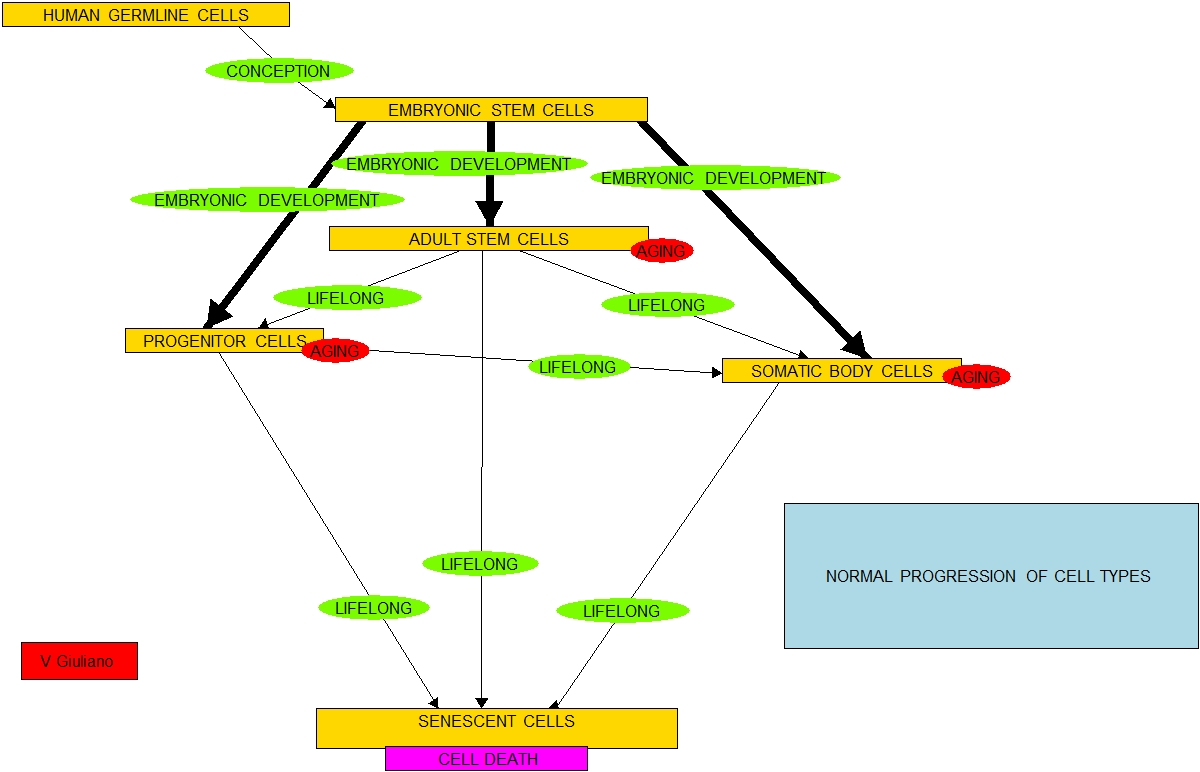
NORMAL CELL TYPE PROGRESSION (SIMPLIFIED)

Normal Progression of Cell Types

The first diagram is a simplified explanation of how cells relate to one another in the course of a normal lifetime. At CONCEPTION of fertilization (upper left corner) the GERMLINE CELLS, sperm from father and egg from mother come together to form an embryo containing at a very early stage EMBRYONIC STEM CELLS. These are pluripotent cells, which means they are capable of eventually differentiating into all of the body’s some 200 different types of cells (blood cells, nerve cells, heart cells, skin cells, etc.). During EMBRYONIC DEVELOPMENT this cell differentiation occurs. In this simplified description three categories of cells are produced: ADULT STEM CELLS, PROGENITOR CELLS and SOMATIC BODY CELLS. These categories of cells will be around the rest of our lives although the specific cells in them will continue to change due to cell division, cell death and, except for adult stem cells, cell replacement.

SOMATIC BODY CELLS for the purpose of this presentation are the working cells of the body: neurons, glia, red blood cells, immune system cells, muscle cells, skin cells, liver cells, thyroid epithelial cells, heart cells, etc. etc. – excluding stem and progenitor cells.

ADULT STEM CELLS can differentiate on an as-needed basis to make replacement SOMATIC BODY CELLS or PROGENITOR CELLS, and they do this throughout a lifetime. ADULT STEM CELLS come in different varieties, such as hematopoietic stem cells which are found in the bone marrow and give rise to all the blood cell types and neural stem cells which give birth to new neurons in the brain and other parts of the body and other related nerve-associated cells like astrocytes and oligodendrocytes. Typically, ADULT STEM CELLS in any category can differentiate into a limited number of target BODY SOMATIC CELL types. They divide like all other cell types and can also morph into PROGENITOR CELLS and SOMATIC BODY CELLS in response to signaling. ADULT STEM CELLS tend to live in stem cell niches which care for them and function like storehouses. Adult stem cells may remain quiescent (non-differentiating although dividing) for substantial periods of time until they are activated by a normal need for more cells to maintain tissues, or by an emergency need induced by disease or tissue injury(ref). The storehouses are always ready to replenish SOMATIC BODY CELLS – that is, as long as a supply of quality ADULT STEM CELLS still exists.

PROGENITOR CELLS are ones intermediate in their range of target differentiation capability between ADULT STEM CELLS and SOMATIC BODY CELLS. They tend to be more specific in what they can differentiate into. For some cell types there is a hierarchy of progenitor cell types and some PROGENITOR CELLS are short-lived intermediates created in the process of differentiation of ADULT STEM CELLS into SOMATIC BODY CELLS. For simplicity of presentation I have shown them as a single box in the diagram although their properties vary widely.

A few factors are important for this discussion:

1.    In us humans and other mammals, renewal of our SOMATIC BODY CELLS through differentiation of ADULT STEM CELLS and PROGENITOR CELLS is required throughout life. In the course of a year, virtually all of our blood cells turn over. If ADULT STEM CELL and PROGENITOR CELL differentiation were to stop, we would soon die. No problem during most of normal life, as long as the stocks of ADULT STEM CELLS and PROGENITOR CELLS are plentiful and the cells are young enough that they will readily differentiate. With advanced aging, those conditions may no longer exist. Disease and death may follow.

2.    Cells in all of these three categories (ADULT STEM CELLS, PROGENITOR CELLS and SOMATIC BODY CELLS) age with progressive cell divisions. That is: a) there are major shifts in their global gene expression patterns ; hundreds if not thousands of genes get upregulated or downregulated, b) their telomeres (caps at the ends of chromosomes) generally get shorter, c) there are multiple changes in the epigenome, i.e. methylation of promoter regions of genes and changes in histone (spools around which DNA is wrapped) acetylation and histone morphology, and d) once a critical number of replications occur the cells become senescent or dysfunctional or destroy themselves or turn cancerous.

3.    With aging ADULT STEM CELLS and PROGENITOR CELLS become less ready to differentiate resulting in the stream of renewal for SOMATIC BODY CELLS slowing down and also the resulting replacement cells being epigenetically older. As cell renewal slows down and the number of senescent cells increases, so does organ renewal slow down or become impaired and disease susceptibility increases. The processes shows up as what we normally call aging and accelerates as the years roll on. Eventually life cannot be sustained and the organism dies.

4.    The process is once-through in nature, as is life as we know it. All our cells age and there is nothing in place to keep them young. Up to this point aging has been absolutely insurmountable. But we may be able to change that.

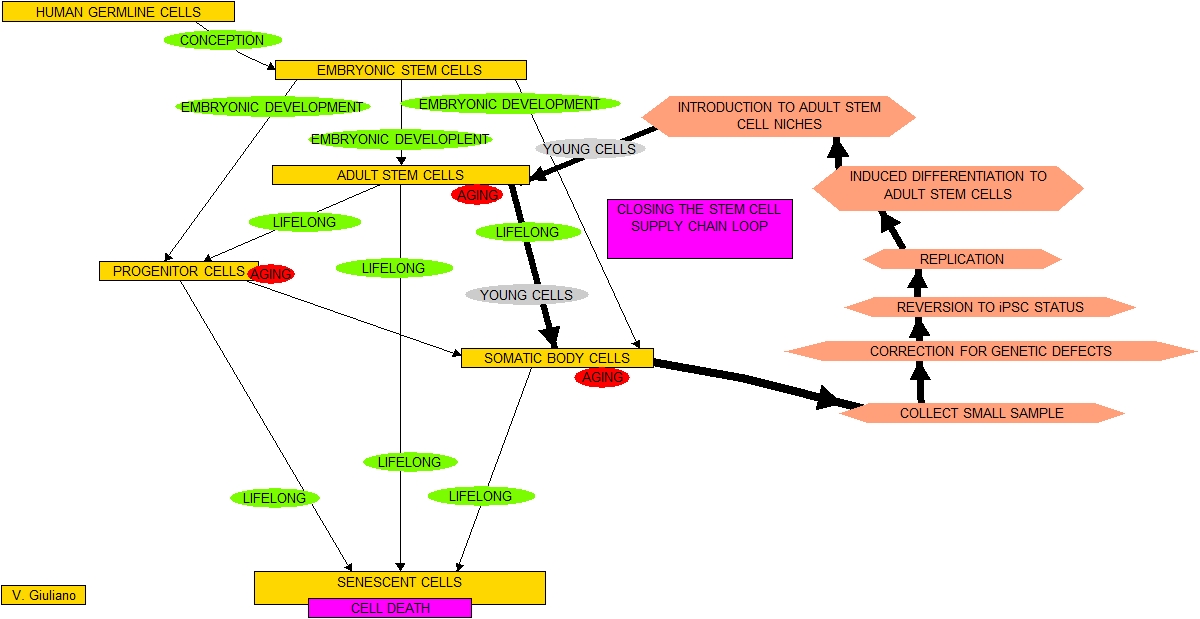
CLOSING THE LOOP IN THE STEM CELL SUPPLY CHAIN

The longevity intervention – closing the loop

The second diagram is the same as the first with additional boxes overlaid and shaded in orange showing the possible longevity intervention. I have described the intervention in previous blog entries(ref)(ref)(ref) but will repeat it here with reference to the diagram.

The first step is to COLLECT A SMALL SAMPLE of SOMATIC BODY CELLS from an individual of any age, perhaps in a drop of blood perhaps in a tiny scraping of skin. All of us have experienced collection of such samples.

The next step is to CORRECT THE COLLECTED CELLS FOR GENETIC DEFECTS. This is now a fairly well-understood procedure(ref)(ref). Any mutated genes that confer disease susceptibilities is snipped out of the DNA and a healthy versions of the same gene is re-inserted in its place. See the blog entry Treating genetic diseases with corrected induced pluripotent stem cells.An option is to perform the last two steps in reverse order. Also, at either stage the number of cells could be multiplied by standard laboratory processes.

The next step is REVERSION TO IPSC STATUS, that is, reversion of the collected corrected cells to being induced pluripotent stem cells. Using one of a number of known approaches, the cells are reverted to being undifferentiated cells that are, apart from correction for damaging genetic mutations, functionally, genetically and immunologically equivalent to the original EMBRYONIC STEM CELLS for the donor of the tissue sample. Reversion to iPSCs is an exciting stream of technology development that has been underway 3-4 years now. See the recent blog entry A breakthrough in producing high-fidelity induced pluripotent stem cells. A key point is that the iPSC cells at this point are young cells like the original EMBRYONIC STEM CELLS. It the reversion job is done right they no longer have any of the markers of aging that were associated with the cells they were made from. This is “the fountain of youth” on the cellular level.

The next step is to INDUCE DIFFERENTIATION INTO ADULT STEM CELLS. Much research has been going on oriented to direction of differentiation of pluripotent cells (hESCs or iPSCs) into specific cell types. Research has shown that such pluripotent cells can be directed to become motor neurons(ref), dopaminergic neuronal subtypes(ref), functional dendritic cells(ref), functional hepatic cells(ref), thyroid follicular cells(ref), chondrocytes(ref), glial, and pancreatic endocrine cells(ref), and many other cell types. While most research has been concerned with direct differentiation into SOMATIC BODY CELLS there should be no barrier in principle to inducing differentiation into ADULT STEM CELL and PROGENITOR CELL types. “The most advanced directed differentiation pathways have been developed for neural cells and cardiac muscle cells, but many other cell types including haematopoietic progenitors, endothelial cells, lung alveoli, keratinocytes, pigmented retinal epithelium, neural crest cells and motor neurones, hepatic progenitors and cells that have some markers of gut tissue and pancreatic cells have been produced(ref).” Note that the thus-derived ADULT STEM CELLS, being derived from young iPSC cells will also be young cells.

The final step of the process is INTRODUCTION INTO ADULT STEM CELL NICHES of these young adult stem cells into the same individual that provided the sample. The idea is to create introduction of each type of ADULT STEM CELL into its respective niches.   I do not know how easy this will be. We do know the places where several types of adult stem cells reside like in bone marrow and in vascular niches. It may be that adult stem cells will more or less know on their own where to go if introduced into the general vicinity of a niche. We do know, for example, that nerve stem cells introduced in the vicinity of damaged nerve tissue will go to that tissue and forthwith start to repair it. An important thing we also know is that the young ADULT STEM CELLS will not generate an immune rejection because they are rejuvenated versions of the original donor’s own cells, immunologically identical. Further research will be required on how best to achieve this step. My intuition says it is achievable.

As can be seen in the diagram, what was a once-through process of aging now is supplemented by a closed-loop process of rejuvenation. The ADULT STEM CELLS introduced in the steps highlighted in orange are young and when they differentiate into SOMATIC BODY CELLS, those cells will by young too. Periodic rejuvenation created by use of this process could be repeated to keep a person young, perhaps if is repeated every ten years. Could the process enable breaking through the historical limit of 123years for human lifespans? Could it enable lifespans of hundreds of years? I don’t know but of all the proposed longevity interventions I am aware of, I think this one provides the best shot.

Every scientist in history has been hampered by not knowing what he does not know, that is, being completely ignorant of and oblivious to important knowledge that emerges later. And, the same is true for me with regard to the longevity intervention I am proposing and what I write. At present I see no reason in principle for why closing the loop in the stem cell supply chain could not work. But the proof will be in the doing. I am optimistic because of the rapid progress I am seeing in the science and practice of each step of the process that I have proposed. Most of the current research on application of iPSCs is in the field of regenerative medicine is aimed at correcting genetic disease-causing defects or at treatment of diseases. While the research is not specifically aimed at longevity, much of the detailed technical knowledge acquired should be applicable to making real the longevity intervention described here.


For research background for closing the loop in the stem cell supply chain as a proposed longevity intervention, please see the November 13, 2010 listing of past blog postings on stem cells and epigenetics.


Posted in Uncategorized | 15 Comments

Policy regarding advertising and promotion in blog comments

I have recently been finding and removing blog comments that are irrelevant to the posting they are associated with and that appear to be thinly-disguised advertising for specific commercial health products or services.  Further, those comments say nothing about the science related to the product or service promoted.  

I ask users not to post such comments and I will remove any I come across.

This is a non-commercial science-oriented blog.  Given the growing readership for this blog, I could probably realize a significant revenue stream from advertising.  However, I have decided to keep the blog non-commercial and that includes comments. This is not about the value of any product or service. It is about the integrity of the blog as a vehicle for scientific communication.

I will, however consider comments responsibly addressing the science behind specific products or services on a case-by-case basis.  I will not consider comments that dismiss the science, for example, by saying “our product strengthens the immune system,” or “supports mitochondrial health”without saying how it does that and citing supporting research literature publications as I do in my blog entries. 

And for the vast majority of you who have generated useful and interesting comments, thank you.

Vince

Posted in Uncategorized | 12 Comments

Telomere lengths, Part 3: Selected current research on telomere-related signaling

This blog entry reviews some recent research topics related to the molecular biology of telomere length homeostasis and to impacts of telomere lengths and cell maturation on health on aging.

This is the third in a 3-part mini-series of blog posts concerned with telomere length topics.  Part1 was concerned with telomere lengths, cancers and disease processesThere I focused on a couple of specific questions: Are shorter telomere lengths predictive of cancers and other disease processes? And, are disease processes or unhealthful body conditions characterized by shorter telomere lengths?  Part2 was concerned with lifestyle, dietary, and other factors associated with telomere shortening and lengthening.  Both of those blog entries reported on population studies and neither were concerned with the molecular biology of telomere formation and telomere impacts on cells as this blog entry is.

Background

It has long been known that uncapped or too-short telomeres can trigger cell senescence or apoptosis and that, with aging, telomeres tend progressively to become shorter.  And some researchers have thought that short telomeres and resulting tissue dysfunctionality might be a main cause of aging.  Again, if you are new to the subject of telomeres and telomerase, I suggest you start with reviewing the discussion of the 12th theory of aging covered in my treatise, Telomere Shortening and Damage.  Also, you may wish to review some of the previous telomere and telomerase-related blog entries listed in the previous blog entry. 

In recent years, there has been an increasing appreciation of the detailed nature of biological changes happening in the process of cell maturation and the negative consequences of too-short telomeres and cell replicative senescence.  Further, there has been discovery that, even short of cell senescence, cell maturation is accompanied by drastic changes in cell gene expression and even restructuring of cell chromatin.  I review selected publications showing important results from 2008 to the latest publication which appeared a few weeks ago.

Better biomarkers are needed for stem and progenitor cells with DNA or telomere damage

The 2008 publication Determining the influence of telomere dysfunction and DNA damage on stem and progenitor cell aging: what markers can we use? relates “The decline in organ maintenance and function is one of the major problems limiting quality of life during aging. The accumulation of telomere dysfunction and DNA damage appears to be one of the underlying causes. Uncapping of chromosome ends in response to critical telomere shortening limits the proliferative capacity of human cells by activation of DNA damage checkpoints inducing senescence or apoptosis. Telomere shortening occurs in the vast majority of human tissues during aging and in chronic diseases that increase the rate of cell turnover. There is emerging evidence that telomere shortening can limit the maintenance and function of adult stem cells — a cell type of utmost importance for organ maintenance and regeneration. In mouse models, telomere dysfunction leads to a depletion of adult stem cell compartments suggesting that stem cells are very sensitive to DNA damage. Both the rarity of stem and progenitor cells in adult organs and their removal in response to damage make it difficult to assess the impact of telomere dysfunction and DNA damage on stem and progenitor cell aging. Such approaches require the development of sensitive biomarkers recognizing low levels of telomere dysfunction and DNA damage in stem and progenitor cells. “

Circulating proteins are associated with short telomeres and DNA damage

The 2008 publication  Proteins induced by telomere dysfunction and DNA damage represent biomarkers of human aging and disease reports the existence of circulating proteins that are created by dysfunctional telomeres and that can serve as biomarkers.  “Telomere dysfunction limits the proliferative capacity of human cells by activation of DNA damage responses, inducing senescence or apoptosis. In humans, telomere shortening occurs in the vast majority of tissues during aging, and telomere shortening is accelerated in chronic diseases that increase the rate of cell turnover. Yet, the functional role of telomere dysfunction and DNA damage in human aging and diseases remains under debate. Here, we identified marker proteins (i.e., CRAMP, stathmin, EF-1alpha, and chitinase) that are secreted from telomere-dysfunctional bone-marrow cells of late generation telomerase knockout mice (G4mTerc(-/-)). The expression levels of these proteins increase in blood and in various tissues of aging G4mTerc(-/-) mice but not in aging mice with long telomere reserves. Orthologs of these proteins are up-regulated in late-passage presenescent human fibroblasts and in early passage human cells in response to gamma-irradiation. The study shows that the expression level of these marker proteins increases in the blood plasma of aging humans and shows a further increase in geriatric patients with aging-associated diseases. Moreover, there was a significant increase in the expression of the biomarkers in the blood plasma of patients with chronic diseases that are associated with increased rates of cell turnover and telomere shortening, such as cirrhosis and myelodysplastic syndromes (MDS). Analysis of blinded test samples validated the effectiveness of the biomarkers to discriminate between young and old, and between disease groups (MDS, cirrhosis) and healthy controls. These results support the concept that telomere dysfunction and DNA damage are interconnected pathways that are activated during human aging and disease.”

Stem and progenitor cells are subject to replicative senescence and express very different genes when young and old, but not due to telomere erosion

The 2009 publication Aging and Replicative Senescence Have Related Effects on Human Stem and Progenitor Cells is important in that a) it established that at least some stem cells are subject to replicative senescence, b) gene expression patterns of young and old stem cells vary drastically with age, and that c) telomere erosion does not appear to be responsible for the differences in gene expression of old and younger stem cells.  The research looked at the gene-expression effects of replicative senescence on mesenchymal stromal cells (MSC) and human hematopoietic progenitor cells (HPC)  and compared these to the gene-expression effects found in in-vivo aging.  It found the effects to be similar, suggesting that stem and progenitor cells are subject to replicative senescence, just as other types of body cells are.  Further, at least in HPCs, telomere erosion does not appear to be well-correlated with aging. 

The publication reports “The regenerative potential diminishes with age and this has been ascribed to functional impairments of adult stem cells. Cells in culture undergo senescence after a certain number of cell divisions whereby the cells enlarge and finally stop proliferation. This observation of replicative senescence has been extrapolated to somatic stem cells in vivo and might reflect the aging process of the whole organism. In this study we have analyzed the effect of aging on gene expression profiles of human mesenchymal stromal cells (MSC) and human hematopoietic progenitor cells (HPC). MSC were isolated from bone marrow of donors between 21 and 92 years old. 67 genes were age-induced and 60 were age-repressed. HPC were isolated from cord blood or from mobilized peripheral blood of donors between 27 and 73 years and 432 genes were age-induced and 495 were age-repressed. The overlap of age-associated differential gene expression in HPC and MSC was moderate. However, it was striking that several age-related gene expression changes in both MSC and HPC were also differentially expressed upon replicative senescence of MSC in vitro. Especially genes involved in genomic integrity and regulation of transcription were age-repressed. Although telomerase activity and telomere length varied in HPC particularly from older donors, an age-dependent decline was not significant arguing against telomere exhaustion as being causal for the aging phenotype. These studies have demonstrated that aging causes gene expression changes in human MSC and HPC that vary between the two different cell types. Changes upon aging of MSC and HPC are related to those of replicative senescence of MSC in vitro and this indicates that our stem and progenitor cells undergo a similar process also in vivo.”

The discussion in this same document related to the impact of telomere lengths on aging is telling.  “Progressive shortening of the telomeres or modified telomeric structures have been discussed to be the main trigger for replicative senescence and it has been anticipated that telomere shortening provides an internal clock. With every cell division the number of telomere repeats decreases and this has also been demonstrated for MSC [12], [14]. The process is counteracted by expression of telomerase in somatic stem cells [49], [50]. This is in line with our results where telomerase activity was detected in HPC. Vaziri et al. have demonstrated that CD34+CD38− HPC from human bone marrow have shorter telomeres than those from fetal liver or cord blood [51]. In this study telomere length decreased only slightly upon aging and we did not detect subpopulations with very short telomeres or signs of telomere dysfunction (uncapped telomeres) in any of the samples.1 Hence, it is unlikely that age-induced gene expression changes in HPC are only due to telomere loss. Though discussed controversially, our data rather support studies by others that telomere shortening may not be the only reason for replicative senescence in hematopoietic cells in vivo [40], [52][54].”  Telomere lengths by themselves are only partial and possibly poor indicators of all the changes that go on in cells with progressive aging and better biomarkers like age-related proteins are becoming available.

Chromatin stress and epigenetic changes triggered by telomeres in the process of cell aging

Another important contribution to the picture of how cell senescence affects aging is provided by the October 2010 publication Reduced histone biosynthesis and chromatin changes arising from a damage signal at telomeres.  During replicative aging of primary cells morphological transformations occur, the expression pattern is altered and chromatin changes globally. Here we show that chronic damage signals, probably caused by telomere processing, affect expression of histones and lead to their depletion. We investigated the abundance and cell cycle expression of histones and histone chaperones and found defects in histone biosynthesis during replicative aging. Simultaneously, epigenetic marks were redistributed across the phases of the cell cycle and the DNA damage response (DDR) machinery was activated. The age-dependent reprogramming affected telomeric chromatin itself, which was progressively destabilized, leading to a boost of the telomere-associated DDR with each successive cell cycle.”  

This same publication puts forward an important new concept: “We propose a mechanism in which changes in the structural and epigenetic integrity of telomeres affect core histones and their chaperones, enforcing a self-perpetuating pathway of global epigenetic changes that ultimately leads to senescence.”  Histones, we recall, are the spindles around which DNA is wrapped, and chaperones are “are proteins that assist the non-covalent folding or unfolding and the assembly or disassembly of other macromolecular structures.” in this case the chaperones are ones that assist folding of DNA in histone structures, HSP90 being a main one discussed below.  

A recent Science Daily article contains information from an interview with one off the publication’s authors and explains the importance of the research behind thepublication.  In a study published in the Oct. 3, 2010, issue of Nature Structural and Molecular Biology, a team led by Jan Karlseder, Ph.D., at the Salk Institute for Biological Studies reports that as cells count down to senescence and telomeres wear down, their DNA undergoes massive changes in the way it is packaged. These changes likely trigger what we call “aging”. — “Prior to this study we knew that telomeres get shorter and shorter as a cell divides and that when they reach a critical length, cells stop dividing or die,” said Karlseder, an associate professor in the Molecular and Cell Biology Laboratory. “Something must translate the local signal at chromosome ends into a huge signal felt throughout the nucleus. But there was a big gap in between.” — Karlseder and postdoctoral fellow Roddy O’Sullivan, Ph.D., began to close the gap by comparing levels of proteins called histones in young cells-cells that had divided 30 times-with “late middle-aged” cells, which had divided 75 times and were on the downward slide to senescence, which occurs at 85 divisions. Histone proteins bind linear DNA strands and compress them into nuclear complexes, collectively referred to as chromatin. —  Karlseder and O’Sullivan found that aging cells simply made less histone protein than do young cells. “We were surprised to find that histone levels decreased as cells aged,” said O’Sullivan, the study’s first author. “These proteins are required throughout the genome, and therefore any event that disrupts this production line affects the stability of the entire genome.” — The team then undertook exhaustive “time-lapse” comparisons of histones in young versus aging cells and confirmed that marked differences in the abundance and variety of histones were evident at every step as cells moved through cell division. — O’Sullivan calls the “default” histone pattern displayed by young cells “happy, healthy chromatin.” By contrast, he says, aging cells appear to undergo stress as they duplicate their chromosomes in preparation for cell division and have difficulty restoring a “healthy” chromatin pattern once division is complete. — Comparisons of histone patterns in cells taken from human subjects-a 9- versus a 92-year-old-dramatically mirrored histone trends seen in cell lines. “These key experiments suggest that what we observe in cultured cells in a laboratory setting actually occurs and is relevant to aging in a population,” says Karlseder. The initiation of diseases associated with aging, such as cancer, is largely attributed to DNA, or genetic, damage. But this study suggests that aging itself is infinitely complex: that progressive telomere shortening hastens chromosomal aging by changing the way genes entwine with histones, so-called “epigenetic” changes. How DNA interacts with histones has enormous impact on whether genes are expressed-hence the current intense interest in the relationship of the epigenomic landscape to disease states. — Rescue experiments in which the team cosmetically enhanced aging cells confirmed that signals emitted by eroding telomeres drove epigenetic changes. When aging cells were engineered to express telomerase, the enzyme that restores and extends stubby telomeres, those rejuvenated cells showed histone levels reminiscent of “happy, healthy chromatin,” and a partial return to a youthful chromatin profile.”

Role of chaperone proteins in telomere activation

The biology of telomere shortening and lengthening is a very complex topic .  “As telomere dysfunction has been associated with ageing and developing cancer, understanding the exact mechanisms regulating telomere structure and function is essential for the prevention and treatment of human cancers and age-related diseases. The mechanisms by which cells maintain telomere lengthening involve either telomerase or the alternative lengthening of the telomere pathway, although specific mechanisms of the latter and the relationship between the two are as yet unknown. Many cellular factors directly (TRF1/TRF2) and indirectly (shelterin-complex, PinX, Apollo and tankyrase) interact with telomeres, and their interplay influences telomere structure and function(ref).”  . I focus on one special topic here, the role of chaperone proteins HSP90 and p23.    

Back in 1999, the publication Functional requirement of p23 and Hsp90 in telomerase complexes reported “Here we show that assembly of active telomerase from in vitro-synthesized components requires the contribution of proteins present in reticulocyte extracts. We have identified the molecular chaperones p23 and Hsp90 as proteins that bind to the catalytic subunit of telomerase. Blockade of this interaction inhibits assembly of active telomerase in vitro. Also, a significant fraction of active telomerase from cell extracts is associated with p23 and Hsp90. Consistent with in vitro results, inhibition of Hsp90 function in cells blocks assembly of active telomerase.” 

The 2001 publication Stable association of hsp90 and p23, but Not hsp70, with active human telomerase reported “We have previously found two additional components of the telomerase holoenzyme, the chaperones p23 and heat shock protein (hsp) 90, both of which are required for efficient telomerase assembly in vitro and in vivo. Both hsp90 and p23 bind specifically to hTERT and influence its proper assembly with the template RNA, hTR. We report here that the hsp70 chaperone also associates with hTERT in the absence of hTR and dissociates when telomerase is folded into its active state, similar to what occurs with other chaperone targets. Our data also indicate that hsp90 and p23 remain associated with functional telomerase complexes, which differs from other hsp90-folded enzymes that require only a transient hsp90.p23 binding. Our data suggest that components of the hsp90 chaperone complex, while required for telomerase assembly, remain associated with active enzyme, which may ultimately provide critical insight into the biochemical properties of telomerase assembly.” 

About five years ago it was noticed that inhibition of the heat shock protein HSP90 in human tumor cells led to telomere erosion in those cells.  As reported in the 2006 publication Induction of nitric oxide synthase-dependent telomere shortening after functional inhibition of Hsp90 in human tumor cells, “ — we observe significant DNA damage assessed by telomere dysfunction, although in the absence of a classical DNA damage response. Overall, our data suggest a novel mechanism whereby inhibition of Hsp90 disrupts free radical homeostasis and contributes directly to telomere erosion, further implicating Hsp90 as a potential therapeutic target for cancer cells.”   

As time progressed, interest grew in the possibility of control of cancers via HSP90 modulation such as outlined in the 2009 publication To fold or not to fold: modulation and consequences of Hsp90 inhibition.  HSP90 affects folding in additional protein substrates besides hTERT, including for example proteins having to do with neural differentiation(ref). “Many of the Hsp90-dependent client proteins are associated with cellular growth and survival and, consequently, inhibition of Hsp90 represents a promising approach for the treatment of cancer. Conversely, stimulation of heat-shock protein levels has potential therapeutic applications for the treatment of neurodegenerative diseases that result from misfolded and aggregated proteins. — Hsp90 modulation exhibits the potential to treat unrelated disease states, from cancer to neurodegenerative diseases, and, thus, to fold or not to fold, becomes a question of great value.”

As if the situation was not already complicated enough, a substance called CHIP is involved along with HSP90 and p23 in telomere length regulation.  An October 19 2010 publication CHIP promotes hTERT degradation and negatively regulates telomerase activity relates “The maintenance of eukaryotic telomeres requires telomerase, which is minimally comprised of a telomerase reverse transcriptase (TERT) and an associated RNA component (TERC). Telomerase activity is tightly regulated by expression of hTERT at both the transcriptional and posttranslational levels. The Hsp90 and p23 molecular chaperones have been shown to associate with hTERT for the assembly of active telomerase. Here we show that CHIP (C terminus of Hsc70-interacting protein) physically associates with hTERT in the cytoplasm and regulates the cellular abundance of hTERT through an ubiquitin-mediated degradation. Overexpression of CHIP prevents nuclear translocation of hTERT and promotes hTERT degradation in the cytoplasm, thereby inhibiting telomerase activity. In contrast, knockdown of endogenous CHIP results in the stabilization of cytoplasmic hTERT. However, it does not affect the level of nuclear hTERT and has no effect on telomerase activity and telomere length. We further show that the binding of CHIP and Hsp70 to hTERT inhibits nuclear translocation of hTERT by dissociating p23. However, Hsp90 binding to hTERT was not affected by CHIP overexpression. These results suggest that CHIP can remodel the hTERT-chaperone complexes. Finally, the amount of hTERT associated with CHIP peaks in G2/M phases but decreases during S phase, suggesting a cell cycle-dependent regulation of hTERT.”

TERRA RNA binding

The 2009 publication TERRA RNA Binding to TRF2 Facilitates Heterochromatin Formation and ORC Recruitment at Telomeres is one of several recent publications illustrating the wheels-within-wheels complexity of telomere formation and maintenance.  “Telomere-repeat-encoding RNA (referred to as TERRA) has been identified as a potential component of yeast and mammalian telomeres. We show here that TERRA RNA interacts with several telomere-associated proteins, including telomere repeat factors 1 (TRF1) and 2 (TRF2), subunits of the origin recognition complex (ORC), heterochromatin protein 1 (HP1), histone H3 trimethyl K9 (H3 K9me3), and members of the DNA-damage-sensing pathway. siRNA depletion of TERRA caused an increase in telomere dysfunction-induced foci, aberrations in metaphase telomeres, and a loss of histone H3 K9me3 and ORC at telomere repeat DNA. Previous studies found that TRF2 amino-terminal GAR domain recruited ORC to telomeres. We now show that TERRA RNA can interact directly with the TRF2 GAR and ORC1 to form a stable ternary complex. We conclude that TERRA facilitates TRF2 interaction with ORC and plays a central role in telomere structural maintenance and heterochromatin formation.” 

Mechanism of action of curcumin on cancers

For those of you who are supplement buffs and take curcumin, the molecular mechanisms described above provide a neat explanation for a long-observed effect, the anti-cancer actions of curcumin.  The title of the 2010 publication Curcumin inhibits nuclear localization of telomerase by dissociating the Hsp90 co-chaperone p23 from hTERT contains the main message.  “Here we demonstrate that curcumin inhibits telomerase activity in a time- and dose-dependent manner by decreasing the level of hTERT expression. Following curcumin treatment, we observed a clear accumulation of hTERT in the cytoplasmic compartment of the cell. The curcumin-induced cytoplasmic retention of hTERT could be due to failure of nuclear import, and the resulting cytoplasmic hTERT protein was rapidly ubiquitinated and degraded by the proteasome. We also report that curcumin treatment results in a substantial decrease in association of p23 and hTERT but does not affect the Hsp90 binding to hTERT. In contrast, the treatment of the Hsp90 inhibitor geldanamycin promotes dissociation of both Hsp90 and p23 proteins from hTERT. Taken together, these results demonstrate that the interaction of the Hsp90-p23 complex with hTERT is critical for regulation of the nuclear localization of telomerase, and that down-regulation of hTERT by curcumin involves dissociating the binding of hTERT with p23. Thus, inhibition of nuclear translocation of hTERT by curcumin may provide new perspectives for regulation of telomerase activity during tumorigenic progression.” 

I am pleased to have this explanation as an addendum of the discussion in my blog entry Curcumin, cancer and longevity.   But I am not happy with at least one implication of the explanation which is that taking curcumin supplements may result in having shorter telomeres than otherwise.  I am uneasily left with a couple of key questions:

·        Is downregulation of hTERT the primary mechanism through which curcumin combats cancers?  The 2009 publication Curcumin and Cancer Cells: How Many Ways Can Curry Kill Tumor Cells Selectively? States “How curcumin kills tumor cells is the focus of this review. We show that curcumin modulates growth of tumor cells through regulation of multiple cell signaling pathways including cell proliferation pathway (cyclin D1, c-myc), cell survival pathway (Bcl-2, Bcl-xL, cFLIP, XIAP, c-IAP1), caspase activation pathway (caspase-8, 3, 9), tumor suppressor pathway (p53, p21) death receptor pathway (DR4, DR5), mitochondrial pathways, and protein kinase pathway (JNK, Akt, and AMPK). How curcumin selectively kills tumor cells, and not normal cells, is also described in detail.”  How important is hTERT downregulation compared to those other pathways when it comes to curcumin controlling cancers?  Is the inhibition of hTERT an upstream or downstream event?

·        Does taking curcumin as a supplement not only help ward off cancers but also inhibit telomerase expression and therefore results in my telomeres being shorter than what they would be?  In other words does taking curcumin as a supplement have both an anti-cancer and pro-aging effect?  If so, what is the detailed nature of the tradeoff?  

Wrapping it all up 

Some key observations based on the research cited above: 

·        Aging and eventual senescence associated with cell replication applies to certain (I suspect, all) adult stem and progenitor cells as well as to normal functional somatic cells. 

·        As cells pass through their lifecycle of successive divisions they progressively change in multiple ways: a) in gene expression profiles, b) in the expression of multiple age-related proteins, c) in the abundance and variety of histones, d)  in telomere lengths, and e) in possible other epigenetic markers. 

·        I remind readers of a November 2009 Blog entry breakthrough telomere research finding that links telomere shortening to another of the key theories of aging, Programmed Epigenomic Changes. “Telomeric shortening at some point induces DNA damage which lets loose signaling which changes the epigenome disrupting epigenetic silencing and resulting in pro-aging global DNA expression.”

·        These changes can affect each other in complex ways.  The statement that “telomere length is the key biomarker clock of aging” is far too simplistic.  Telomere length is not the be-all and end-all of cellular aging.  And as a biomarker by itself, it can be tricky.

·        Telomere length homeostasis is a devilishly complex topic and we are just starting to sort out all the factors and interactions involved.  CHIP, HSP90 and p23 get added to TRF1/TRF2, shelterin-complex, PinX, Apollo, TERRA, ORC, HP1,  H3 K9me3 and tankyrase as factors involved in telomerase extension/shortening.  And of course a host of lifestyle and dietary measures are involved.  Gone are the old days of simple thinking “Want longer telomeres?  Just activate your telomerase gene.”

·        Taking curcumin as a supplement could involve an anti-cancer pro- telomeric-aging tradeoff.  This needs further study.

·        I see the above discussion as supportive of some of my favorite longevity concepts, namely:

o   aging involves a systematic process of choreographed epigenetic changes and is not simply the accumulated product of random damaging events,

o   adult stem cells are needed for tissue renewal but they themselves age and  require renewal, and

o   long-term strategies for extended longevity are a) focus on making the stem cell supply chain into a closed-loop process(ref)(ref) and b) discovery of how to generate systematic modifications of cell chromatin to restore earlier epigenetic states(ref).

Posted in Uncategorized | 13 Comments

Telomere lengths, Part 2: Lifestyle, dietary, and other factors associated with telomere shortening and lengthening

This blog entry provides an update on 2010 research relating to how certain everyday factors such as lifestyle, exercise and diet affect telomere lengths. 

This is the second in a 3-part mini-series of blog posts concerned with the implications of telomere lengths.  Part1 was concerned with telomere lengths, cancers and disease processes.  There I focused on a couple of specific questions: Are shorter telomere lengths predictive of cancers and other disease processes? And, are disease processes or unhealthful body conditions characterized by shorter telomere lengths?    I have also produced a Part 3 post concerned with the molecular biology of telomere length management focused on such subjects as the role of HSP-90 and P23 in regulation of telomere lengthening by telomerase.  That post will also state some of my views of the implications of telomere-related knowledge for healthy aging.

Background

If you are new to the subject of telomeres and telomerase, I suggest you start with the telomere/telomerase discussion in my treatise.    The discussion there provides background on telomeres, telomere shortening and lengthening, and the importance of telomere biology for aging.  I have also published a number of blog posts that provide much additional background including:

·        Stress, exercise and telomere lengths

·        Telomerase activators – what do they really do?

·        Vitamins, supplements and telomerase – upregulation or downregulation?

·        Exercise, telomerase and telomeres

·        Timely telomerase tidbits

·        Extra-telomeric benefits of telomerase – good news for telomerase activators

·        Telomere and telomerase writings

·        Revisiting telomere shortening yet-agai

·        More telomerase tidbits

·        You may be able to keep your telomeres long

The purpose of this current blog post is to cover some selected 2010 research not already discussed in my treatise or in the above blog entries.  I also weigh in with opinions on a few key points.

Telomere lengths and processed meats

It is possible to couple the results of two studies related to processed meats to see some interesting relationships.  The first such study is described in a 2010 publication published in Circulation, a journal of the American Heart Association Red and Processed Meat Consumption and Risk of Incident Coronary Heart Disease, Stroke, and Diabetes Mellitus.  This study is a meta-analysis of studies relating red and processed meat to CHD (coronary heart disease), stroke, and diabetes mellitus. Background— Meat consumption is inconsistently associated with development of coronary heart disease (CHD), stroke, and diabetes mellitus, limiting quantitative recommendations for consumption levels. Effects of meat intake on these different outcomes, as well as of red versus processed meat, may also vary.Methods and Results— We performed a systematic review and meta-analysis of evidence for relationships of red (unprocessed), processed, and total meat consumption with incident CHD, stroke, and diabetes mellitus. We searched for any cohort study, case-control study, or randomized trial that assessed these exposures and outcomes in generally healthy adults. Of 1598 identified abstracts, 20 studies met inclusion criteria, including 17 prospective cohorts and 3 case-control studies. All data were abstracted independently in duplicate. Random-effects generalized least squares models for trend estimation were used to derive pooled dose-response estimates. The 20 studies included 1 218 380 individuals and 23 889 CHD, 2280 stroke, and 10 797 diabetes mellitus cases. Red meat intake was not associated with CHD (n=4 studies; relative risk per 100-g serving per day=1.00; 95% confidence interval, 0.81 to 1.23; P for heterogeneity=0.36) or diabetes mellitus (n=5; relative risk=1.16; 95% confidence interval, 0.92 to 1.46; P=0.25). Conversely, processed meat intake was associated with 42% higher risk of CHD (n=5; relative risk per 50-g serving per day=1.42; 95% confidence interval, 1.07 to 1.89; P=0.04) and 19% higher risk of diabetes mellitus (n=7; relative risk=1.19; 95% confidence interval, 1.11 to 1.27; P<0.001). Associations were intermediate for total meat intake. Consumption of red and processed meat were not associated with stroke, but only 3 studies evaluated these relationships.Conclusions Consumption of processed meats, but not red meats, is associated with higher incidence of CHD and diabetes mellitus. These results highlight the need for better understanding of potential mechanisms of effects and for particular focus on processed meats for dietary and policy recommendations.”

The second study (2008) looks at telomere lengths as related to kinds of food intake Dietary patterns, food groups, and telomere length in the Multi-Ethnic Study of Atherosclerosis (MESA).  Objective: With data from 840 white, black, and Hispanic adults from the Multi-Ethnic Study of Atherosclerosis, we studied cross-sectional associations between telomere length and dietary patterns and foods and beverages that were associated with markers of inflammation.Design: Leukocyte telomere length was measured by quantitative polymerase chain reaction. Length was calculated as the amount of telomeric DNA (T) divided by the amount of a single-copy control DNA (S) (T/S ratio). Intake of whole grains, fruit and vegetables, low-fat dairy, nuts or seeds, nonfried fish, coffee, refined grains, fried foods, red meat, processed meat, and sugar-sweetened soda were computed with responses to a 120-item food-frequency questionnaire completed at baseline. Scores on 2 previously defined empirical dietary patterns were also computed for each participant.   Results: After adjustment for age, other demographics, lifestyle factors, and intakes of other foods or beverages, only processed meat intake was associated with telomere length. For every 1 serving/d greater intake of processed meat, the T/S ratio was 0.07 smaller (β ± SE: –0.07 ± 0.03, P = 0.006). Categorical analysis showed that participants consuming 1 serving of processed meat each week had 0.017 smaller T/S ratios than did nonconsumers. Other foods or beverages and the 2 dietary patterns were not associated with telomere length.  Conclusions: Processed meat intake showed an expected inverse association with telomere length, but other diet features did not show their expected associations.

So, together the two studies say:

·        Consumption of processed meat correlates with both shorter telomere lengths and increased susceptibility to CHD and diabetes mellitus.  Neither of these correlations exist for consumption of red meat.

·        Of a number of possibly not-good-for-you foods like sugar-sweetened soda, only consumption of processed meats was correlated with shorter telomeres.

·        Causal chain is unclear, e.g. whether eating processed meats leads to shorter telomeres which leads to increased disease susceptibilities or whether eating processed meats leads to disease susceptibilities which lead to shorter telomeres, or both or neither.

From a health and longevity perspective the two studies combine fairly powerfully to contraindicate eating processed meats, foods which have long been suspected to be carcinogenic because they tend to be infused with nitrites(ref).

Telomere lengths, dietary and lifestyle factors in middle-aged and older women

The 2010 publication Associations between diet, lifestyle factors, and telomere length in women reports “Background: Leukocyte telomere length is associated with diseases of aging, but there is limited knowledge of diet and lifestyle determinants.  Objective: The objective was to examine cross-sectionally the association between diet, body composition, and lifestyle factors on leukocyte telomere length in women.Design: Leukocyte telomere length was measured by quantitative polymerase chain reaction in 2284 female participants from the Nurses’ Health Study, who were selected as controls for an investigation of biological predictors of cancer. Diet, lifestyle, and anthropometric data were assessed by questionnaire.  Results: After multivariate adjustment, dietary fiber intake was positively associated with telomere length (z score), specifically cereal fiber, with an increase of 0.19 units between the lowest and highest quintiles (P = 0.007, P for trend = 0.03). Although total fat intake was not associated with telomere length, polyunsaturated fatty acid intake (–0.26 units, quintile 5 compared with quintile 1: P = 0.002, P for trend = 0.02), specifically linoleic acid intake, was inversely associated with telomere length after multivariate adjustment (–0.32 units; P = 0.001, P for trend = 0.05). Waist circumference was inversely associated with telomere length [0.15-unit difference in z score in a comparison of the highest ( 32 in, 81.28 cm) with the lowest ( 28 in, 71.12 cm) category (P = 0.01, P for trend = 0.02) in the multivariate model]. We found no association between telomere length and smoking, physical activity, or postmenopausal hormone use.  Conclusion: Although the strength of the associations was modest in this population of middle- and older-age women, our results support the hypothesis that body composition and dietary factors are related to leukocyte telomere length, which is a potential biomarker of chronic disease risk.”

I find the dietary associations with telomere lengths  in this study of women to be not at all surprising.   However, the assertions in the statement  We found no association between telomere length and smoking, physical activity, or postmenopausal hormone use” are surprising though they indeed may represent the data at hand.  Other well-designed studies have come up with contradictory conclusions: 

·        With respect to smoking, the 2005 publication Obesity, cigarette smoking, and telomere length in women found, for a sample of 1122 white women aged 18-76 years “A dose-dependent relation with smoking was recorded (p=0.017), and each pack-year smoked was equivalent to an additional 5 bp of telomere length lost (18%) compared with the rate in the overall cohort.”  This study, incidentally, also correlated obesity with shorter telomeres.  Telomeres of obese women were 240 bp shorter than those of lean women (p=0.026).” —  . Our results emphasize the pro-ageing effects of obesity and cigarette smoking.”  Other studies also support a strong correlation between cigarette smoking and telomere erosion.  The 2008 study Telomere Length, Cigarette Smoking, and Bladder Cancer Risk in Men and Women reports “We also observed a significant difference in telomere length across categories of pack-years of smoking (P = 0.01).”

·        With regard to exercise, in the blog entry Stress, exercise and telomere lengths I discuss a small research study that indicates that women who are under psychological stress and who participate in moderate exercise find the telomere-shortening effect of the stress nullified.  As predicted, among non-exercisers a one unit increase in the Perceived Stress Scale was related to a 15-fold increase in the odds of having short telomeres (p<.05), whereas in exercisers, perceived stress appears to be unrelated to TL (B = −.59, SE = .78, p = .45).”  This was a relatively small (63 healthy post-menopausal women aged between 54 and 82) and short (3 days) study using a self-evaluation 10-item questionnaire to measure psychological stress.  Nonetheless the implication is most interesting: exercise can nullify erosion in telomere lengths due to psychological stress.”

·        With respect to postmenopausal hormone use, again we seem to have a contradiction, this time as exemplified by the 2005 publication Effect of Long-Term Hormone Therapy on Telomere Length in Postmenopausal Women.  “Relative telomere length ratios in the HT group (65 women who had been on estrogen and progesterone therapy for more than five years) were significantly greater than those in the non-HT group (p<0.01). HT was significantly correlated with the relative telomere length ratio in multivariate analysis when potential confounding variables were controlled for (p<0.05). In conclusion, telomere lengths were longer in postmenopausal women who had a history of long-term HT than in postmenopausal women without HT. Long-term HT in postmenopausal women may alleviate telomere attrition.”

Telomere lengths in coronary heart disease patients as associated with Omega-3 fatty acid levels. 

The 2010 JAMA publication Association of Marine Omega-3 Fatty Acid Levels With Telomeric Aging in Patients With Coronary Heart Disease reports on a special population but comes to what I believe is a generally-valid conclusion.  Context:  Increased dietary intake of marine omega-3 fatty acids is associated with prolonged survival in patients with coronary heart disease. However, the mechanisms underlying this protective effect are poorly understood. – Objective:  To investigate the association of omega-3 fatty acid blood levels with temporal changes in telomere length, an emerging marker of biological age. — Design, Setting, and Participants:  Prospective cohort study of 608 ambulatory outpatients in California with stable coronary artery disease recruited from the Heart and Soul Study between September 2000 and December 2002 and followed up to January 2009 (median, 6.0 years; range, 5.0-8.1 years). — Main Outcome Measures:  We measured leukocyte telomere length at baseline and again after 5 years of follow-up. Multivariable linear and logistic regression models were used to investigate the association of baseline levels of omega-3 fatty acids (docosahexaenoic acid [DHA] and eicosapentaenoic acid [EPA]) with subsequent change in telomere length.  Results:  Individuals in the lowest quartile of DHA+EPA experienced the fastest rate of telomere shortening (0.13 telomere-to-single-copy gene ratio [T/S] units over 5 years; 95% confidence interval [CI], 0.09-0.17), whereas those in the highest quartile experienced the slowest rate of telomere shortening (0.05 T/S units over 5 years; 95% CI, 0.02-0.08; P < .001 for linear trend across quartiles). Levels of DHA+EPA were associated with less telomere shortening before (unadjusted β coefficient x 10–3 = 0.06; 95% CI, 0.02-0.10) and after (adjusted β coefficient x 10–3 = 0.05; 95% CI, 0.01-0.08) sequential adjustment for established risk factors and potential confounders. Each 1-SD increase in DHA+EPA levels was associated with a 32% reduction in the odds of telomere shortening (adjusted odds ratio, 0.68; 95% CI, 0.47-0.98). – Conclusion:  Among this cohort of patients with coronary artery disease, there was an inverse relationship between baseline blood levels of marine omega-3 fatty acids and the rate of telomere shortening over 5 years.”  I suspect this conclusion generalizes beyond CHD patients.

Telomere lengths and marital status

I am getting fairly good at predicting the outcomes of telomere length studies just from the titles of the studies.  An example is the October 2010 study Leukocyte telomere length and marital status among middle-aged adults.  My reasoning is “of course telomere lengths will generally be longer in married people, because they on the whole are probably less stressed.”  The study reports: “Background: being unmarried is associated with worse health and increased mortality risk. Telomere length has emerged as a marker for biological ageing but it is unclear how telomere length relates to marital status.   Objective: to examine the relationship between telomere length and marital status in a sample of middle-aged adults. Design and subjects: cross-sectional analysis among 321 adults aged 40-64 years. — Methods: telomere length was measured by PCR (T/S ratio). Participants provided information on healthy lifestyle activities including smoking, alcohol use, diet, exercise, obesity as well as social support. — Results: participants married or living with a partner had a mean T/S ratio of 1.70 and those widowed, divorced, separated or never married had a mean T/S ratio of 1.58 in a model adjusted for age, gender and race/ethnicity (P < 0.001). When the analysis was further adjusted for diet, alcohol consumption, exercise, smoking, social support, poverty and obesity, persons married or living with a partner had a higher mean T/S ratio of 1.69 than their unmarried counterparts (1.59) (P = 0.004). — Conclusions: these results indicate that unmarried individuals have shorter telomeres. This relationship between marital status and telomere length is independent of presumed benefits of marriage such as social support and a healthier lifestyle.”  OK.  No surprise here.

Telomere length, lifestyle and risk of coronary atherosclerosis

The September 2010 publication Effect of healthy lifestyle behaviors on the association between leukocyte telomere length and coronary artery calcium offers a somewhat more subtle message.  “The telomere length is an indicator of biologic aging, and shorter telomeres have been associated with coronary artery calcium (CAC), a validated indicator of coronary atherosclerosis. It is unclear, however, whether healthy lifestyle behaviors affect the relation between telomere length and CAC. In a sample of subjects aged 40 to 64 years with no previous diagnosis of coronary heart disease, stroke, diabetes mellitus, or cancer (n = 318), healthy lifestyle behaviors of greater fruit and vegetable consumption, lower meat consumption, exercise, being at a healthy weight, and the presence of social support were examined to determine whether they attenuated the association between a shorter telomere length and the presence of CAC. Logistic regression analyses controlling for age, gender, race/ethnicity, and Framingham risk score revealed that the relation between having shorter telomeres and the presence of CAC was attenuated in the presence of high social support, low meat consumption, and high fruit and vegetable consumption. Those with shorter telomeres and these characteristics were not significantly different from those with longer telomeres. Conversely, the subjects with shorter telomeres and less healthy lifestyles had a significantly increased risk of the presence of CAC: low fruit and vegetable consumption (odds ratio 3.30, 95% confidence interval 1.61 to 6.75), high meat consumption (odds ratio 3.33, 95% confidence interval 1.54 to 7.20), and low social support (odds ratio 2.58, 95% confidence interval 1.24 to 5.37). Stratification by gender yielded similar results for men; however, among women, only fruit and vegetable consumption attenuated the shorter telomere length and CAC relation. In conclusion, the results of the present study suggest that being involved in healthy lifestyle behaviors might attenuate the association between shorter telomere length and coronary atherosclerosis, as identified using CAC.”  The message here is worth emphasis: What seems to be very important for reducing  the risk of coronary atherosclerosis (by lowering coronary artery calcium) is the healthy lifestyle behavior, and whether telomeres are longer or shorter is secondary.

In summary, drawing not only on the above but on previously-reported studies:

·        Population study results sometimes appear to come to contradictory conclusions with respect to what shortens telomere lengths.

·        In general, it appears that negative health conditions like smoking, obesity or poor diet results in shorter telomeres.

·        Conditions that tend to reduce stress like being partnered tend to keep telomeres longer.

·        Interventions that enhance health like hormone replacement therapy, consuming Omega-3 oils or good diet tend to keep telomeres longer.

·        There can be considerable variability in telomere lengths both across studies and within individual studies.

There is much more to be said about telomere shortening/lengthening and even more to be learned.  The Part 3 post for this miniseries on telomere shortening is concerned with some of the key biomolecular mechanisms involved with telomere lengthening via telomerase.  Also, in that post I will recapitulate my current views on the implications of telomere science for longevity.

Posted in Uncategorized | 7 Comments

Telomere lengths, Part 1: Telomere lengths, cancers and disease processes

Telomere lengths and the complex processes of telomere homeostasis are being researched intensively from a number of viewpoints.   However, it has been some time since I have discussed issues related to telomere lengths in this blog.  In this Part 1 blog posting, I focus on research relating telomere lengths to disease processes.  I address a couple of specific questions: Are shorter telomere lengths predictive of cancers and other disease processes? And, are disease processes or unhealthful body conditions characterized by shorter telomere lengths?  As usual the applicable literature is vast and I have had to be highly selective in what I cover.  I include only selected controlled human population studies here, saving laboratory studies for subsequent blog entries.

In a Part 2 post, I will review research concerned with lifestyle, dietary, and other factors that appear to be associated with telomere shortening and lengthening.  A Part 3 post will be concerned with the molecular biology of telomere length management focused on such subjects as the role of HSP-90 and P23 in regulation of telomere lengthening by telomerase, and implications for healthy aging.

Telomere lengths as predictors of cancers

For some time it has been known that cancer patients tend to have shorter telomere lengths in certain non-cancerous cells (e.g. blood lymphocytes) than correspondingly matched individuals without cancer.  It has also been widely thought that abnormally short telomere lengths may increase cancer susceptibilities and, further, their presence could serve as biomarker predictors of cancers. 

For example, consider the 2003 paper Telomere dysfunction: a potential cancer predisposition factor.  BACKGROUND: Genetic instability associated with telomere dysfunction (i.e., short telomeres) is an early event in tumorigenesis. We investigated the association between telomere length and cancer risk in four ongoing case-control studies. — METHODS: All studies had equal numbers of case patients and matched control subjects (92 for head and neck cancer, 135 for bladder cancer, 54 for lung cancer, and 32 for renal cell carcinoma). Telomere length was measured in peripheral blood lymphocytes from study participants. Genetic instability was assessed with the comet assay. Patient and disease characteristics were collected and analyzed for associations with risk for these cancers. All statistical tests were two-sided. — RESULTS: Telomeres were statistically significantly shorter in patients with head and neck cancer (6.5 kilobases [kb]) than in control subjects (7.4 kb) (difference = 0.9 kb, 95% confidence interval [CI] = 0.5 to 1.2 kb; P<.001). Nine percent of patients with head and neck cancer were in the longest quartile of telomere length, whereas 59% were in the shortest quartile. Similar patterns were observed for lung, renal cell, and bladder cancer. — CONCLUSION: Short telomeres appear to be associated with increased risks for human bladder, head and neck, lung, and renal cell cancers.”  Note that the measurements showing shorter telomeres were in patients who already had cancers.  The authors assumed that these patients started out with shorter telomeres and therefore concluded that shorter telomeres could be predictive of cancer risk.  An alternative hypothesis is that telomere shortening resulted from the cancer process itself in which case the author’s conclusion would not follow.  It would be like saying “Wet puddles on the ground are associated with increased risk of rain.”

Two 2010 studies and a 2009 study cast doubt on the hypothesis that short telomeres are predictive biomarkers for cancers.  And one important 2010 study tends to support the same proposition.

The 2010 report Telomere length in blood cells and breast cancer risk: investigations in two case-control studies states “Telomere dysfunction, which leads to genomic instability, is hypothesized to play a causal role in the development of breast cancer. However, the few epidemiologic studies that assessed the relationship between telomere length in blood cells and breast cancer risk have been inconsistent. We conducted two case-control studies to further understand the role of telomere length and breast cancer risk. Overall telomere lengths were measured by telomere quantitative fluorescent in situ hybridization (TQ-FISH) and telomere quantitative real-time PCR (TQ-PCR). The associations between telomere length in blood leukocytes and risk of breast cancer were examined in two breast cancer case-control studies that were conducted at Roswell Park Cancer Institute (RPCI) and Lombardi Comprehensive Cancer Center (LCCC). Using the 50th percentile value in controls as a cut point, women who had shorter telomere length were not at significantly increased risk of breast cancer compared with women who had longer telomere length in the RPCI study (odds ratio [OR] = 1.34, 95% confidence interval [CI] = 0.84-2.12), in the LCCC study (OR = 1.18, 95% CI = 0.73-1.91), or in the combined RPCI and LCCC studies (OR = 1.23, 95% CI = 0.89-1.71). There was no significant dose-response relationship across quartiles of telomere length and no significant difference when comparing women in the lowest to highest quartile of telomere length. Overall telomere length in blood leukocytes was not significantly associated with the risk of breast cancer.”

The second 2010 study casting doubt on the value of telomere lengths for assessing cancer risk has a similar-sounding publication title but is quite different: Telomere length in prospective and retrospective cancer case-control studies.  “Previous studies have reported that shorter mean telomere length in lymphocytes was associated with increased susceptibility to common diseases of aging, and may be predictive of cancer risk. However, most analyses have examined retrospectively collected case-control studies. Mean telomere length was measured using high-throughput quantitative real-time PCR. Blood for DNA extraction was collected after cancer diagnosis in the East Anglian SEARCH Breast (2,243 cases and 2,181 controls) and SEARCH Colorectal (2,249 cases and 2,161 controls) studies. Prospective case-control studies were conducted for breast cancer (199 cases) and colorectal cancer (185 cases), nested within the EPIC-Norfolk cohort. Blood was collected at least 6 months prior to diagnosis, and was matched to DNA from two cancer-free controls per case. In the retrospective SEARCH studies, the age-adjusted odds ratios for shortest (Q4) versus longest (Q1) quartile of mean telomere length was 15.5 [95% confidence intervals (CI), 11.6-20.8; p-het = 5.7 x 10(-75)], with a “per quartile” P-trend = 2.1 x 10(-80) for breast cancer; and 2.14 (95% CI, 1.77-2.59; p-het = 7.3 x 10(-15)), with a per quartile P-trend = 1.8 x 10(-13) for colorectal cancer. In the prospective EPIC study, the comparable odds ratios (Q4 versus Q1) were 1.58 (95% CI, 0.75-3.31; p-het = 0.23) for breast cancer and 1.13 (95% CI, 0.54-2.36; p-het = 0.75) for colorectal cancer risk. Mean telomere length was shorter in retrospectively collected cases than in controls but the equivalent association was markedly weaker in the prospective studies. This suggests that telomere shortening largely occurs after diagnosis, and therefore, might not be of value in cancer prediction.”

The 2009 report The association between leukocyte telomere length and cigarette smoking, dietary and physical variables, and risk of prostate cancer states “In comparison to normal tissues, telomeres are shorter in high-grade intraepithelial neoplasia and prostate cancer. We examined prostate cancer risk associated with relative telomere length as determined by quantitative PCR on prediagnostic buffy coat DNA isolated from 612 advanced prostate cancer cases and 1049 age-matched, cancer-free controls from the PLCO Cancer Screening Trial. Telomere length was analyzed as both a continuous and a categorical variable with adjustment for potential confounders. Statistically significant inverse correlations between telomere length, age and smoking status were observed in cases and controls. Telomere length was not associated with prostate cancer risk (at the median, OR = 0.85, 95% CI: 0.67, 1.08); associations were similar when telomere length was evaluated as a continuous variable or by quartiles. The relationships between telomere length and inflammation-related factors, diet, exercise, body mass index, and other lifestyle variables were explored since many of these have previously been associated with shorter telomeres. Healthy lifestyle factors (i.e., lower BMI, more exercise, tobacco abstinence, diets high in fruit and vegetables) tended to be associated with greater telomere length. — This study found no statistically significant association between leukocyte telomere length and advanced prostate cancer risk.”

On the other side of the scale, the study described in the July 2010 JAMA report Telomere Length and Risk of Incident Cancer and Cancer Mortality measured telomere lengths at baseline in a cohort population long before incidences of cancer.  There is therefore no possibility of telomere shortening occurring after incidence of cancer.  Objective:  To determine the association between baseline telomere length and incident cancer and cancer mortality.   Design, Setting, and Participants:  Leukocyte telomere length was measured by quantitative polymerase chain reaction in 787 participants free of cancer at baseline in 1995 from the prospective, population-based Bruneck Study in Italy.   Main Outcome Measures:  Incident cancer and cancer mortality over a follow-up period of 10 years (1995-2005 with a follow-up rate of 100%). Results:  A total of 92 of 787 participants (11.7%) developed cancer (incidence rate, 13.3 per 1000 person-years). Short telomere length at baseline was associated with incident cancer independently of standard cancer risk factors (multivariable hazard ratio [HR] per 1-SD decrease in loge-transformed telomere length, 1.60; 95% confidence interval [CI], 1.30-1.98; P < .001). Compared with participants in the longest telomere length group, the multivariable HR for incident cancer was 2.15 (95% CI, 1.12-4.14) in the middle length group and 3.11 (95% CI, 1.65-5.84) in the shortest length group (P < .001). Incidence rates were 5.1 (95% CI, 2.9-8.7) per 1000 person-years in the longest telomere length group, 14.2 (95% CI, 10.0-20.1) per 1000 person-years in the middle length group, and 22.5 (95% CI, 16.9-29.9) per 1000 person-years in the shortest length group. The association equally applied to men and women and emerged as robust under a variety of circumstances. Furthermore, short telomere length was associated with cancer mortality (multivariable HR per 1-SD decrease in loge-transformed telomere length, 2.13; 95% CI, 1.58-2.86; P < .001) and individual cancer subtypes with a high fatality rate.   Conclusion:  In this study population, there was a statistically significant inverse relationship between telomere length and both cancer incidence and mortality.”

The 2007 publication Leukocyte Telomere Length Predicts Cancer Risk in Barrett’s Esophagus describes a prospective study where telomere length is measured initially in patients with a pre-cancerous condition, Barrett’s esophagus. “Purpose: Leukocyte telomere length has gained attention as a marker of oxidative damage and age-related diseases, including cancer. We hypothesize that leukocyte telomere length might be able to predict future risk of cancer and examined this in a cohort of patients with Barrett’s esophagus, who are at increased risk of esophageal adenocarcinoma and thus were enrolled in a long-term cancer surveillance program. — Patients and Methods: In this prospective study, telomere length was measured by quantitative PCR in baseline blood samples in a cohort of 300 patients with Barrett’s esophagus followed for a mean of 5.8 years. Leukocyte telomere length hazard ratios (HR) for risk of esophageal adenocarcinoma were calculated using multivariate Cox models. — Results: Shorter telomeres were associated with increased esophageal adenocarcinoma risk (age-adjusted HR between top and bottom quartiles of telomere length, 3.45; 95% confidence interval, 1.35-8.78; P = 0.009). This association was still significant when individually or simultaneously adjusted for age, gender, nonsteroidal anti-inflammatory drug (NSAID) use, cigarette smoking, and waist-to-hip ratio (HR, 4.18; 95% confidence interval, 1.60-10.94; P = 0.004). The relationship between telomere length and cancer risk was particularly strong among NSAID nonusers, ever smokers, and patients with low waist-to-hip ratio. — Conclusion: Leukocyte telomere length predicts risk of esophageal adenocarcinoma in patients with Barrett’s esophagus independently of smoking, obesity, and NSAID use. These results show the ability of leukocyte telomere length to predict the risk of future cancer and suggest that it might also have predictive value in other cancers arising in a setting of chronic inflammation.”

Shorter telomeres in cancer patients

Most cancer cells express telomerase and this serves to keep the telomeres in cancer cells long enough so that these cells do not senesce and become virtually immortal. However, studies have established that patients with several kinds of cancer have shorter telomeres than their normal counterparts.  Some representative study reports bringing out this point are:

(2008) Short telomeres, telomerase reverse transcriptase gene amplification, and increased telomerase activity in the blood of familial papillary thyroid cancer patients.  RESULTS: RTL (relative telomere length), measured by quantitative PCR, was significantly (P < 0.0001) shorter in the blood of FPTC (familial papillary thyroid cancer) patients, compared with sporadic PTCs, healthy subjects, nodular goiter subjects, and unaffected siblings. Also by fluorescence in situ hybridization analysis, the results confirmed shorter telomere lengths in FPTC patients — CONCLUSION: Our study demonstrates that patients with FPTC display an imbalance of the telomere-telomerase complex in the peripheral blood, characterized by short telomeres, hTERT gene amplification, and expression.”

The study described in the 2007 paper Telomere length, cigarette smoking, and bladder cancer risk in men and women compares telomere lengths in bladder cancer cases and healthy controls. “Truncated telomeres are among the defining characteristics of most carcinomas. — Using quantitative real-time PCR, we measured relative telomere length in bladder cancer cases and healthy controls and evaluated the association between telomere length, cigarette smoking, and bladder cancer risk in a case-control study nested within the Health Professionals Follow-up Study and a case-control study nested within the Nurses’ Health Study. Telomeres were significantly shorter in bladder cancer cases (n = 184) than in controls (n = 192). The mean relative telomere length in cases was 0.23 (SD, 0.16) versus 0.27 (SD, 0.15) in controls (P = 0.001). The adjusted odds ratio for bladder cancer was 1.88 (95% confidence interval, 1.05, 3.36) for individuals in the quartile with the shortest telomeres as compared with individuals in the quartile with the longest telomeres (P(trend) = 0.006). We observed a statistically significant difference in telomere length among men and women (P < 0.001); however, the interaction between gender, telomere length, and bladder cancer risk was not significant. We also observed a significant difference in telomere length across categories of pack-years of smoking (P = 0.01).”  However, a conclusion was drawn by the authors that does not appear to be justified by the data: “These findings suggest that truncated telomeres are associated with an increased risk of bladder cancer.”  Since the shorter telomeres were observed in patients that actually had bladder cancer it is not clear whether the patients tended to have shorter telomeres to start with, or whether telomere shortening was a consequence of the cancer process. 

The 2007 paper Short telomeres in aggressive non-Hodgkin’s lymphoma as a risk factor in lymphomagenesis characterizes how telomeres are shorter in lymphoma cancer patients but again may incorrectly conclude that such shorter telomeres may serve as disease-predictive biomarkers. “OBJECTIVE: Telomeres cap chromosomal ends and help to maintain chromosomal integrity. Telomere shortening may result in chromosomal instability and, ultimately, malignant transformation of cells. It has not been systematically studied whether patients with malignancy have shortened telomeres in their normal, nontransformed cells, which might point to a preexisting disposition for chromosomal instability. — METHODS: We designed an (age-) matched pair analysis that compared telomere length in nonmalignant peripheral leukocytes from previously untreated patients who recently developed an aggressive non-Hodgkin’s lymphoma, with leukocytes from healthy individuals. — RESULTS: Telomere lengths in B and T lymphocytes as well as granulocytes from the patients’ group were significantly shorter than those from age-matched healthy controls. We were able to rule out increased proliferation, telomerase defects, or increased oxidative stress in patients as confounding factors of shortened telomeres.”  CONCLUSION: Short telomeres in nontransformed leukocytes may constitute a risk factor for lymphomagenesis.”  The conclusion may not be valid since the observation of telomeres in nontransformed leukocytes took place in patients who had already developed an aggressive non-Hodgkin’s lymphoma.

Telomere lengths as predictors of stroke consequences

The 2006 publication Telomere length predicts poststroke mortality, dementia, and cognitive decline looked at telomere lengths in stroke survivors.  Objective:Long-term cognitive development is variable among stroke survivors, with a high proportion developing dementia. Early identification of those at risk is highly desirable to target interventions for secondary prevention. Telomere length in peripheral blood mononuclear cells was tested as prognostic risk marker. – Methods:  A cohort of 195 nondemented stroke survivors was followed prospectively from 3 months after stroke for 2 years for cognitive assessment and diagnosis of dementia and for 5 years for survival. Telomere lengths in peripheral blood mononuclear cells were measured at 3 months after stroke by in-gel hybridization. Hazard ratios for survival in relation to telomere length and odds ratios for dementia were estimated using multivariate techniques, and changes in Mini-Mental State Examination scores between baseline and 2 years were related to telomere length using multivariate linear regression. – Results:  Longer telomeres at baseline were associated with reduced risk for death (hazard ratio for linear trend per 1,000bp = 0.52; 95% confidence interval, 0.28–0.98; p = 0.04, adjusted for age) and dementia (odds ratio for linear trend per 1,000bp = 0.19; 95% confidence interval, 0.07–0.54; p = 0.002) and less reduction in Mini-Mental State Examination score (p = 0.04, adjusted for baseline score).  Interpretation: Telomere length is a prognostic marker for poststroke cognitive decline, dementia, and death.”

Telomere shortening and cardiovascular disease

The 2008 paper Telomere biology in heart failure offers a thoughtful discussion:  Conclusions and perspectives  Telomere and telomerase have recently been shown to be associated with cardiovascular disease and its risk factors. Critically short telomeres, changes in telomere-binding proteins, and decreased telomerase activity have all been implicated in the activation of cellular damage pathways, and eventually cellular dysfunction, senescence and apoptosis. It remains to be elucidated whether WBC telomere shortening, which is frequently observed in CHD and CHF is a cause or a consequence of the disease. Future experimental and epidemiological studies to determine telomere length in relation to cardiac function will contribute to our understanding of the role of telomeres in cardiovascular disease and might open up new avenues for risk stratification and interventions.” 

The 2010 publication Telomere length trajectory and its determinants in persons with coronary artery disease: longitudinal findings from the heart and soul study illustrates the complexity of telomere biology and why simplistic correlations of telomere lengths with disease states may not work. “Leukocyte telomere length, an emerging marker of biological age, has been shown to predict cardiovascular morbidity and mortality. However, the natural history of telomere length in patients with coronary artery disease has not been studied. We sought to investigate the longitudinal trajectory of telomere length, and to identify the independent predictors of telomere shortening, in persons with coronary artery disease. — METHODOLOGY/PRINCIPAL FINDINGS: In a prospective cohort study of 608 individuals with stable coronary artery disease, we measured leukocyte telomere length at baseline, and again after five years of follow-up. We used multivariable linear and logistic regression models to identify the independent predictors of leukocyte telomere trajectory. Baseline and follow-up telomere lengths were normally distributed. Mean telomere length decreased by 42 base pairs per year (p<0.001). Three distinct telomere trajectories were observed: shortening in 45%, maintenance in 32%, and lengthening in 23% of participants. The most powerful predictor of telomere shortening was baseline telomere length (OR per SD increase = 7.6; 95% CI 5.5, 10.6). Other independent predictors of telomere shortening were age (OR per 10 years = 1.6; 95% CI 1.3, 2.1), male sex (OR = 2.4; 95% CI 1.3, 4.7), and waist-to-hip ratio (OR per 0.1 increase = 1.4; 95% CI 1.0, 2.0).  CONCLUSIONS/SIGNIFICANCE: Leukocyte telomere length may increase as well as decrease in persons with coronary artery disease. Telomere length trajectory is powerfully influenced by baseline telomere length, possibly suggesting negative feedback regulation. Age, male sex, and abdominal obesity independently predict telomere shortening. The mechanisms and reversibility of telomeric aging in cardiovascular disease deserve further study.”

Telomere lengths, insulin resistance and obesity

Two interesting 2010 studies look at Arab populations.  The very-recent October 2010 study Adiposity and insulin resistance correlate with telomere length in middle-aged Arabs: the influence of circulating adiponectin reports: “OBJECTIVE: Studies in obesity have implicated adipocytokines in the development of insulin resistance, which in turn may lead to accelerated aging. In this study, we determined associations of chromosomal telomere length (TL) to markers of obesity and insulin resistance in middle-aged adult male and female Arabs with and without diabetes mellitus type 2 (DMT2). — DESIGN AND METHODS: One hundred and ninety-three non-diabetic and DMT2 subjects without complications (97 males and 96 females) participated in this cross-sectional study. Clinical data, as well as fasting blood samples, were collected. — RESULTS: Circulating chromosomal leukocyte TL had significant inverse associations with body mass index (BMI), systolic blood pressure, fasting insulin, homeostasis model assessment of insulin resistance (HOMA-IR), low-density lipoprotein (LDL)- and total cholesterol, ANG II and hsCRP levels. Adiponectin, BMI, systolic blood pressure, and LDL cholesterol predicted 47% of the variance in TL (P<0.0001). HOMA-IR was the most significant predictor for TL in males, explaining 35% of the variance (P=0.01). In females, adiponectin accounted for 28% of the variance in TL (P=0.01). — CONCLUSION: Obesity and insulin resistance are associated with chromosomal TL among adult Arabs. Evidence of causal relations needs further investigation. The positive association of adiponectin to TL has clinical implications as to the possible protective effects of this hormone from accelerated aging.”  Yet again, what is cause and what is effect is unclear.

The July 2010 study Telomere length in relation to insulin resistance, inflammation and obesity among Arab youth reports “ AIM: The aim of this study was to determine the associations of telomere length to markers of obesity, insulin resistance and inflammation in Saudi children. — METHODS: A total of 69 boys and 79 girls, aged 5-12 years, participated in this cross-sectional study. Anthropometrics were measured. Serum glucose and lipid profile were measured using routine laboratory methods. Serum insulin, leptin, adiponectin, resistin, tumour necrosis factor-alpha and active plasminogen activator inhibitor 1 were quantified using customized multiplex assay kits. C-reactive protein and angiotensin II were quantified using ELISA. Leucocyte telomere length was examined by quantitative real time PCR utilizing IQ cycler. —RESULTS: Mean telomere length was significantly shorter in obese boys compared with their lean counterparts (p = 0.049), not in girls. It was not associated to insulin resistance, adipocytokines and markers of inflammation. In girls, the significant predictor of telomere length was waist circumference, explaining 24% of variance (p = 0.041) while in boys, systolic blood pressure explained 84% of the variance (p = 0.01). — CONCLUSION: Childhood obesity in boys corresponds to shorter leucocyte telomere length which is not evident in girls. The association of leucocyte telomere length to blood pressure and waist circumference in children suggests clinical implications as to the contribution of these parameters in premature ageing.” 

If you have a subscription to the Annals of the New York Academy of Sciences and want to explore more on this subject, you could read the September 2010 article Telomeres and life histories: the long and the short of it.

My take on these sometimes-contradictory studies is that:

·        The extent to which telomere shortening is cause or consequence of a disease process is an open question not only for several cancers but also for other conditions like coronary heart disease and obesity.  Much further clarification is needed.

·        In general, shorter telomeres appear to be associated with the presence of diseases and conditions of poor health or health risk like smoking, poor diet or obesity and with advancing age.

·         Most likely, initial lengths of blood cell telomeres are predictive of both cancer risk, cancer mortality and even overall mortality in the most general sense.

·        The value of short telomeres as a biomarker of cancer risk may depend critically on the type of cancer or precancerous condition.  E.g. The indicator could be valuable in the case of Barrett’s esophagus but not be useful for predicting susceptibility for breast and colorectal cancers.

·        Although several cancers are associated with shorter telomeres in healthy tissues, this does not appear to be the case for all cancers, e.g. prostate cancer.

·        For some special conditions such as prediction of stroke consequences, telomere length appears to be a useful biomarker.

·        Simplistic correlations of telomere lengths with disease states or progression for prognostic or diagnostic purposes may be misleading or not work.  And even in some people with serious diseases, telomeres may grow longer over a period of years as well as get shorter.  Many causes operate to determine telomere lengths.  Part 3 of this mini-series of blog posts will be concerned with some of the molecular biological mechanisms for telomere length homeostasis.

·        There appears to be a significant amount of research going on related to telomere lengths, and new results can be expected to appear frequently.  Hopefully, this research will clarify some of the existing confusion as to the value of telomere lengths as a predictive biomarker.

·        My current opinion is that there is so much variability associated with telomere lengths that for most disease processes a telomere length biomarker will be useful only in a patterned combination with other predictive biomarkers, probably several of them.

Posted in Uncategorized | 2 Comments